February 10: "The Shakespeare Code"

And so this year's celebrity historical involves one William Shakespeare -- at a point before the Doctor ever met him it seems (in Shakespeare's personal timeline, that is -- see, among others, City of Death and The Mark of the Rani for suggestions that the Doctor has met Shakespeare before, albeit after 1599184).  It's also Martha's first trip in the TARDIS, and you can tell that writer Gareth Roberts (in his first official Doctor Who televised script -- he'd previously done "Attack of the Graske" and a number of the TARDISodes last series, but nothing that went out as part of the main series) is having a great time with it:
MARTHA: But are we safe?  I mean, can we move around and stuff?
DOCTOR: Of course we can.  Why do you ask?
MARTHA: It's like in the films.  You step on a butterfly, you change the future of the human race.
DOCTOR: Tell you what then, don't step on any butterflies.  What have butterflies ever done to you?
MARTHA: What if, I don't know, what if I kill my grandfather?
DOCTOR: Are you planning to?
MARTHA: No.
DOCTOR: Well, then.
Martha's worries about her race are also shrugged off: "Just walk about like you own the place," the Doctor tells her.  "Works for me."  Easy for him to say, he looks like a white man.  The bit about there being black people in Elizabethan England is historically accurate, though.  What's probably less accurate is how no one makes any sort of comment about Martha's race (beyond Shakespeare referring to her as a "Dark Lady", which is actually a reference to his sonnets) or about the strange clothing she's wearing (again, one passing comment from Shakespeare and that's it).  But I suppose there's only so much you can fit in in 45 minutes and Roberts in interested in other things.

William Shakespeare on the Globe stage after a performance of
Love's Labour's Lost. ("The Shakespeare Code") ©BBC
Those other things include witchcraft, with three witches (actually aliens, but it hardly matters) using their witchcraft to get Shakespeare to free their fellow witches, and Shakespeare himself, who's shown to be keenly intelligent (note how he's not fooled by the psychic paper when Martha is) and in love with life -- the way he yells at the audience in the beginning of the episode ("Shut your big fat mouths!") being a prime example.  Dean Lennox Kelly does a fine job of presenting Shakespeare as a person, rather than just a caricature.  Even if he's less bald than we might expect.

But the idea behind "The Shakespeare Code" is that words have power, and that thus Shakespeare has the power to bring the Carrionites back from where the Eternals (see Enlightenment and a brief mention in "Army of Ghosts") banished them at the beginning of time.  It's a fun script, with lots of witch elements (including the now-standard three witches gathered around a cauldron) and some mysterious deaths, like that of the Master of the Revels, who appears to have drowned in the middle of a dry street.  ("I've never seen a death like it," says the Doctor, who seems to have forgotten all about the death of Professor Kettering in The Mind of Evil -- and if Roberts is enough of a fanboy to slip one of David Whitaker's lines from The Crusade into the "text" for Love's Labour's Won ("The eye should have contentment where it rests"), you'd think he would have remembered this.)  The way the Doctor and Martha keep making Shakespeare references is also cute, particularly since they do play with it a little (such as the reference to Henry V: "Wait a minute, that's one of mine").

But yes, witches and Shakespeare and genuine lost Shakespearean plays; it's a fun script, and even when it's showing us genuinely alien moments (such as the trip to Bethlem Hospital) it moves along.  There are parts to quibble over (such as the Doctor being an oblivious bastard to Martha while they're sharing a bed: "No, there's something I'm missing, Martha.  Something really close, staring me right in the face and I can't see it.  Rose'd know."  (Ass.  Bet she wouldn't, anyway)), and I'm of two minds about the Harry Potter references: on the one hand I find it a bit crass to put them in the same category as Shakespeare, but it does get across the point of the popularity of Shakespeare's works in contemporary times and helps make the connection for younger audience members.  (That said, the "Expelliarmus" bit is a bit too far.)  It does a good job of keeping the viewer entertained, with a lot of energy and deftness on display, and it's not afraid to play with its subject a little, which makes him seem more human and alive, and thus more relatable.  "The Shakespeare Code" gives us Doctor Who in confident control, and it's hard not to join in with the fun.


184 Strictly speaking, they've screwed up the year, as Love's Labour's Won is mentioned in a book dated 1598.  But never mind.

February 9: "Smith and Jones"

The start of Doctor Who's third series sees us launch straight into the opening titles -- no teaser this time around (the first time that's happened since "Rose").  "Smith and Jones" also sees a new start for the show: Rose Tyler is gone and while David Tennant is still around, we have the debut of new companion Martha Jones.  But it's old in some ways, as we get a number of Who veterans in this episode -- Trevor Laird (Martha's dad) was in Mindwarp, Adjoa Andoh (Martha's mum) was in "New Earth", and Anne Reid (Florence Finnegan, the villainous Plasmavore) was Nurse Crane in The Curse of Fenric.  Even Freema Agyeman, the new companion, was in "Doomsday" as Adeola (here retconned as Martha's cousin).  And while Roy Marsden hadn't actually been in Doctor Who before, he seems like the sort of actor who should have been.  (Well, all right, he'd been in the Eighth Doctor audio Human Resources earlier in the year, but that's not what I meant and you know it.)

There's a lot to admire and enjoy in this episode.  Occasionally the revived show has felt rushed in its storylines, as it tries to cram in a lot of incident and action in a 45-minute slot, but "Smith and Jones" feels like it's just the right size.  We get lots of incident and action, but we also get quiet moments to breathe, to explore the characters a bit.  Obviously, there are a lot of introductions to get out of the way, but they never feel like it's too much too soon.  Instead we get a look inside Martha's life and we see how capable she is.  Freema Agyeman charms by being strong and sweet as Martha, with a nice helping of intelligence to boot.  Her interactions with David Tennant are good; they clearly have chemistry, and so their scenes together are very watchable.

The Judoon examine the overcharged MRI while Martha looks after
the Doctor. ("Smith and Jones") ©BBC
It certainly helps that they've got a clever little storyline to work with.  The Judoon are a cool creation, and the idea of them as slightly dim mercenary cops is entertaining.  I also like their solution regarding a lack of jurisdiction on Earth by taking the entire hospital up to the moon, which is the sort of mad idea that Doctor Who does so well.  Meanwhile, Anne Reid is so wonderful as the Plasmavore that you can't help but love to hate her.  The straw is a gloriously kitschy touch.

But it's really David Tennant who's in top form, from happily commenting on a little shop in the hospital to praising Martha for keeping her head in such a strange situation to his frankly marvelous performance as a confused mailman to get Anne Reid to suck his blood.  There's also the way he mouths "bigger on the inside" as Martha says it and then charges ahead: "Is it?  I hadn't noticed."  He is a joy to watch, and it's easy to believe he's the Doctor in this.  I also like the new blue suit and red Chuck Taylor's he's wearing, and the gag with the tie is great: "Crossing into established events is strictly forbidden.  Except for cheap tricks."

It's not perfect -- the bit with the Doctor shaking the radiation out of his body is a strange attempt at humor that takes you almost completely out of the story, and I'd like to know just how you could turn an MRI machine into a device that could kill half the planet from the moon -- but the confidence on display, matched with all the things that do work in "Smith and Jones", means that this is BBC Wales' most successful season opener yet.

February 8: "End of Days" (TW)

Sigh.  I suppose it was too much to hope for a decent ending to the season.

This deals with the fallout of opening the Rift last episode, and they give us a potentially interesting set-up of people from various times all showing up in modern Cardiff, bringing various diseases and things with them.  We even get some good drama coming out of it -- the Roman soldier is whatever (and why isn't he pronouncing all his /v/'s as [w]'s?), but the stuff with the Black Death is really nice.  Owen's worries about smallpox or future diseases is also worth exploring.  And at the heart of everything is Bilis, the caretaker from last time who makes a living bringing timepieces from their original eras into the 21st century and selling them as antiques (yes, just like Edward Waterfield back in "The Evil of the Daleks").  They could have gone in a lot of intriguing directions with this, and a show that was freely mixing and matching time periods could be fun.

But alas, that's not what we get.  Instead we get various people having visions of dead/missing loved ones telling them to open the Rift, but rather than attempt to work out what it all means or tell anyone about them, they just spend their time yelling at each other and not listening at all -- and apparently they're all more willing to listen to inexplicable visions than their leader.  So much for loyalty.  The way Owen shoots Jack is a bit shocking (and he gets a good line: "I'm sick of people doubting me"), but as we know he can't die it ultimately feels more convenient than anything else.

Jack prepares to confront Abaddon. ("End of Days") ©BBC
Look, all of this is just about OK.  The interpersonal dynamics among the team take significant steps backwards (all the yelling, remember -- and then there's Gwen's decision to tase Rhys and lock him in a filthy Torchwood cell), but at least there's some semblance of drama, even if some of it feels oddly manufactured -- in particular, Bilis's murder of Rhys (who's still the best character on the show) looks designed to make Gwen act than anything else.  But then, once they decide to open the Rift (which sends all the anachronisms back, apparently), things take a left turn into Stupidland.  Apparently, there's a giant crap CGI beast called Abaddon living under the Rift since "before time" who is the son of the "Great Beast" (so they're clearly trying to tie this in with "The Impossible Planet"/"The Satan Pit" for no obviously good reason), whose very shadow kills anyone it touches, and opening the Rift unleashed it.  How to stop it?  Make Captain Jack keep dying until Abaddon can't take it anymore.  "If Abaddon is the bringer of death, let's see how he does with me," Jack says. "If he feeds on life, then I'm an all-you-can-eat buffet."  Even though no one's mentioned that Abaddon feeds on life, or that he uses his shadow to feed, or that too much life will kill him, or that Jack's "can't die" ability will actually have any effect whatsoever.  Yeeeaaahhh...  There comes a point where you just have to accept that this isn't going to make any sense at all and to just go with it.  (Although, if we're going to discuss things that make no sense... why is Rhys back alive at the end of this?  He wasn't killed by an anachronism, he was stabbed in the gut by Bilis.  Why was that sufficiently Rift-y to be undone?)

But yeah, Jack saves the day (incredibly quickly, actually -- they brought up Abaddon just to take care of him in the next scene) and eventually comes back to life -- Tosh actually only says it's been "days" since he died and not actually "three days", but you get the idea -- just in time for an end-of-season cliffhanger: that severed hand starts beeping and bubbling, and then we hear the TARDIS materializing.  Next thing we know, Jack has disappeared.  Guess we'll have to wait for Doctor Who to find out what happens there.

This episode isn't very good, sad to say.  It could have been a lot more interesting than what it was, but instead a lot of potential was squandered in favor of a resolution with a terrible effect.  (Seriously, Abaddon is really poor-looking -- usually visual effects company The Mill is much better at this sort of thing.)  But while "End of Days" is really dumb, bordering on nonsensical, at least it's not offensively dumb.  That might make it Chris Chibnall's best script yet.

That brings an end to Torchwood's first series, and to be brutally honest, it hasn't been a very good run.  The scripts started out really really bad, and while things got a lot better by the end of the series, it wasn't enough to make this show really worthwhile.  Part of the problem lies in the characterization of the main characters.  I'm not sure why they thought it was a good idea to try and systematically make every member of Torchwood an unlikeable sod, but they did.  Gwen suffers particularly because of this, and while Owen's character improves greatly over the course of this first year, he's still kind of a dick.  But the biggest problem might be Captain Jack.  This isn't to cast aspersions on John Barrowman, who plays the character he's been given (and who gives the lines a twinkle here and there that they sorely need), but rather on Torchwood's conception of the character.  The reason Jack was so popular on Doctor Who was that he was a charming rogue who nevertheless was totally loyal to the Doctor.  Here they've turned him into a brooding, tragic character for some reason -- as if what we really wanted was John Barrowman doing his version of Buffy's Angel.

The ratings were good enough that Torchwood was renewed for a second series (and a shift from BBC Three to BBC Two), but it's hard to shake the feeling that they shouldn't have bothered.  The saving grace is that it does start to look as if they know what they're doing by the end of this series; if they stay on this trajectory Torchwood might become worthwhile.  But as is, it's sadly not really worth your time.

(Still, if you want to be cheered up after this, you can pull out your Ultimate Foe DVD and watch a young Chris Chibnall complain about The Trial of a Time Lord being too formulaic and clichéd on the "Open Air" special feature.  It's oddly satisfying, knowing he'd later be in charge of this.)

February 7: "Captain Jack Harkness" (TW)

After a couple days away it's back to Torchwood to finish up the rest of series 1.  This episode is written by Catherine Tregenna, who also wrote "Out of Time", and fortunately it's also a decent episode.  Seriously, it seems if you want Torchwood to come out all right, have a woman write it.

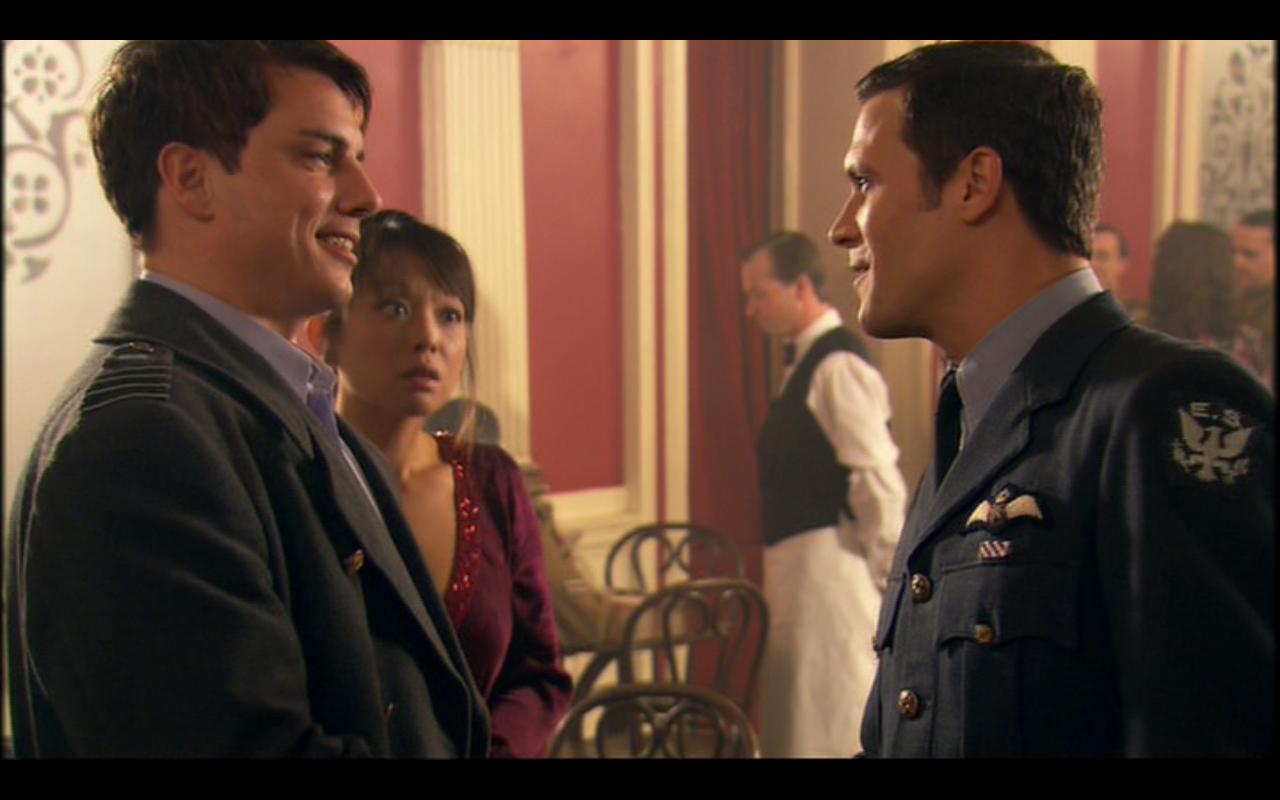
Jack and Tosh meet the real Captain Jack Harkness. ("Captain Jack
Harkness") ©BBC
Tregenna's script does two interesting things: first, it causes Captain Jack and Tosh to become victims of the Rift themselves, as they suddenly find themselves transported back to 20 January 1941 (hey, 44 years, to the day, before my brother's birthday!) and unsure of how to get back; and second, it brings Jack face-to-face with his namesake -- after all, the identity we've known since "The Empty Child" was an assumed one, a way for the con man to make his con easier.  It's an interesting move, and much of the episode focuses on the relationship between these two men, which starts out as almost fraternal but then changes into something more romantic.

This is the first concern with this episode; there doesn't really seem to be a good dramatic motivation for this burgeoning romance.  The fraternal aspect is fine, even laudable; Jack knows the real Captain's future, and he wants to ensure that he makes the right choices before he dies.  It's just not clear why this would cause the Captain (as the credits call him) to suddenly want to start kissing Jack.  If he thinks he's going to die (which might be the case, but if so it's very subtle), then fine, maybe, but it still seems both weird and superfluous -- the story doesn't gain anything from Jack sharing a kiss with his namesake.183  And what did the Captain's men think of this?  (Or the Rift suddenly opening up, for that matter.)

The other storyline involves Toshiko's attempts to provide the present-day Torchwood team with the mathematical formulas they'll need to safely open the Rift and bring Tosh and Jack home.  So while Tosh is trying to hide papers with numbers on them, Gwen and Owen are looking for ways to bring them back.  Owen seems hell-bent on getting them both back, to the point that he doesn't question any of the increasingly strange coincidences going on.  The 21st-century team realizes that the current caretaker of the building, Bilis Manger, is the same person as the one in 1941, which leads Owen to realize that Bilis can travel back and forth through the Rift.  (Or maybe he's incredibly long lived, like Jack, but that doesn't seem to have occurred to him.)  But does he interrogate Bilis, or grab and throw him into a holding cell?  No, Owen looks through Bilis's office, finds the missing piece of the Rift Manipulator (without stopping to consider why on Earth Bilis would have this in the first place -- and in fact this point isn't touched on at all), and decides he's going to use it to open the Rift.  There's loyalty and then there's blind loyalty, and Owen seems to be falling into the second category.

That stuff seems to be setting up the series 1 finale next episode, though; the primary focus of the episode is in 1941, in that relationship between Jack and the Captain.  And up until the point where it starts to turn romantic, it works really well.  There's an interesting exploration of what you do if you know someone's going to die but can't tell them, and there's also a nice discussion of what it means to be a leader, and does that mean you have to be brave in front of your squadron all the time?  Are you allowed to be scared, and is it OK to be scared?  It's a question deftly handled by the script.

Really, except for the strange resolution of the 1941 storyline and Owen's unquestioning use of specifically Rift equipment found in unlikely places (so, SOP for Torchwood members, then), "Captain Jack Harkness" does a good job of balancing its points of view in a way that doesn't make you hate everyone on screen.  It even takes a bit of time to indulge in some racism against Tosh, just to demonstrate that we really are in 1941 (compare with reactions to Martha in, say, "The Shakespeare Code").  It's not a knockout success, but it is another in a line of decent stories that you can watch without too much difficulty.


183 We later find out in "Fragments" that our Jack has super-charged pheromones, and so the Captain's response to Jack might just be because of that.  But obviously that explanation isn't anywhere to be found in this.

February 6: "Invasion of the Bane" (SJA)

1 January 2007 was an exciting day for Doctor Who spinoff fans; not only did we get the last two episodes of series 1 of Torchwood, but we also got the first episode of the latest Doctor Who spinoff, The Sarah Jane Adventures, earlier in the day.  Note that "Invasion of the Bane" isn't a pilot though, even though it aired separately from the rest of the first series' episodes; the whole series was commissioned at once and it was planned at the outset that this would be a holiday special.

Now, when Russell T Davies first wanted to revive Doctor Who (long before they actually let him do it), his first pitch was reportedly for a low-budget version about a retired time-traveller who dealt with alien threats from a house on an ordinary street (rather than travelling through the universe and having to create a new alien world every week).  Knowing that, it's not hard to see how The Sarah Jane Adventures reuses that idea, with Sarah Jane in place of the Doctor.

The first thing that's obvious about "Invasion of the Bane" is how much less xenophobic it is than Torchwood.  Sarah Jane may initially be more cautious about getting other people involved in her life, but the first thing we see her doing is helping an alien head back home -- and not just any alien, but one from the same species as from the Torchwood episode "Greeks Bearing Gifts".  Sarah Jane seems to be a lot more open-minded than Captain Jack and his team.

The second thing that's obvious is that this is pitched more towards children than adults, with the other lead characters being teenagers.  Maria Jackson is shown to be a bit of loner by virtue of having just moved into the neighborhood, and while her dad is shown to be all right her mom is clearly pitched to be obnoxious and a bit oblivious.  (It's an odd divorce, though, that sees Chrissie constantly over at her ex-husband's place.)  Yet despite the emphasis on younger viewers, it's not talking down to them -- and the overall effect is one that adults can find entertaining as well.  It also helps that the script does a good job of slowly introducing the weirdness into things, as Maria sees Sarah Jane with the alien, and then heads to the Bubble Shock (a form of pop) factory to find more weirdness -- including a teenaged boy who doesn't seem to know anything.  Like I said, they do a good job of ramping everything up while introducing the main characters, rather than just thrusting the weirdness upon the audience and hoping they'll keep up.

Maria, Luke, Sarah Jane, and Kelsey in Sarah Jane's attic.
("Invasion of the Bane") ©BBC
One of the best moments, in fact, is after the Bane attacks Sarah Jane and the others in her home, at which point they find themselves in the attic.  It's a piece of exposition, plain and simple, but it's delivered really well by Elisabeth Sladen:
SARAH JANE: Aliens are falling to Earth all the time.  It's not just those stories you hear on the news.  All sorts of creatures.  Some have got lost, like the one you saw me sending home last night.  Some of them crash-land, and some of them want to invade. ...
MARIA: But how'd you get started?
SARAH JANE: I met this man.  A very special man, called the Doctor.  And years ago, we travelled together.
MARIA: In space?
SARAH JANE: Space, and time.  And then it came to an end, and suddenly I was back to a normal life.  Electric bills, burst pipes, bus tickets and rain. ... For years I tried to forget, and then I met him again, the Doctor.  We'd both changed, but it's funny because we were still both the same.  And I learnt I could carry on here on Earth, doing what we always did.  That's when I started this.  I began my life again.
It's lovely and sweet and a far cry from "the 21st century is when it all changes and you've got to be ready."  Torchwood plays on fears; The Sarah Jane Adventures, it seems, play on hope.

Of course, this is a Doctor Who spin-off, so we do get an alien invasion from a species called the Bane, who are putting a part of themselves into Bubble Shock so that they can take over the world (for some reason -- it's not actually quite clear what they want).  And yes, it's really hard not to think of the episode of Futurama where Fry learns what's really in his favorite drink Slurm -- I wonder if Russell T Davies and/or Gareth Roberts were aware of that when they were writing this.  But it's still nicely done (and I love the design of the Bane -- bizarre without being laughable).

In fact, if you wanted a spin-off of Doctor Who that was actually somewhat like its parent show, you could do a lot worse than "Invasion of the Bane", which shows that there's actually quite a bit of life even in a more limited format like this.  It's certainly a lot closer to the spirit of Doctor Who, and none of the main characters are particularly irritating.  (Well, except Kelsey, but she appears to be designed to be annoying -- and this is her only appearance anyway.)  There's a sense of affection in the writing and the direction, and it's absolutely wonderful to see Sarah Jane Smith out on her own, standing up for the right causes and not under anyone's shadow.  If the rest of the series is like this, The Sarah Jane Adventures will be quality entertainment.

February 5: "The Runaway Bride"

We interrupt our journey through the first series of Torchwood to bring you the 2006 Doctor Who Christmas Special, "The Runaway Bride"...181

If we go by the DVD, "The Runaway Bride" kicks off series 3 of the show.  But if we go by what we actually see, we're in a transitional state.  We don't get introduced to new companion Martha Jones at all.  Instead this episode picks up immediately where "Doomsday" left off, with Catherine Tate standing in the TARDIS wearing a wedding gown and yelling at the Doctor.  This meant a lot more to British audiences, who were more used to her hugely successful sketch show (hey, it's not every show that gets a word in the Oxford English Dictionary -- although Doctor Who is a show that can also make that claim) than overseas audiences.  Fair enough, it's a British show for British viewers; I'm just pointing out that the impact of this stunt casting is largely lost on those of us in the former colonies and beyond.

It's not an entirely successful opening to the show, though; after the initial shock value wears off, there's little to really keep you entertained.  "The Runaway Bride" really wants to be a screwball comedy, but in these initial TARDIS scenes Tennant and Tate exhibit little chemistry together.  That's partly because all Donna is doing is shouting unpleasantly, not listening to anything the Doctor is saying, and partly because we don't see any real interaction between the two: Donna is shouting and the Doctor is flying the TARDIS, and while they might be doing these actions at each other, it's more that each is going past the other.  This is also the first time that Murray Gold's music really gets in the way of the scene -- it's practically screaming at you to find this stuff funny, which makes you even less inclined to do so.

It gets a bit better when they're actually out on the streets of London -- there's a sense that they're actually listening to each other a bit more, and consequently the jokes land a little better.  I'm not too sure about that TARDIS/car chase down the motorway; I don't mind the idea, but there are some weird moments, like Donna asking the Doctor if Rose had trusted him -- that seems like a strange question to ask in the situation.  And the two kids in the car, shouting "Jump!" and cheering when Donna does, is really over-egging the pudding -- it's supposed to be triumphant but it feels crass instead.  (And the rest of the motorists -- including the parents of the kids screaming in the car -- seem awfully unconcerned about a police box flying down the road at high speed; almost as if they just filmed the drivers and then inserted the TARDIS afterwards...)

The Doctor and Donna watch the Earth form. ("The Runaway
Bride") ©BBC
Once the Doctor and Donna stop and have their conversation on the roof, that's when the two leads start to actually click; it's clear they've started paying attention to what the other is saying, and the result is noticeably better.  Of course, this is the scene that also introduces this episode's technobabble -- a type of subatomic particle that the Time Lords got rid of (what?) but nevertheless are contained inside Donna (WHAT?) and which caused Donna to be transported into the TARDIS in the first place (WHAT?).  Fine, we can just about accept this -- but when we later learn that you can extract Huon particles from water, you just have to shake your head in despair that they can't even keep their technobabble consistent.  Similarly, what possible reason does Lance have to sneak up on the Empress of the Racnoss?  Is he simply trying to be a jerk and give Donna false hope?

The Empress herself is hopelessly overacted by Sarah Parish -- I understand that it's hard to act through all that make-up, but she looks like she isn't taking any of this seriously.  And if she's not bothering, why should we?  The plan to drill into the center of the Earth and release her 4.5 billion-year-old babies with Huon particles is risible, as is the solution of draining the Thames into the hole.182

I'm being hard on this story, but it's not completely without merit.  David Tennant is generally good in his scenes, and once Donna stops yelling, Catherine Tate isn't bad.  The scene at the non-wedding reception is rather charming (and I like the special song, "Love Don't Roam", as sung by Neil Hannon of the Divine Comedy).  The whole production is nice and slick (even if they are reusing the robots from last year's special), and Euros Lyn does a good job with the direction.  If you were watching this on Christmas, full of turkey and wine, and just letting it flow past, you'd probably be reasonably entertained.

But if you're watching this as part of the ongoing Doctor Who narrative (which should be just about everyone after the initial broadcast), then its flaws are harder to overlook.  There's just too much technobabble and not enough time to make the relationship between the Doctor and Donna work.  There's also a sense that Doctor Who now knows it's a hit show and should thus do all the predictable, crowd-pleasing things that's expected of them.  The change can be summed up by the snow: last year it was a subversion of the cliché, being the Sycorax ship breaking up in the atmosphere; this time it's actually snow.  This isn't a step forward.


181 Owing to the fact that I'm trying to go as chronologically as possible (though it's gonna get tricky when we get to the Australian K-9 spinoff), and "Combat" was broadcast on 24 December 2006 -- aka the day before "The Runaway Bride".
182 Two points for old-school fans: when Torchwood (or whoever) dug into the center of the earth, did a bunch of them turn into Primords after touching a weird green slime?  And why didn't the Earth blow up anyway?  (And quickly pouring a lot of water into the center of the earth is a lot like Professor Zaroff's plan to blow up the world in The Underwater Menace -- so that's two ways the world should have been destroyed.)

February 4: "Combat" (TW)

"Combat" is a bit of an odd episode.  It doesn't actually do too much wrong, but let's face it -- the episode boils down to Alien Fight Club.  But if you can look past the derivative-yet-loony premise, there are some good moments in this.

Owen in the cage with a Weevil. ("Combat") ©BBC
Although the episode starts with involving most of the team, this turns into Owen's episode.  He's still hurting from Diane's departure and is apparently "even more erratic than usual" as a result -- which translates to refusing to answer his phone and getting in fights in bars (though, to be fair, that guy was clearly asking for it).  However, he ends up being the person trying to infiltrate the Weevil-stealing operation and find out where the Weevils are being held.  What's interesting is how friendly Owen is with Mark Lynch (the guy helping run the fights).  Mark (played very well by Alex Hassell) is every inch the bored rich guy looking for thrills -- the way he fights in the bar and demands that the one guy get up is quite compelling to watch.  It's a world that Owen seems quite tempted by -- and, interestingly, one that Mark is willing to show him, even after Owen's cover is blown.  And it's interesting to see how much Owen seems to be drawn into this world -- even though he insists that this is wrong and needs to be stopped, he's seduced by the idea of "stripping things back to the core".  It's a neat idea well-realized, and it makes sense for Owen to be the one drawn in.

Where this episode doesn't succeed is with Gwen.  I'm not sure how they managed it, but they've transferred the label of "least likeable character" from Owen to Gwen.  She's pissy and self-absorbed when talking with Owen about their relationship, and the way she tells Rhys about her infidelity but then drugs him so he'll forget she told him is pure cowardice -- and the way in which she tries desperately to get Rhys to say he forgives her before he slips into unconsciousness is truly unpleasant.  One scene of her crying while feeling bad about the whole situation doesn't redeem her at all.

It's not a stand-out episode and unlikely to be fondly remembered, but given how easily this could have been yet another incredibly stupid episode, we should be thankful that things didn't spiral out of control.  Writer Noel Clarke (who you might remember as Mickey Smith) does a good job with keeping things realistic and more or less grounded.  If it weren't for the Gwen moments, this would be a much better episode; as it is it's merely OK.

So that's three reasonable episodes in a row; has Torchwood finally turned the corner?