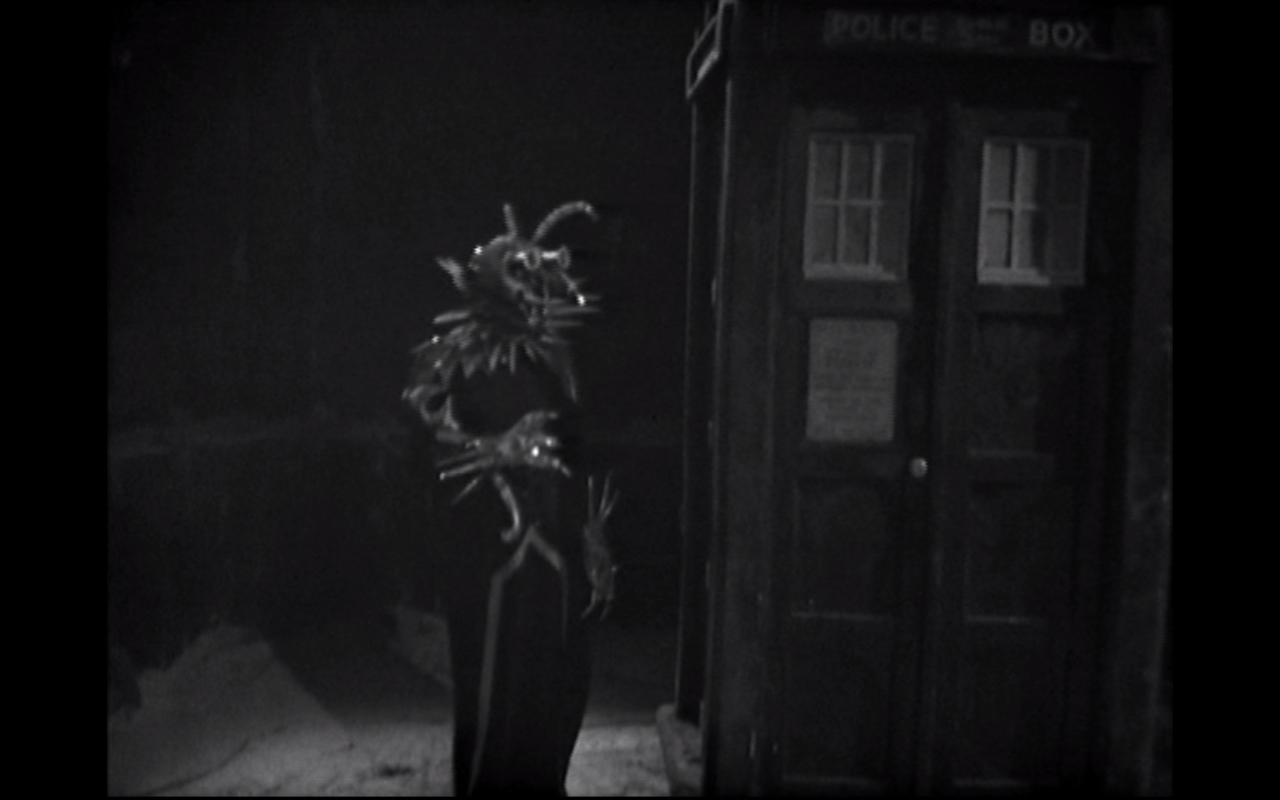
January 31: "Crater of Needles" / "Invasion"

(The Web Planet episodes 4 & 5)

"Oh, my eyes are so sore," Barbara complains at the beginning of "Crater of Needles", and we know what she means.  The smearing effect is really starting to wear out its welcome.

The Doctor and Vicki plot in the control room of the
Carcinome. ("Crater of Needles") ©BBC
Frustratingly, nothing really happens in "Crater of Needles".  Barbara is back from her vacation last time, and she gets a lot of exposition about the Menoptra and the planet Vortis.  And curiously, there's no real mention of her having severe difficulty breathing, given that Ian never got to her to give her the miracle breathing drug.  The Doctor and Vicki are still stuck inside the Carcinome, trying to outwit the Animus but inadvertently giving away the Menoptra's invasion plans.  Only Ian really gets much to do, as he falls (literally) into the midst of the Optera -- underground Menoptra who've lost their wings and hate the surface -- and has to convince them that he and Vrestin are their allies, not their enemies.  But it takes the whole episode for him to even do that.  There's a bit of action at the end as the Menoptra spearhead is repelled by the Zarbi and their larvae guns, but even that's oddly stagey and not terribly exciting.

It looks like things are finally improving in "Invasion" (potentially confusing episode title #412), with some actual incident.  The Doctor and Vicki manage to escape the Carcinome with the help of a controlled Zarbi nicknamed Zombo -- Vicki's habit of giving things cute nicknames really developing here (unless you count Sandy the Sandbeast in "Desperate Measures"), and they meet up with Barbara and the remnants of the Menoptra invasion force, who are planning to launch an assault on the Animus.  Meanwhile, Ian and Vrestin convince the Optera to also attack the Animus from below (or, as the Optera call it, Pwodarauk), which leads to some deservedly oft-praised dialogue conveying alien thought patterns: "A silent wall. We must make mouths in it with our weapons. Then it will speak more light."  Of course, this is followed three minutes later by the Optera Nemini sacrificing herself to stop a flow of acid into the cavern by jamming her head into the hole, which really is an astonishing sight to behold.  Ian looks like he has no idea what to make of it.  But as the Doctor and Vicki head back to the Carcinome to try and destroy the Animus while Barbara and the Menoptra distract the Zarbi with a frontal attack, it at last feels like the plot is ready to advance.

(Oh, and finally a special note for the stagehand clearly visible through a doorway in the Carcinome in this episode: Richard Martin's reputation as a slapdash director really starts with this serial, doesn't it?)


12 Doubly confusing this time around, as not only is there a Troughton story called The Invasion, but part one of Invasion of the Dinosaurs is just called Invasion -- presumably to preserve the surprise appearance of the dinosaurs that had already been widely promoted.

January 30: "The Zarbi" / "Escape to Danger"

(The Web Planet episodes 2 & 3)

"So that's where they've taken the ship to," Ian says during "The Zarbi", indicating an indistinct white haze among the indistinct grey-white haze, and it takes quite a bit to even realize that the indistinct white haze is what he's referring to.  The filters were a nice touch last time, but they're starting to wear out their welcome here: it's not just that they rendered that aforementioned shot virtually incomprehensible, but they also start to hurt the eyes as they try and fail to focus on the image.  And not all of the cameras have the filter: this is presumably to show a difference between interior and exterior shots, but then Richard Martin uses cameras with filters for interiors and cameras without for exteriors, so it does rather start to look like there's a problem with one of the cameras more than anything else.  There's also the amazing scene of the TARDIS wandering across Vortis on its own, with the shot of the Zarbi looking on worthy of particular mention.  Yes, it's supposedly being dragged, but the wiggle motion that the model makes ruins that impression somewhat. 

Barbara is held by the Menoptra. ("The Zarbi") ©BBC
Sadly, things are also about as slow here as they were in the last episode.  There's a lot of slow conversations with the Menoptra, owing to the way they speak -- a nice thought, but it doesn't help the pacing any.  Meanwhile, the Zarbi can't speak at all, so there's no hope of sustaining interest there.  The fact is that you begin to stop seeing them as giant ants and start to pity the poor people hunched over inside the costumes.  That said, there's a scene where Barbara and an Menoptra called Hrostar are captured by the Zarbi, and then Barbara watches in horror as the Zarbi rip the wings off Hrostar, that's really quite horrific.  But sadly that's an exception for this episode, rather than the rule.

Admittedly, things do get a little better in "Escape to Danger" (and how wonderful is it that there's actually an episode called "Escape to Danger"!  Particularly for anyone who grew up on the Target novelizations and greeted chapter titles like "Escape to Danger" like fond friends), in no small part because the Zarbi have been given a voice through their controlling force, the Animus.  And full marks for casting Catherine Fleming as said voice -- she delivers a silky smooth performance as the Animus, improving things dramatically.  There also seems to be more incident in this episode, as the Doctor looks at his astral map and Ian makes a dramatic escape (...into danger!).  Things may finally be picking up.


Of course, this is also the infamous episode where a Zarbi runs into the camera; it's a whacking great collision too, but part of the problem is that the scene seems to exist purely to have a Zarbi crash into a camera -- there's no narrative reason for the scene to be present at all.  Then there's an odd shot of a wall inside the Carcinome that goes on uncomfortably long with nothing happening -- perhaps a Zarbi missed its cue, but that doesn't change the fact that we're staring at a wall for five long seconds.  And if you look closely you can see a camera operator through the Carcinome's webbed walls as Ian makes his escape.  So things may be picking up, but they still could be going better.  And make no mistake: just because we're doing better than the last two episodes doesn't mean that "Escape to Danger" isn't slow -- it's just not as slow.  But given the current direction of this story, I'll take what I can get.

January 29: "Inferno" / "The Web Planet"

 (The Romans episode 4 & The Web Planet episode 1)

It's probably inevitable that "Inferno" (potentially confusing episode title #3) isn't quite as funny as "Conspiracy", on account of its needing to actually conclude the story rather than just lark about having a good time.  But that's not to say that it doesn't have its moments: in particular the Doctor's conversation with Nero about playing in the arena, knowing he's going to be set upon by the lions but carrying on teasing Nero with statements like "I shall try to make it a roaring success", "something they can really get their teeth into", and "I've always wanted to be considered as an artist of some taste."  And Nero's downfallen expression is really quite marvelous.

Nero tells Poppea of his plans for Rome. ("Inferno") ©BBC
But beyond that, this is much more plot-oriented.  Ian has to rescue Barbara from the palace, while the Doctor and Vicki have to leave quickly as well -- after all, they don't actually want to be thrown to the lions.  But there's also an interesting sea change going on here.  Before the Doctor and his companions have always been observers in history, able to see important events but not have any real influence on them.  But here the Doctor (inadvertently) gives Nero the idea to burn Rome down so it can be rebuilt (although it's probably not historically true that Nero initiated the fire, but never mind).  And when Vicki calls him out on it later, he starts to protest but seems rather pleased with the fact nevertheless.  Now the travellers can actually cause history rather than just observe it.

The Romans really is a fun story, full of charm and wit, and far more concerned with exploring a setting than with being at a significant moment of history.  It's something to be cherished.

But now it's on to a dramatically different change of pace (in more ways than one) with "The Web Planet".  One of the first things to notice is that this moves a lot slower than the previous three episodes.  It's a very relaxed pace, giving us lots of pans across the alien surface and long shots inside the TARDIS (the set of which Richard Martin has rotated 180°, showing us the other side of the console room).  You can see that some care has gone into the effects: there is a pretty impressive space backdrop, some nice costume work for the Zarbi creatures roaming the surface, and lots of well done crags and things on the surface (even if Martin then goes and spoils it with a high shot that shows the crags are just flats angled together).  And there's a really nice echo effect "outside", with some interesting filters on the cameras that create a sort of smeared lighting effect. 

It's just too bad that the plot (what little of it there is) doesn't bear quite as much praise.  As I said, it's really quite dramatically slow (there's a 30-second section of just Barbara cleaning some samples and watching Ian and the Doctor wander around outside!), with some odd character moments: Ian, for instance, has completely forgotten about "The Sea of Death" and decides he's going to take a wash in a pool of what's inevitably acid -- and curiously, he appears to be wearing his Coal Hill tie as a belt.  Vicki gets a nice "I'm from the future" character bit, but it's all a bit slow.  Still, at the end Ian is trapped in a net, Barbara is possessed and walking toward said acid pool, and the TARDIS appears to have disappeared, so maybe things will pick up in the next episode.

January 28: "All Roads Lead to Rome" / "Conspiracy"

(The Romans episodes 2 & 3)

Oh, it turned out with another lovely fight!  William Hartnell gets another opportunity to flex his action muscles, engaging his would-be assassin in an energetic scuffle which ends up with the attacker pitched out the window.  "You know, I am so constantly outwitting the opposition, I tend to forget the delights and satisfaction of the arts, the gentle art of fisticuffs," he proclaims afterwards.

But ultimately "All Roads Lead to Rome" is largely a setting-up episode: Ian is a slave on a galley ship which is destroyed in a storm, allowing him to make his way to Rome, where he's recaptured and sent to the gladiator school; Barbara is sold into slavery as a member of Caesar Nero's staff; and the Doctor and Vicki make their way to Rome to meet Nero.  There are some nice moments -- particularly when the Doctor, upon first encountering Nero, flatters him so immensely that he manages to avoid playing the lyre.  But really, this is about putting all the pieces into the right places.

Tavius tells the Doctor everything is ready, while Vicki
looks on. ("Conspiracy") ©BBC
"Conspiracy", by contrast, is where things really take off.  This is by far the funniest episode of Doctor Who yet.  The Doctor is embroiled in a conspiracy about which he knows nothing, while Barbara is chased around the palace by Emperor Nero, who then tries to play the innocent when caught by his wife, Poppea (played by the beautiful Kay Patrick).  "Oh, I'm so sorry," says Nero innocently to Barbara, who he's chased to the floor of his bedroom; "I didn't know you were there.  Did you want something?"  Derek Francis plays Nero more as a big kid than any sort of tyrant or powerful ruler, and it makes him not only more sympathetic but also much funnier.

Meanwhile, as Barbara is repeatedly chased around the palace, the Doctor and Vicki, in best farce tradition, keep just missing her, entering rooms as she's leaving.  The Doctor, of course, has to figure out how to play the lyre in front of a large audience, which he ultimately does by miming playing, after asserting that "the music is so soft, so delicate, that only those with keen perceptive hearing, will be able to distinguish this melodious charm of music."  This leads to enraptured listening to silence, where no one is willing to admit that they can't hear anything.  "He's all right, but he's not all that good," complains Nero.  And Vicki meets up with the court poisoner, Locusta, and switches a poisoned cup from being given to a servant (in reality Barbara, although Vicki doesn't know that) to Caesar Nero himself.  "His wife was going to murder some poor slave or other and I didn't see why that should happen, so I thought...  Well, I swapped the drinks round," Vicki says, causing the Doctor to burst in and warn Nero, who subsequently, in possibly the funniest part of the episode, summons his annoying servant Tigilinus over and has him drink the poison.  When he dies, Derek Francis looks thoughtfully at the camera and says, "He was right."  Trust me, it plays much better than it reads.

The only one who doesn't get to do any larking about is Ian, who's stuck in a cell contemplating fighting his new friend Delos in the gladiator arena.    When he's finally called out to do it, at the end of the episode, he sees Barbara watching but still has to fight (in what's really a very good fight, particularly for a studio session -- you can tell they put a lot of practice into it).  And then, at the end of the episode, he loses...

January 27: "Desperate Measures" / "The Slave Traders"

(The Rescue episode 2 & The Romans episode 1)

The Doctor confronts Koquillion in the People's Hall of
Judgement. ("Desperate Measures") ©BBC
That ended rather quickly, didn't it?  All this story really needed was for the Doctor to wander in and work everything out.  From the moment he enters the spaceship he's charming to Vicki, intrigued about Bennett, and sharply analytical about the truth of what's going on.  For him it doesn't seem to take much effort to deduce the truth about Koquillion, and he gets a decent fight scene to boot!

And he's not the only one, as Barbara gets to be heroic shooting a flare gun at a slavering monster.  Of course, it turned out to be Vicki's pet, and she's terribly upset about the whole thing, but nevertheless, Barbara's doing her best.  And Ian gets the weirdest line ever, as he refers to Koquillion as "Cockylickin" -- this apparently isn't in the script though, and is William Russell's contribution.

But really, this is about introducing Maureen O'Brien as new companion Vicki, and it's a job it does quite well.  She's quite likable, acting pert and strong yet with a bit of vulnerability -- the perfect person for the Doctor to take under his wing.  And the fact that we get a nice little story to boot, with crashed spaceships, menacing aliens, and a neat little plot twist at the end, as well as nice characterization for all the cast, means that The Rescue is quite wonderful.

But then it's on to the next adventure, as the TARDIS pitches over a cliff!  As About Time points out, the next shot is of Ian, seemingly lying unconscious -- but he's actually just stuffing his face with grapes, rather than in any actual danger.  "The Slave Traders" is full of fun moments like this, with the Doctor enraptured by Barbara's menu, Ian getting a somewhat Roman hairstyle which leads him to proclaim Julius Caesar, Vicki complaining about how bored she is...there's a lot of fun to be had.  Plus the pun from the Doctor where, upon being mistaken for lyre player Maximus Pettulian, he introduces Vicki with the line, "She keeps her eye on all the lyres," is good fun (and you can tell Vicki gets the joke).  Really, this is the most relaxed we've ever seen the TARDIS crew, to the point where Vicki is complaining about it: "The way you spoke I thought we were going to have adventures and see things!  We've been here nearly a month and all everyone wants to do is sit around and rest." 

But there're also some real threats here too: the slave traders Sevcheria and Didius are quite threatening, especially since the audience is anticipating their abduction of Ian and Barbara and we're wondering how they'll get out of it.  The fact that they don't is what leads to the episode's near-cliffhanger, where Ian is sold off and has to leave Barbara behind.  I say "near-cliffhanger" because it seems like it should be the end of the episode, except they have a little bit more time to fill and so the actual cliffhanger shows the Doctor about to be assassinated.  Hmm, I wonder how that will turn out...

January 26: "Flashpoint" / "The Powerful Enemy"

(The Dalek Invasion of Earth episode 6 & The Rescue episode 1)

And finally all these disparate threads come together.  Barbara and Jenny make their way into the Daleks' control room, while Ian sabotages their Earth-shattering bomb (twice!), Susan and David cause the Daleks to overheat for a bit, and the Doctor and Tyler also enter the Daleks' control room and help defeat them, thanks to an idea from Barbara to order the Robomen to turn on the Daleks.  And!  The first genuine cry of "exterminate"!

That said, it's actually a bit matter-of-fact, to be honest: this happens, then this happens, then this happens, with no real threat from the Daleks, the Robomen, or anything else.  It's more a matter of wrapping up loose ends than providing any last minute threat.  But that's probably partly to give Carole Ann Ford a proper leaving scene.  Yes, this is Susan's last episode, and her leaving scene is rather sweet: forced to choose between David and her grandfather, both of whom she loves but in different ways, she becomes rather upset, and the Doctor (who presumably has been watching on the scanner) makes the decision for her, delivering one of the finest speeches in the history of the show:
One day, I shall come back.  Yes, I shall come back.  Until then, there must be no regrets, no tears, no anxieties.  Just go forward in all your beliefs, and prove to me that I am not mistaken in mine.  Goodbye, Susan.  Goodbye, my dear.
But David gets the last word, just to make the point explicit: "He knew.  He knew you could never leave him."  It's quite moving.

Of course, the thing to take away from The Dalek Invasion of Earth is how confident it all seems.  It's quite large in scope, moving through parts of London and up to Bedfordshire, but you never get the sense that they're playing it safe.  The production team knows it can pull this off, and so they just go for it, essentially making an action-adventure movie over 6 weeks.  The plot is admittedly very silly, and there's also a sense that the Daleks don't actually get to do much after the third episode, but nevertheless this is a self-assured story that just about manages to get away with it.

Koquillion examines the TARDIS. ("The Powerful Enemy")
©BBC
The next episode takes us to the planet Dido, and a crashed spaceship complete with Union Jack on its fin.  We're still in the future, encountering a young girl named Vicki, an injured man named Bennett, and their captor/terrorizer, an alien creature named Koquillion.  But it turns out the Doctor's been to Dido before, and he can't understand why a native Didonian would be so hostile as to try and kill Barbara and Ian.  But we'll have to wait until next time to find out.

For now, we're left with David Whitaker's script, with some really lovely moments.  "The trembling's stopped," Barbara tells the Doctor, referring to the motion of the TARDIS while travelling.  "Oh, my dear, I’m so glad you’re feeling better," he responds, completely misunderstanding her.  There's also the part where Ian and Barbara are discussing the Doctor's current state of mind, and the Doctor pops his head out and says, "Remember I can hear what you’re saying!"  And I don't know if it's in the script, but the part where the Doctor shows Barbara how to open the TARDIS doors and then compliments her before saying, "You won’t, of course, try to do that during transit, will you?", and she responds with this sidelong exasperated glare, is really quite funny.  But it's  interesting how out-of-sorts the Doctor is, seemingly forgetful and tired in the wake of Susan's departure.  It's quite lovely characterization, of the sort we'll come to expect from Whitaker: very understated and very sweet.

January 25: "The End of Tomorrow" / "The Waking Ally"

(The Dalek Invasion of Earth episodes 4 & 5)

"The End of Tomorrow" doesn't feature William Hartnell, but not because he's on vacation; rather, he was injured during the filming of the previous episode and had to rest up this week.  Of course, it's not terribly noticeable, other than in David's resourcefulness in defusing the bomb left at the end of last week.

The thing to notice about this episode is that the Daleks are hardly in it.  This episode is much more about the humans involved.  If "The Daleks" and "Day of Reckoning" belonged to the Daleks, this belongs to the guest cast.  There are some noteworthy moments, too: Barbara smashing a truck through a blockade of Daleks is one such moment, but there's also Ian and Larry Madison's encounter with Wells (a young Nicholas Smith, now best known for his role as Mr. Rumbold in Are You Being Served?), which leads them to meet up with Ashton (lamentably not played by Philip Madoc here, but still ably portrayed by Patrick O'Connell).  It shows that not all of humanity is united against the Daleks; there are those who use the situation to their own advantage.  It's a nice touch, which also comes up again in the next episode, as Barbara and Jenny are betrayed by the two women to the Daleks.

The Daleks in their control room. ("The Waking Ally") ©BBC
The focus of "The Waking Ally", though, is back on the Daleks, as their plans finally become clear: they want to remove the Earth's magnetic core so they can drive the Earth around the universe.  Er, yes.  But anyway, the full extent of the workings of the mine in Bedfordshire becomes apparent, with Daleks on display overseeing workers and plotting Earth's downfall.  And of course, you can also try to answer one of Doctor Who's great unanswered questions (along with other greats like "What did Chang's dying clue mean?" in The Talons of Weng-Chiang): who or what is the "waking ally" referred to in the title?  Is it the Slyther, dispatched near the beginning of the episode?  Is it the two women who betray Barbara and Jenny?  Is it Wells, starting to help Ian in stopping the Daleks?  Of course, this episode also sees the first (fleeting) kiss between Susan and David, so maybe we shouldn't delve too much further into the question, other than to note that the Doctor says, "I can see something’s cooking," after catching them in the act, and it's pretty clear he doesn't mean the rabbit stew.

And then the cliffhanger involves Ian (somehow) entering Dalek HQ and (somehow) hiding inside a bomb without (somehow) being seen by the Daleks, who then prepare to use the bomb to drop down into the Earth.  At least they don't actually show the bomb fall down the shaft, but it's still a pretty weird-looking cliffhanger; the bomb itself would be fine, without having to get Ian trapped in it.