January 27: "Desperate Measures" / "The Slave Traders"

(The Rescue episode 2 & The Romans episode 1)

The Doctor confronts Koquillion in the People's Hall of
Judgement. ("Desperate Measures") ©BBC
That ended rather quickly, didn't it?  All this story really needed was for the Doctor to wander in and work everything out.  From the moment he enters the spaceship he's charming to Vicki, intrigued about Bennett, and sharply analytical about the truth of what's going on.  For him it doesn't seem to take much effort to deduce the truth about Koquillion, and he gets a decent fight scene to boot!

And he's not the only one, as Barbara gets to be heroic shooting a flare gun at a slavering monster.  Of course, it turned out to be Vicki's pet, and she's terribly upset about the whole thing, but nevertheless, Barbara's doing her best.  And Ian gets the weirdest line ever, as he refers to Koquillion as "Cockylickin" -- this apparently isn't in the script though, and is William Russell's contribution.

But really, this is about introducing Maureen O'Brien as new companion Vicki, and it's a job it does quite well.  She's quite likable, acting pert and strong yet with a bit of vulnerability -- the perfect person for the Doctor to take under his wing.  And the fact that we get a nice little story to boot, with crashed spaceships, menacing aliens, and a neat little plot twist at the end, as well as nice characterization for all the cast, means that The Rescue is quite wonderful.

But then it's on to the next adventure, as the TARDIS pitches over a cliff!  As About Time points out, the next shot is of Ian, seemingly lying unconscious -- but he's actually just stuffing his face with grapes, rather than in any actual danger.  "The Slave Traders" is full of fun moments like this, with the Doctor enraptured by Barbara's menu, Ian getting a somewhat Roman hairstyle which leads him to proclaim Julius Caesar, Vicki complaining about how bored she is...there's a lot of fun to be had.  Plus the pun from the Doctor where, upon being mistaken for lyre player Maximus Pettulian, he introduces Vicki with the line, "She keeps her eye on all the lyres," is good fun (and you can tell Vicki gets the joke).  Really, this is the most relaxed we've ever seen the TARDIS crew, to the point where Vicki is complaining about it: "The way you spoke I thought we were going to have adventures and see things!  We've been here nearly a month and all everyone wants to do is sit around and rest." 

But there're also some real threats here too: the slave traders Sevcheria and Didius are quite threatening, especially since the audience is anticipating their abduction of Ian and Barbara and we're wondering how they'll get out of it.  The fact that they don't is what leads to the episode's near-cliffhanger, where Ian is sold off and has to leave Barbara behind.  I say "near-cliffhanger" because it seems like it should be the end of the episode, except they have a little bit more time to fill and so the actual cliffhanger shows the Doctor about to be assassinated.  Hmm, I wonder how that will turn out...

January 26: "Flashpoint" / "The Powerful Enemy"

(The Dalek Invasion of Earth episode 6 & The Rescue episode 1)

And finally all these disparate threads come together.  Barbara and Jenny make their way into the Daleks' control room, while Ian sabotages their Earth-shattering bomb (twice!), Susan and David cause the Daleks to overheat for a bit, and the Doctor and Tyler also enter the Daleks' control room and help defeat them, thanks to an idea from Barbara to order the Robomen to turn on the Daleks.  And!  The first genuine cry of "exterminate"!

That said, it's actually a bit matter-of-fact, to be honest: this happens, then this happens, then this happens, with no real threat from the Daleks, the Robomen, or anything else.  It's more a matter of wrapping up loose ends than providing any last minute threat.  But that's probably partly to give Carole Ann Ford a proper leaving scene.  Yes, this is Susan's last episode, and her leaving scene is rather sweet: forced to choose between David and her grandfather, both of whom she loves but in different ways, she becomes rather upset, and the Doctor (who presumably has been watching on the scanner) makes the decision for her, delivering one of the finest speeches in the history of the show:
One day, I shall come back.  Yes, I shall come back.  Until then, there must be no regrets, no tears, no anxieties.  Just go forward in all your beliefs, and prove to me that I am not mistaken in mine.  Goodbye, Susan.  Goodbye, my dear.
But David gets the last word, just to make the point explicit: "He knew.  He knew you could never leave him."  It's quite moving.

Of course, the thing to take away from The Dalek Invasion of Earth is how confident it all seems.  It's quite large in scope, moving through parts of London and up to Bedfordshire, but you never get the sense that they're playing it safe.  The production team knows it can pull this off, and so they just go for it, essentially making an action-adventure movie over 6 weeks.  The plot is admittedly very silly, and there's also a sense that the Daleks don't actually get to do much after the third episode, but nevertheless this is a self-assured story that just about manages to get away with it.
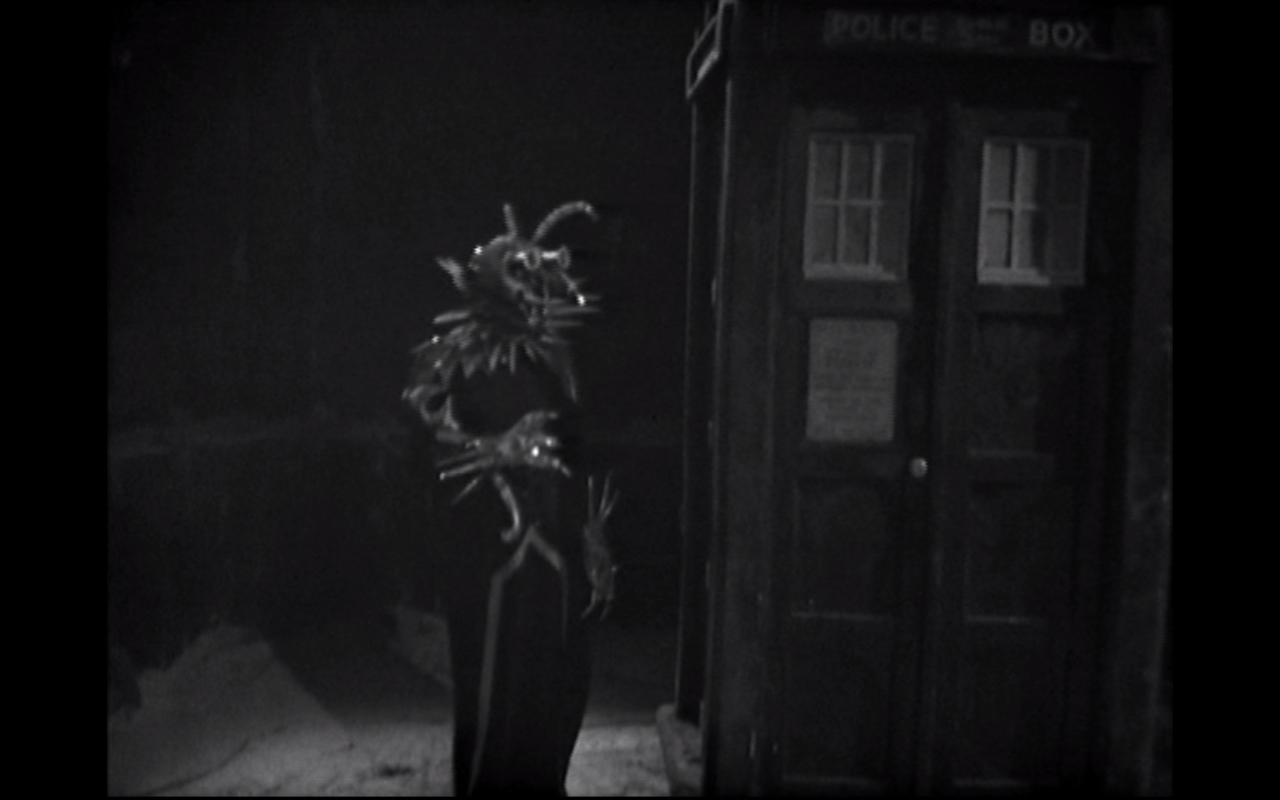
Koquillion examines the TARDIS. ("The Powerful Enemy")
©BBC
The next episode takes us to the planet Dido, and a crashed spaceship complete with Union Jack on its fin.  We're still in the future, encountering a young girl named Vicki, an injured man named Bennett, and their captor/terrorizer, an alien creature named Koquillion.  But it turns out the Doctor's been to Dido before, and he can't understand why a native Didonian would be so hostile as to try and kill Barbara and Ian.  But we'll have to wait until next time to find out.

For now, we're left with David Whitaker's script, with some really lovely moments.  "The trembling's stopped," Barbara tells the Doctor, referring to the motion of the TARDIS while travelling.  "Oh, my dear, I’m so glad you’re feeling better," he responds, completely misunderstanding her.  There's also the part where Ian and Barbara are discussing the Doctor's current state of mind, and the Doctor pops his head out and says, "Remember I can hear what you’re saying!"  And I don't know if it's in the script, but the part where the Doctor shows Barbara how to open the TARDIS doors and then compliments her before saying, "You won’t, of course, try to do that during transit, will you?", and she responds with this sidelong exasperated glare, is really quite funny.  But it's  interesting how out-of-sorts the Doctor is, seemingly forgetful and tired in the wake of Susan's departure.  It's quite lovely characterization, of the sort we'll come to expect from Whitaker: very understated and very sweet.

January 25: "The End of Tomorrow" / "The Waking Ally"

(The Dalek Invasion of Earth episodes 4 & 5)

"The End of Tomorrow" doesn't feature William Hartnell, but not because he's on vacation; rather, he was injured during the filming of the previous episode and had to rest up this week.  Of course, it's not terribly noticeable, other than in David's resourcefulness in defusing the bomb left at the end of last week.

The thing to notice about this episode is that the Daleks are hardly in it.  This episode is much more about the humans involved.  If "The Daleks" and "Day of Reckoning" belonged to the Daleks, this belongs to the guest cast.  There are some noteworthy moments, too: Barbara smashing a truck through a blockade of Daleks is one such moment, but there's also Ian and Larry Madison's encounter with Wells (a young Nicholas Smith, now best known for his role as Mr. Rumbold in Are You Being Served?), which leads them to meet up with Ashton (lamentably not played by Philip Madoc here, but still ably portrayed by Patrick O'Connell).  It shows that not all of humanity is united against the Daleks; there are those who use the situation to their own advantage.  It's a nice touch, which also comes up again in the next episode, as Barbara and Jenny are betrayed by the two women to the Daleks.

The Daleks in their control room. ("The Waking Ally") ©BBC
The focus of "The Waking Ally", though, is back on the Daleks, as their plans finally become clear: they want to remove the Earth's magnetic core so they can drive the Earth around the universe.  Er, yes.  But anyway, the full extent of the workings of the mine in Bedfordshire becomes apparent, with Daleks on display overseeing workers and plotting Earth's downfall.  And of course, you can also try to answer one of Doctor Who's great unanswered questions (along with other greats like "What did Chang's dying clue mean?" in The Talons of Weng-Chiang): who or what is the "waking ally" referred to in the title?  Is it the Slyther, dispatched near the beginning of the episode?  Is it the two women who betray Barbara and Jenny?  Is it Wells, starting to help Ian in stopping the Daleks?  Of course, this episode also sees the first (fleeting) kiss between Susan and David, so maybe we shouldn't delve too much further into the question, other than to note that the Doctor says, "I can see something’s cooking," after catching them in the act, and it's pretty clear he doesn't mean the rabbit stew.

And then the cliffhanger involves Ian (somehow) entering Dalek HQ and (somehow) hiding inside a bomb without (somehow) being seen by the Daleks, who then prepare to use the bomb to drop down into the Earth.  At least they don't actually show the bomb fall down the shaft, but it's still a pretty weird-looking cliffhanger; the bomb itself would be fine, without having to get Ian trapped in it.

January 24: "The Daleks" / "Day of Reckoning"

(The Dalek Invasion of Earth episodes 2 & 3)

"We are the masters of Earth!  We are the masters of Earth!" a Dalek chants at the beginning of "The Daleks" (the second of Doctor Who's potentially confusing episode titles11).  It's a neat approach, showing not the Daleks attempting to invade Earth but having already succeeded.  It sets up the Daleks as an already unbeatable force, even if we hadn't met them before.

Of course, the fact is that we have in fact met the Daleks before, but that's what makes the choices so canny.  Here in 2014, we're so used to Daleks chanting and conquering and invading and such that we don't really notice how Terry Nation is recrafting the Daleks under our noses.  Remember, this isn't at all how the Daleks behaved in their debut serial.  There they were city-bound, paranoid, and concerned with survival, leaving their city, and destroying the Thals.  But here they've taken the desire to exterminate others (although, it's worth noting that "exterminate" still isn't their battle cry, as they exclaim "kill him!" when surrounding a helpless man) and made that the driving force, adding in conquest and subjugation into the mix.  Yes, the Daleks have become the Nazis.

The Daleks under attack by the rebels. ("The Daleks") ©BBC
Still, it's impressive how well they succeed with this change.  The Daleks may not be as interesting as they were the first time, but they do seem more powerful.  This leads to some great shots in "Day of Reckoning", as we see Daleks gliding around an apparently deserted London, waving their sucker arms up and down and generally acting like they own the place. This matched with scenes of Barbara and Jenny trying to get the wheelchair-bound Dortmun to safety while dodging Dalek patrols makes for some exciting viewing.

There are also some hints from Susan that she's starting to grow up: we had the argument with her grandfather during The Sensorites, and now she's questioning his judgment, favoring decisions made by resistance fighter David Campbell.  But ultimately, these two episodes are about the Daleks, and their triumphant return to Doctor Who.


11 In case you've forgotten, the first was episode 7 of The Daleks: "The Rescue".

January 23: "Crisis" / "World's End"

(Planet of Giants episode 3 & The Dalek Invasion of Earth episode 1)

It's well-known (in Doctor Who circles, at least) that Planet of Giants was filmed as a four-part serial, but when BBC Head of Serials Donald Wilson saw the final two episodes, he deemed them unbroadcastable9 and ordered that they be edited down into a single episode.  The result is this episode, "Crisis".  You can sort of tell, occasionally -- for instance, in one scene they've decided to take Barbara back to the TARDIS, and in their next scene Ian's arguing for taking her back while the rest are taking Barbara's side to do...something; it's never exactly made clear what.

Forrester and Smithers are wanted for questioning.
("Crisis") ©BBC
Really, though, the TARDIS crew barely make a difference in this episode.  About the most important thing they do is cause a telephone to go off the hook -- except the switchboard operator was already suspicious of the goings-on at the Smithers farmhouse and was probably going to send her policeman husband down to investigate anyway.  Oh, and I guess they caused a can of insecticide to explode in Farrow's face, allowing Smithers to grab the gun off him.  But really, Smithers has already worked out how poisonous DN6 is, and Bert the policeman is already on his way anyway, so unless had Farrow gotten desperate and shot both Smithers and Bert, things would have turned out the same.

In a nutshell, this is sort of the problem with Planet of Giants.  It's so unlike any other Doctor Who adventure thus far that it's rather difficult to come to grips with.  The Silent Spring-influenced DN6 plot carries on more or less largely on its own, and for the TARDIS crew it's about exploring a familiar environment from a strange new perspective.  That's entertaining enough fortunately, but any other attempt to put it into the larger context of the show essentially falls flat.

But it's on to the next adventure10, with "World's End".  It's a suitably effective exercise in mood, as we see what appears to be a deserted London in the future.  There's some great location footage here, being used much more extensively than in "Guests of Madame Guillotine", and it must be said that the Robomen do rather resemble the Cybermen (not that at anyone in 1964 knew that, of course), which makes them a bit more effective than they otherwise might be, as they're really just men in grubby clothes wearing metal headgear.  (Special mention, by the way, goes to the "dead" Roboman the Doctor and Ian find in the warehouse, who seems to be moving quite a bit under his own power.)

Still, it has to be said: this episode is one great big delaying tactic for the big reveal at the end: the Daleks are back!  Of course, as this had been promoted in the British press prior to the actual episode (with their own Radio Times cover!), holding back the main baddies is less a shocking cliffhanger and more a tease: we have to wait until next time to actually get any Dalek (tricky) action.


9 Having previously seen the reconstructed versions of the original "Crisis" and the follow-up "The Urge to Live" on the Planet of Giants DVD, complete with a lengthy sequence where we actually see them map out the formula for DN6, I get the distinct impression that he was probably right.
10 Side note to say that on the Region 1 DVDs you can work out roughly when a story came out on DVD by the BBC Wales Doctor Who trailer included at the beginning.  I've mainly been experiencing Matt Smith trailers, indicating that the majority of season 1 was released quite recently; The Dalek Invasion of Earth, by contrast, is old enough to not have any trailer at all.

January 22: "Planet of Giants" / "Dangerous Journey"

(Planet of Giants episodes 1 & 2)

Season 2 starts not with a bang but with a fault: the doors of the TARDIS open in flight, worrying the Doctor and Susan quite a bit.  It turns out the moment of materialization is the most dangerous moment in the TARDIS's flight and thus the worst moment for the doors to open.  Still, everyone seems all right until they venture outside and realize that they've been shrunk down to an inch in height.  The planet of giants is in fact Earth: "Susan, this means we're on Earth!" Ian exclaims excitedly, as if they haven't just been on Earth (maybe they haven't; again, Past Doctor Adventure writers take note).

The production crew have been kicking around the idea of an "incredible shrinking TARDIS crew" story since the very beginnings of Doctor Who, and this is the final result.  It's an interesting serial, and the episodes are quite unlike anything we've yet encountered.  The guest cast (which consists of a scientist, a man from the ministry, an unscrupulous businessman, and a cat) never directly interact with the regulars; they unknowingly cause problems by carting them around and such, but the fact that the TARDIS crew is only an inch tall rather precludes any sort of conversations or similar interactions being held.  This means that the star of the show is less the characters and more the sets.  Fortunately, Ray Cusick's designs are more than up to the task, with some really wonderful sets and elements (the briefcase and the plug chain are really nice, and the various insects are all quite good -- with special mention of the twitching fly in "Dangerous Journey").  This story is more about exploring an environment than anything we've gotten previously, and it's a nice change of pace.  It does mean we get two rather odd-looking cliffhangers, even if they make sense in context.  A close-up of a cat and a man letting water run down the drain don't sound particularly exciting, but they're both quite effective as part of the narrative.  And a special mention for the ominous musical sting that accompanies the line, "There's a sink in the lab" -- marvelous.  Oh!  And this is Dudley Simpson's first score for the show, before he goes on to dominate the incidental music for the '70s.  Not that it's particularly distinctive in comparison to any of the other scores we've gotten so far, but still, you have to start somewhere.

And one final note: "Planet of Giants" (the episode) features another use of "TARDIS sans 'the' ".  Looks like this, combined with the uses in Marco Polo and one I didn't mention in "The Keys of Marinus", suggests that this was a stylistic choice in use at the time rather than one author's decision.  Interesting, given how bizarre it sounds to our ears nowadays.

January 21: "A Bargain of Necessity" / "Prisoners of Conciergerie"

(The Reign of Terror episodes 5 & 6)

It's another animated episode, but thankfully this one seems to be edited a little less hectically.  "A Bargain of Necessity" has some nice moments: the fight between Jules and Leon sounds good (and the animation is quite good here, actually), and there are some more moments of comedy, such as when the Doctor convinces the jailer to let Barbara go so they can follow her but then insists that the jailer was supposed to do the following after she goes free.  And Barbara and Ian have a nice argument about the Revolution itself: "The Revolution isn't all bad, and neither are the people who support it.  It changed things for the whole world, and good, honest people gave their lives for that change," Barbara states.  It's a moment to reflect that, even though in this story we're ostensibly on the side of those fighting the Terror, not everyone who supports the Revolution should be automatically worthy of disdain.

But really, the most significant moment comes when we look in again on Robespierre.  "Mark my words, Lemaitre," he says; "if this plot is successful, tomorrow, the 27th of July 1794, will be a date for history."  (Of course, he should actually call it the 9th of Thermidor Year II, but never mind.)  It is indeed a date for history: we're going to witness the downfall of Robespierre.  But as far as our heroes are concerned, the more pressing problem is the Doctor's seeming betrayal of Jules to Lemaitre, which ends the episode.

But no, it turns out that Lemaitre is in fact the man Ian was told to find: James Stirling himself.  We're back on video for the final episode, and after a moment's readjustment to a shot language no longer like an action movie, we learn that Barrass is plotting Robespierre's downfall and Ian knows where he's going to be.  (And let's take a moment to address something often called a mistake but isn't: Webster tells Ian to look for Jules Renan at the sign of Le Chien Gris.  He does this, and in fact Jules' colleagues find him there -- off-screen and in a missing episode, admittedly, but still.  When exactly Webster told Ian about Barrass and the Sinking Ship is a different problem, but it's not that the name of the inn changed between episodes 2 and 6: they're two separate places.)  This means that not only do we meet Robespierre, we also encounter Barrass and Napoleon Bonaparte, as they plot out the future of France (in a meeting that almost certainly never actually happened) -- because if you're in revolutionary France, obviously you need to meet Napoleon.

Robespierre is taken away by soldiers. ("Prisoners of
Conciergerie") ©BBC
But the best part is when Lemaitre and Ian rush to the palace to help Robespierre; it's too late, obviously, but it does mean that Ian (and therefore the audience) is actually present for Robespierre's arrest -- we even hear the gunshot to the jaw.  It's the first time that the TARDIS crew has been present for a significant historical event, and it's quite fascinating to watch it unfold.  Really, this entire serial is quite good, even if some of the history is a bit suspect -- the period is quite effectively conveyed, even if it's mainly through a prison and a safehouse.  It's certainly entertaining, and it makes you want to learn more about the French Revolution -- quite a compliment indeed.

And finally, the episode ends with a conversation about how there's nothing the Doctor or his friends could do to change history, which leads into a rather sweet end-of-season speech about their destiny lying in the stars.  And that's how the first season of Doctor Who ends.