May 30: Colony in Space Episode Six / The Dæmons Episode One

The Doctor kicks the Master's remote control out of his hand, and before the Master can reclaim it they're both captured by the Primitives -- and thus Jo Grant's life is saved.  And now the Master is inside the Primitive city, which means he can finally gain access to the Doomsday Weapon we were told about at the very beginning of this story.

The Master illustrates the uses for the Doomsday Weapon.
(Colony in Space Episode Six) ©BBC
Actually, this episode is probably the best of the six, because it moves at a decent clip on account of having to wrap up two separate storylines (the colonist/mining one and the Primitive city one) in the span of 25 minutes.  Some of this is a bit perfunctory, such as the scenes with sending all the colonists packing, but even with this we get some nice moments, such as Captain Dent surveying the empty dome after the colonists have left and tearing down their crops chart in a fit of pique, or Winton and an IMC guard having a knock-down-drag-out in a wet clay pit, resulting in one of Doctor Who's more realistic-looking fights.  And given how this storyline has been proceeding, having the colonists' spaceship actually taking off and exploding in the air is a surprising moment, and all the more welcome for it (in terms of plotting at least -- not (necessarily) in terms of wanting all the colonists dead).  With the colonist storyline wrapped up, the Primitive city stuff is finally fully explained by the Master, who's looking to use their ultimate weapon for himself.  Interestingly, he offers the Doctor a share in the power -- illustrating the respect he clearly has for the Doctor, even when he's been trying to kill him off earlier.  It's only when the Guardian intervenes, telling the Doctor to set the self-destruct mechanism, that the Master's plan is foiled.  Then when they emerge from the dying city (along with Jo and Caldwell, who went in after them), they're surrounded by IMC troops who are then themselves surrounded by the colonists, who snuck off the spaceship when IMC wasn't looking.  The Master escapes in the confusion, and soon the colonists win and everything ends happily...unless you're a Primitive.

The main problem with Colony in Space is that it's simply too long.  If they'd made this a four-parter and introduced the Master at the end of episode two this might have been all right.  But instead they've given Malcolm Hulke six episodes and he turns in a story in which the colonists and IMC trade the upper hand every episode (odd, this; usually Hulke is a lot better at filling his stories out).  With a colony totally devoid of interest and an IMC crew that's been neutered against the director's wishes (Morgan was originally going to be played by actress Susan Jameson until BBC Head of Drama Serials Ronnie Marsh overruled Michael Briant's decision), there's far too much time wasted with dull power struggles and not enough on the far more interesting Primitive city.  The point of the colonist story (corporations are evil and ruthless -- admittedly a more radical idea in 1971 than now) is made early in episode two and then reiterated ad nauseam, and the Primitive city is only given prominence in episodes four and six.  The result is a rather tedious runaround, and the first real clunker of Jon Pertwee's run.

But now it's time to turn our attention to the last story of season 8: The Dæmons62.  This first episode is a bit of an odd one: it starts with the Doctor dismissing Jo Grant's belief in anything magical or occult ("You know, really, Jo, I'm obviously wasting my time trying to turn you into a scientist") and then spends the rest of the time with the Doctor trying to stop an archaeological dig because a number of occult signs are lining up ("Aquarius?  The Devil's Hump?  Beltane?" the Doctor mutters to himself), with no scientific explanation (or even technobabble) given.  It's just off to Devil's End to stop Professor Horner because a white witch named Miss Hawthorne said so.  Well, all right, it's not quite that simplistic, but it sometimes feels like it.

And then there are strange goings-on in the village of Devil's End (the first "outsiders aren't welcome" village of the 70s, and only the second ever after The Smugglers -- and note Bert the Landlord's reaction to the Doctor if you need proof), with strong winds, unexplained deaths, and police constables temporarily turning homicidal.  It would also seem the vicar has disappeared -- but this one can be explained, as we see that his replacement, Mr. Magister, is in fact the Master.  Clearly evil things are afoot, and the ceremony the Master is carrying out is clearly designed for mischief, ending as it does with a gargoyle's head moving and the Master crying out "Azal!  Azal!"  Although, entertainingly, during this ceremony the Master throws up the horns during his invocation.  All right, clearly he's meant to be summoning the devil or some such and thus is using the sign correctly, but it's still fun to see.

So the Doctor tries to get to the dig to stop Horner from breaking into the Devil's Hump, but he's juuuust too late, and Horner and the Doctor are blasted by what appears to be snow as the ground begins shaking violently.  This could be an issue... but we'll have to wait until next time to learn more.


62 You can blame director Christopher Barry for the inclusion of the ash (that's the name for the symbol æ) in the title -- apparently he thought it gave the story extra atmosphere.

May 29: Colony in Space Episodes Four & Five

Thank goodness for the Master; his arrival improves things immensely.  Now everyone has someone they can react against, even if the Master is pretending to be an Adjudicator from Earth, ready to settle the dispute between the colonists and IMC.  That dispute suddenly comes into focus as both sides plead their case.  Roger Delgado is as watchable as ever, listening calmly to both sides, after which he declares an adjournment while he ponders the situation, threatens the Doctor in the back room, and then immediately comes back out and announces that he's reached a decision in favor of IMC.  Guess that didn't require much thought, did it?

The Guardian of the Primitive city. (Colony in Space
Episode Four) ©BBC
The other good thing about episode four is that the Doctor has gone into the Primitive city to rescue Jo Grant, and so we learn more about this civilization and how they were once an advanced race before some sort of tragedy happened that reduced them to their current savage state. There also appear to be three races: the Primitives, the smaller Priests ("Is it humanoid?" the Doctor asks Jo about, essentially, a small man with a weird head; "No, not really," replies Jo -- the speciesist), and their leader, a tiny figure called (in the credits, at least) the Guardian.  The Guardian seems to be the only one who can talk, and honestly he (she?) seems like a reasonable person, even if he/she threatens the Doctor and Jo with death if they ever return.  The whole city in general is an interesting design, with lots of rock-like textures and blacks and green on display, and a welcome contrast to the more muted tones of the colonists' domes.

But as I said, the Master has ruled in favor of IMC.  This displeases the colonists, so they stage a rebellion by luring the IMC officers to the main dome under the pretext of signing official paperwork.  And have the colonists been keeping close tabs on Norton?  Of course not, so he gets to warn the IMC personnel as they arrive, leading to a shootout.  And in the confusion, the Master is prepared to kill Jo and the Doctor -- victims of "stray bullets"; only Ashe's arrival saves them from this fate.

Episode five has the colonists winning this struggle and ordering IMC to leave Uxarieus.  The Master appears willing to help them declare independence -- it's not clear what his ultimate goal is, but he does want to explore the Primitive ruins.  The bits with the Master are reasonably entertaining -- as is the Doctor's investigation of the Master's TARDIS.  Even if Jo spoils it all by suddenly deciding she's impatient and walking all the way across the TARDIS to trip an alarm beam that she knew about on her way in (in even more flagrant a manner than Zoe in The Mind Robber), which leads to the Master gassing them both.  Meanwhile, IMC leaves, works out the Master is an imposter, and then comes back, capturing all the colonists and ordering them to either leave the planet or be killed.  It's not very exciting, to be honest, even if it does eat up a lot of screen time, and the stuff with the Master is far more interesting.  He's very interested in the Primitive city, and once he learns that only the Doctor has been inside and come back out, he forces the Doctor to help him -- lest Jo Grant be killed.  And when Caldwell and Morgan make their way inside the Master's TARDIS (via a dropped key) and discover Jo imprisoned, the Master is alerted.  "I warned you, Doctor!" the Master says, his finger poised to flood Jo's chamber with deadly gas.

May 28: Colony in Space Episodes Two & Three

So what was the point of the Time Lord sequence at the beginning of episode one?  Was it to assure viewers that the Master would drop in at some point, just be patient?  Because by the end of episode three there's still no sign of the Master or any sort of doomsday weapon.

Instead what we do get is two episodes of politicking as the Interplanetary Mining Corporation "arrives" and tries to convince the colonists to leave.  Even though their colony is failing, they're all on the brink of starvation, and they were discussing leaving last episode, now they don't want to leave.  And it's not like IMC are exactly above board with their dealings: it becomes clear they've been around for a while and are behind the lizard attacks in an effort to drive the colonists out.  But really, none of their villainy is particularly imaginative; the lizards are a nice touch, but then they try to kill the Doctor and do things like literally chain Jo Grant and a man named Winton to a bomb in order to dissuade the Doctor from testifying against IMC when the Adjudicator arrives to decide which group gets the planet.  Oh, and they've got a man on the inside (Norton is IMC, it turns out) who doesn't actually do a very good job of blending in -- even Jo Grant looks at him suspiciously.  And his whole "destroy the generator and blame it on the Primitives suddenly going crazy" plan doesn't seem very well thought out either, even if the colonists seem to swallow the story.  Mind, it only seems to take the Doctor a few moments before he's convinced that Norton is working for IMC, but when he warns Winton ("Unless you want IMC warned, I'd keep a very close watch on our friend Norton"), do they immediately grab him and lock him up somewhere?  Not obviously -- let's hope that doesn't come to bite them in the ass.

Jo is captured by the Primitives. (Colony in Space Episode
Three) ©BBC
The main problem is that the colonists are so thick sometimes that it's hard to root for them, and the IMC people are so evil that they might as well be wearing signs.  This might be acceptable if something interesting happened, but instead we get a lot of people talking and not a lot of doing -- to the point where the Doctor has to hop out of a car and fight some Primitives just to inject some action into the proceedings.  The Primitives are just about the most interesting thing on display so far, and all they've done is wander around silently.

Actually, that might be the main problem so far with Colony in Space -- we're finally, after a season and a half, away from Earth and on an alien world (even if it's just about the dullest alien world ever), and they take up the time by having two groups of humans squabbling with each other, rather than by exploring this world and the native inhabitants.  And since the squabbling isn't even particularly interesting to begin with, the result is that these first few episodes just plod along.  The one bright spot in all this (other than the Primitives) is Caldwell, the IMC miner with a conscience.  By giving us one person who's not willing to act villainously, we get some glimpse of hope that maybe things will turn out unexpectedly.  And it doesn't hurt that Bernard Kay is doing a good job of portraying a man conflicted between greed and Doing the Right Thing.  But he can't carry the whole story (nor should he have to), and so what we're left with is still awfully tedious.

Things can only get better, right?  Right?

May 27: The Claws of Axos Episode Four / Colony in Space Episode One

Axos is tearing itself apart, with lots of psychedelic lights and overlayed figures floating around as the Doctor and Jo try to escape.  Jo is in sheer hysterics -- so much so that the Doctor slaps her to bring her back (well, that's what it looks like; it's admittedly a bit difficult to tell for certain, what with all the flashing lights and superimposed images, but careful viewings would seem to indicate that a slap does occur).  But it's not the end for Axos, as they manage to redirect the power back into the light accelerator and save themselves -- but at least Jo and the Doctor manage to escape in the confusion.

Once free, the Doctor explains that "the claws of Axos are already deeply embedded in the Earth's carcass", but that he might be able to stop Axos before it activates the axonite and consumes the world -- only he'll need the Master's help.  Except inside the TARDIS the Doctor admits that he doesn't have a plan, and he wants the Master's help in order to get the TARDIS working so they can both escape.  The Doctor certainly seems earnest enough when he discusses this plan -- enough so that you worry that he might be telling the truth about things.

The Doctor brings the Master back to Axos. (The Claws of Axos
Episode Four) ©BBC
Meanwhile, Axos is coming to life, so Yates and Benton (who've been watching it) have to fight off attacking Axons as they make their escape.60  And while that's going on, the Doctor reveals his plan and dematerializes with the Master in the TARDIS -- only to rematerialize inside Axos.  Apparently the Doctor wants Axos's help to overthrow the High Council of the Time Lords (the first mention of this piece of Doctor Who mythology), so he's willing to give Axos the secrets of time travel in exchange.  But not really (did you think he would?); he's actually putting Axos into a time loop that they'll never be able to break free from, and he's willing to sacrifice himself to do so.  The ruse is successful and Axos is time-looped; the Doctor boosts the circuits in the TARDIS and manages to break free (whether Axos would be able to do the same thing isn't addressed), although it's pretty clear that the Master escaped before the loop was activated.  Still, Earth is saved, even if while the Doctor was away Axos overloaded the light accelerator, which blew up and destroyed a lot of the building it was in.  (Let's be charitable and assume that the nuclear reactor at Nuton which powered the light accelerator was somehow unaffected by the surge and explosion, or else everyone's happily wandering around a heavily radioactive area with no concerns whatsoever.  Although the next time Bob 'n Dave do this, we'll be less forgiving.)

In many ways The Claws of Axos is a pretty workman-like story; there's an interesting big idea at its core (aliens give Earth a gift that turns out to be a Trojan horse), but it's buried beneath layers of what one might call "typical" Doctor Who -- so, e.g.,  the Axons are naturally evil, and they attack soldiers more when it's time for some action in the episode rather than because it makes logical sense.  There's nothing really that new or unusual here -- even the Doctor working with the Master scenes had been done in The Mind of Evil (though to be fair they're better in this story).  But then, overlayed on top of that, are some really lovely alien designs (both the gold-skinned Axons and the spaghetti version) and some trippy psychedelic effects inside Axos -- certainly the interior of Axos is more wonderfully strange than anything we've seen thus far (or will see again until arguably Terror of the Zygons in 1975).  It's these things that help make The Claws of Axos a little more than a bog-standard story -- not to the standard of a true classic, mind, but enough to make it worth your while to watch.

The next story, Colony in Space, opens with the Time Lords gravely concerned about the actions of the Master: he's stolen a file about a doomsday weapon, and it seems only the Doctor can stop him.  But to do that, the Time Lords will have to send the Doctor to a different planet and a different time.  So after a brief discussion with the Brigadier about the Master, the Doctor and Jo enter the TARDIS and are forcibly transported away, Jo refusing to believe anything the Doctor has said about the TARDIS in the meantime.  (What, did she forget about everything that happened at the end of the last story?  Mind you, she also seems to think that the colonists left Earth in 1971.61)  She's therefore quite surprised (and a little alarmed) to learn she's on the planet Uxarieus in the year 2472.  And look!  It's the first alien planet we've seen since The War Games, and Jo Grant's first trip in the TARDIS.  Or, as Arthur Dent might say, "'this is the first time I've actually stood on the surface of another planet . . . a whole alien world . . . !  Pity it's such a dump though.'"  Yes, it's another bleak BBC quarry, and without black-and-white film to help give it a sense of atmosphere it just looks like a lousy desolate world.  Still, better than nothing, even if they've screwed up the TARDIS materializing/dematerializing effect since the last story.  (Oh, and the TARDIS doors open with the Dalek door sound effect too.)

And on this world are a bunch of colonists struggling to survive; apparently their crops refuse to grow, and nothing they do seems to change that.  The Doctor thinks there's an external force at work, but that's not the only problem: giant lizards have been spotted, and one of them attacks and kills two of the colonists.  Although the Doctor is suspicious: if the lizard was really twenty feet tall as it was described, how could it have gotten into the colonists' dome to kill them?  But then another person is discovered, from a previously unknown colony, who describes how his colony was destroyed by giant lizards, which would seem to lend credence to the lizards' existence, even though no one had seen them until very recently.  (Or, as Mary Ashe puts it, "There's no animal life [on Uxarieus], just a few birds and insects.")  But when the Doctor goes back to the Martins' dome to investigate the attack, he's set upon by a terrifying robot...


60 All right, let's discuss the backdrop/sky issue here.  As Benton and Yates are fleeing, shots of them from inside the Jeep appear to have what might be a dark backdrop placed behind them.  It's sometimes suggested that this might be a CSO cloth that nothing was keyed in over, as a) the color doesn't match any of the long shots of the sky, and b) the lighting in the Jeep makes it looks like they're inside something, not out in the open.  But no, we're told, no CSO work was ever attempted or even planned on film, so this can't possibly be a CSO backcloth and instead it's just a weird color of sky.  Except it doesn't look like sky (although, compounding the problem, there are some similar shots which do appear to be the sky -- but it's not the same shade as the controversial shots).  Fair enough on the CSO issue (particularly since it doesn't look like a very useful shade of blue to chromakey out), but given that the last time Michael Ferguson directed a story (The Ambassadors of Death), we had another unconvincing backdrop placed in the windows of vehicles, can we not just consider the possibility that hanging sky-colored cloth in vehicles is Ferguson's method of (say) hiding the fact that the background isn't moving when the vehicle allegedly is?  It's also a bit odd that no one seems to bring up this issue in The Ambassadors of Death -- though that might be because the scenes in question have only recently been restored to color.
61 It's sometimes suggested that if you flip the order of The Claws of Axos and Colony in Space so that Colony is first, a lot of these issues go away.  The main problem with this theory is that at the beginning the Doctor is explicitly attempting to "bypass the Time Lords' homing control", which he only found out about at the end of The Claws of Axos.

May 26: The Claws of Axos Episodes Two & Three

It's a bit odd; other than a couple moments where Axos scans humans to find out about them, and the indication that they're lying about their sales pitch to the humans, there's no real indication that Axos is in fact malicious -- but episode two just assumes that of course they're bad and trying to take over/drain the planet.  But the only thing preventing worldwide distribution of axonite is that Chinn has taken charge, hoarding the supply for Britain and locking up all the UNIT people and anyone who might disagree or spill the beans.  He really is easy to dislike, isn't he?  And note that it's not just the audience that feels this way; even his superiors seem rather annoyed with him, warning him that it's his "head on the block" if things go wrong.

We also learn that it was the Master who told the Axons to come to Earth, that it would be a planet perfect for their needs.  Of course, now they're holding him hostage to make sure everything works the way he said it would -- only things aren't going their way, so they have to release him so that he can tell the rest of the world about axonite.  Apparently there's a "best by" date on axonite, and it needs to be as widespread as possible.

But the main thrust of this episode is the Doctor's effort to learn more about axonite, which he ultimately does (after a number of arguments with Winser about the best way to go about it, which leads into some guff about time travel) by sticking it into a light accelerator and having it analyze itself -- only this apparently causes the axonite to activate early, which means that the Axons have to shut it down before it's too late.  But this causes the Doctor to realize that axonite is the same stuff as Axos which is the same stuff as the Axons -- they're all the same: "Don't you see we're dealing with one single living creature?  Axonite was just the dormant state until I activated it...  This stuff could endanger the entire world!"

An Axon attacks two UNIT soldiers. (The Claws of Axos
Episode Three) ©BBC
Episode three might be the best one so far, even though the Doctor and Jo spend most of it captured inside Axos, where the Doctor is interrogated about the secrets of time travel.  It seems Axos wants to have all of time to feed on, and that's why they've been holding the Master prisoner. But he's free and, having told the world about axonite (via a hypnotized UNIT radio operator), he's now waiting inside the Doctor's TARDIS.  Which means we get our first look inside the TARDIS since The War Games -- and our first look at the redesigned TARDIS console.  Only, bravely, they've shown it in a state of disrepair, as the Doctor has clearly been tinkering with it trying to make it work.  "But what does he think he's doing?" the Master despairs, looking at all the loose wiring on the console.  "What a botch-up!"  (And even when he's made some repairs, he's still unhappy with the results: "Oh, hopeless!  Overweight, under-powered old museum piece!... You may as well try to fly a second-hand gas stove!")

But Axos has determined, meanwhile, that if they absorb the output of the main nuclear reactor at Nuton, they'll have enough energy to achieve time travel.  And since all of Axos is connected, they send an Axon into the heart of the reactor to absorb that power.  Once the Master realizes what's happening (and that he can't escape from Earth), he decides to work with UNIT to stop Axos before it's too late -- and with the Doctor gone, they have no choice but to go along with it.   His plan is to store the nuclear energy in the Doctor's TARDIS and then send it all to Axos in one go, overloading it.  "What else can we do?" asks Hardiman, the director of the complex.  "Oh, nothing very much.  Oh, I suppose you can take the normal precautions against nuclear blast, like sticky tape on the windows and that sort of thing," the Master replies marvelously.  There's just one problem with this plan: as the Doctor and Jo are still being held inside Axos, when it goes up they go up with it.  But as the Master says, "Either we destroy Axos or Axos destroys the world."  And so the Brigadier has no choice but to let the Master proceed...

May 25: The Mind of Evil Episode Six / The Claws of Axos Episode One

Well, turns out it wasn't Mailer's pistol going off; it was the Brigadier shooting Mailer.  What a cheat of a resolution.  Although full marks to the Doctor's ungrateful response: "Thank you, Brigadier.  But do you think that for once in your life you could manage to arrive before the nick of time?"

The parasite inside the Keller Machine. (The Mind of Evil
Episode Six) ©BBC
It's an odd episode, this -- particularly for a closing installment.  Rather than a race against time to stop the Master's evil scheme, the attitude here is one of mopping up.  There's still the matter of the Keller Machine and the Thunderbolt missile, but the Doctor thinks he can stop the former and the Brigadier is confident he can handle the latter.  It's only a curious conversation between the Master and the Doctor, where the Master agrees to take his dematerialization circuit in exchange for control of Thunderbolt, that really sets the final act in motion.  And since the Doctor has learned that Barnham causes the parasite inside the Keller Machine to go dormant, he can use that to his advantage.  So a plan is formulated where the Doctor will distract the Master long enough to get the Keller Machine out and near him, and then blow them all up with the abort function on the Thunderbolt missile (once the Doctor can reconnect it).  The most curious part of this, though, is the Doctor's willingness to leave the Master to die, at the mercy of either the Keller Machine or an atomic explosion.  It seems rather out of keeping with how we like to think of the Doctor typically behaving.  In the end, it's only the intervention of Barnham (who apparently can't bear to see someone suffer) that saves the Master's life, leaving him to escape with the dematerialization circuit after callously killing Barnham by hitting him with a car.  And then the episode ends with the Master taunting the Doctor over the telephone: "So, we won't be seeing you for quite some time," the Doctor says.  "Not for quite some time.  But one day, I will destroy this miserable planet and you along with it.  Goodbye, Doctor.  Oh, by the way, enjoy your exile." 

It's a bit of a curious story overall.  There are times when it feels like Doctor Who's answer to a James Bond film (and it's been three years since their last attempt, 1967-68's The Enemy of the World) -- particularly the bit with the missile and the Peace Conference -- but these get interspersed with the stuff about the Keller Machine, which is a lot more like a B-movie.  These two approaches are both fine, but they never quite gel together to form a cohesive whole.  Still, it looks great, and there's enough incident here to keep the audience happily entertained.  And the Master firmly establishes himself as a threat in his own right, even more so than in Terror of the Autons.  This alone makes The Mind of Evil worth watching.

Next up is The Claws of Axos and the debut of the "Bristol Boys" (as Terrance Dicks nicknamed them), writers Bob Baker and Dave Martin.  It certainly starts promisingly, as a strange golden ship flies through space, being tracked by UNIT radar, with (presumably) weird red tentacled monster-like creatures aboard (fandom often describes them as "spaghetti bolognese monsters").  But then we cut to an incredibly officious chap from the Ministry of Defence named Chinn, who is clearly earmarked to be as obstructive as possible throughout this story, and Peter Bathurst (last "seen" in The Power of the Daleks as Governor Hensell) plays him in such a way as to engender no sympathy in the viewers whatsoever.  And add into the mix Paul Grist as an American agent (presumably CIA, but it's never explicitly stated) named Bill Filer who's there to discuss the Master (in case we'd forgotten about him since last week), and we have a mix ripe for conflict.

Into this situation comes the golden spaceship, apparently called Axos, which lands on the southeast coast of England near the (fictional) Nuton Power Complex, after Chinn tries and fails to shoot it (Axos, not Nuton) out of the sky.  "There are freak weather conditions over the whole area... Sudden snowstorms, sir.  Dense fog's covering the area," Corporal Bell reports, in order to explain the ludicrous filming conditions experienced by the location crew.  So we're treated to the amazing sight of the tramp named Pigbin Josh cycling through snowy fields, looking through trash piles and mumbling incoherently to himself.  It looks an awful lot like they've decided to insert part of an episode of Monty Python's Flying Circus into this thing (and the fact that David G. Marsh, playing the second radar technician, bears a resemblance to Terry Jones doesn't help this any).  His story ends when a glowing yellow tentacle ensnares him and drags him into Axos.

Our heroes, on the other hand, are invited in.  Here we really get to see the interior of Axos, which looks a lot like the designers have decided to take full advantage of this new color system Doctor Who is being made in, so we get rather creepy organic textures painted in lots of lurid shades of red, purple, and gold.  The other thing we see (not that the Doctor and company know it yet) is that Axos is holding the Master prisoner.  So, "not for quite some time" translated to roughly 18 minutes or so then.  (Or a week and 18 minutes, if you want to think of it in terms of the original broadcast.)  We find this out because Bill Filer (who's around because of the Master, remember) decides to go investigate Axos on his own and gets captured.  "Who are you?" Filer asks the man he's there to help track down.  What, did UNIT not even provide a photograph of the Master?

The Axons themselves appear to the Doctor's party as golden-skinned humanoids, there with a promise of limitless energy and power in exchange for a bit of power to refuel their spaceship.  Somewhat naturally, the Doctor seems suspicious: "And yet you still ran out of fuel?" he asks after the properties of the Axons' gift, a substance called axonite, are described.  But Chinn is more blinded by the thought of limitless fuel for England.  We'll have to see how that works out for them in future episodes, though, as episode one ends with a shot of the hideous spaghetti monster appearing in front of Jo Grant, who naturally screams as a result.

May 24: The Mind of Evil Episodes Four & Five

The Master's fear is made manifest. (The Mind of Evil
Episode Four) ©BBC
It's slightly muddled by later dialogue (which seems to suggest that the Master wanted the Doctor's help all along), but it looks like the reason the Doctor isn't left to be killed by the Keller Machine isn't because the Master needs him, but because the Keller Machine is growing so strong that it's affecting everyone in that part of the prison: we see prisoners slumped over, and even the Master has to struggle to overcome its effect.  The really interesting moment of this, therefore, is that we get to see the Master's fear: the Doctor, larger than life, laughing mockingly at the Master.  It's not a moment that's dwelt on, but it gives us a fascinating insight into the Master's character.  Not bad for only his second story.

But as a result of his ordeal with the Keller Machine ("You wanted to know how long I could hold out against that machine.  Well, the answer is I can't.  Nobody can"), the Doctor slips into his third coma in six stories.  It's probably not intentional, but this is starting to become the defining characteristic of this Doctor; consider, after all, the number of times the first and second Doctors went into self-healing comas (none for Hartnell, once for Troughton in The Wheel in Space) and then compare it with the third.  Of course, this does lead to director Timothy Combe's lovely dissolve from the Doctor's unconscious face to the Master's worried one, about ten minutes into episode four.

And this is the episode where the third major plotline comes into play: the Master has a plan to hijack the Thunderbolt missile, conveniently being transported right past Stangmoor Prison.  This, it seems, is why the Master has taken Stangmoor over.  And, oddly, the Doctor doesn't seem the least bit surprised by this development -- as if it's perfectly natural for the Master to try and steal a missile that up to this point has had nothing to do with the plot (at least as far as the Doctor is concerned).  But we do get an exciting setpiece as the prisoners attack the UNIT escort, leading to Sergeant Benton with a head trauma under a van, and Captain Yates with a wounded hand but still enough resolve to follow the stolen missile on a motorbike.

However, even with a stolen nuclear-powered missile full of nerve gas in the Master's possession, the focus of the cliffhanger is still on the eponymous Mind of Evil, the Keller Machine.  We learn that not only is there in fact a living parasite inside the thing, but that it's grown strong enough to teleport around, killing people (and presumably feeding off their "evil") in the process.

The first part of episode five feels like a bit of a delaying action.  We don't learn anything new and nothing of note happens, beyond the Brigadier working out that Stangmoor is the likeliest place for the Master to be operating from.  Well, that's not completely fair; the Master does tell Yates how he was able to capture the missile (with a nice line from the Master near the top of the scene: "All right, Captain.  You can stop pretending to be unconscious now"), but that's about it.  Oh, and we're introduced to UNIT's Major Cosworth, who's clearly intended to be an upper-class "traditional" style of officer, designed to be a contrast with the more practical Brigadier.  But he's so earnest and honest in how he goes about his business that you can't help but like him, even when he's unintentionally treading on the Brigadier's toes.  It's a shame he was never brought back.

Mailer threatens the Doctor's life. (The Mind of Evil Episode
Five) ©BBC
Another thing worth noting is how, after getting the Doctor to help him control the Keller Machine by threatening Jo, the Master's attitude toward the Doctor becomes awfully deferential.  He seems eager to help the Doctor with his plan, and the impression given is less of someone forced to rely on his archenemy for assistance and more that of two friends working toward a common goal.  It's another intriguing look into the Master and the Doctor's relationship.

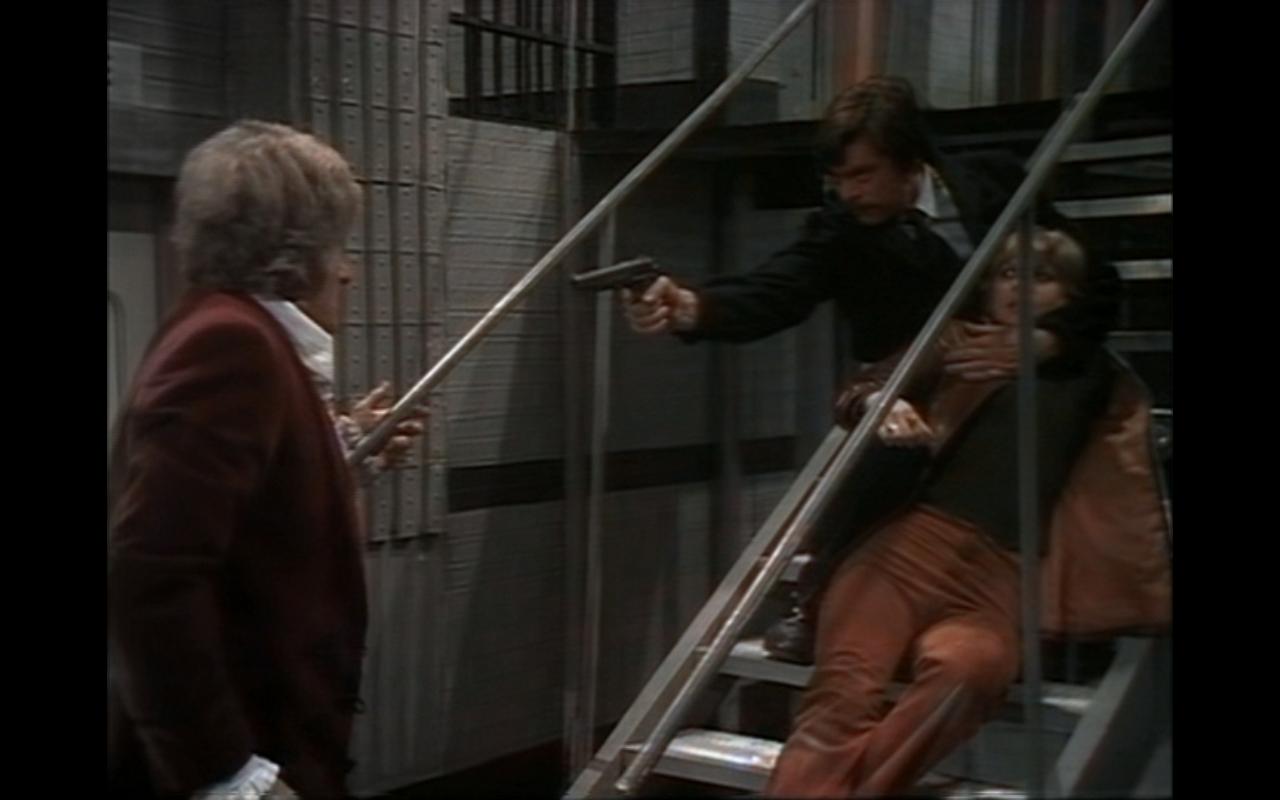
But what the whole episode is building toward is UNIT's efforts to retake Stangmoor, as the Brigadier heads undercover with a handful of picked men to infiltrate the prison, thus avoiding having to lay siege to a fortress.  Meanwhile, Benton takes some men to a secret passage that leads directly into the prison (er, yes...).  It's fun to see the action sequence, and we also get to see how good a shot the Brigadier is, as he picks off a number of prisoners with deadly accuracy.  But all the commotion has led Mailer to take the Doctor and Jo hostage, to aid his escape -- and when Jo attempts to knock Mailer down, Mailer grabs Jo and points his gun at the Doctor: "I warned you.  I only need one of you."  And then we see the gun go off!  Now that's a cliffhanger.