August 22: The Sun Makers Parts One & Two

There's a school of thought that says that The Sun Makers is a political satire about taxation.  There are some jokes and references on the surface, sure, but at its heart (at least based on these first two episodes) it's about an oppressed society, like a number of other stories: the only difference here is that the main tool of oppression appears to be heavy taxation, rather than just troops with big guns stationed everywhere.

This is in many ways a bleak couple of episodes.  Citizen Cordo would rather commit suicide than be in debt to the Company, and there's some indication of how much disparity exists: Cordo is completely unable to come up with the outstanding balance of 31 talmars to pay for his father's death, while Gatherer Hade is willing to give the Doctor 1000 talmars in order to sustain an illusion of mistaken identity long enough for the Doctor to reveal the location of the other rebel leaders (Hade believes).  Meanwhile, the rebels living in the Undercity are just as despicable (if not more so), with the leaders more interested in self-preservation at any cost than in any more noble acts against the Company.  Only Goudry (as played by Michael Keating, soon to become rather more well-known as Vila in Blake's 7) has any sort of redeeming qualities, and he's just as concerned about not drawing attention to himself as anyone else.  The only honorable people we meet are Cordo and Bisham, the man being held in the Correction Centre with the Doctor.

The problem, however, is that that surface layer of jokes has led to a much lighter feel for this story than might have been intended.  Now obviously some scenes (including basically anything with Gatherer Hade) are meant to be lighter.  But one never really gets the sense that the people living underground are in any danger, and the Doctor and Leela never really feel like they're in danger either (not even in either cliffhanger).  And so we get a sense of a society that we're told is bleak and being controlled by drugs in the air, but we never really get to see any of the effects.

The other odd thing about this story is how we're on Pluto in the far future, surrounded by six artificial suns, and yet this becomes a background element almost immediately.  It obviously didn't help that it was miserably overcast on the days they shot outside, but there's a story in the mix about how even the light is something the citizens have to pay for, but it's never brought up.  All this and the haphazard set design (though, to be fair to designer Tony Snoaden, the design thought processes seem to have been changed halfway through the design stage, which leads to some odd juxtaposition of elements -- Aztec faces, giant fake-looking animal rib cages, and blown up circuitry (from AMD, you may have noticed) all fight for screen prominence, with little rhyme or reason) make this a story that seems like it's been put together in a rush.  Hopefully things improve in the last two episodes, but right now this feels like a story that's hoping that the tax jokes will distract people from the fact that this is a roughly-sketched-out oppressed society with no real threat or danger behind it.

August 21: Image of the Fendahl Parts Three & Four

The Doctor is saved by Leela, and off they go to regroup at Ma Tyler's cottage.  After establishing both that Ma Tyler is all right and that she has precognition (which the Doctor puts down to living near a time fissure -- "it's a weakness in the fabric of space and time.  Every haunted place has one, doesn't it?  That's why they're haunted.  It's a time distortion" -- and thus gives the viewers an offhand, pseudo-scientific explanation for ghosts), it's off to the fifth planet for some reason (padding, most likely -- we learn almost nothing from this side trip).  The bit in the cottage is still nice though.  "How do 'ee know so much?" Ma Tyler asks him.  "I read a lot," the Doctor replies.

The bits back at the Priory are much more interesting.  Max Stael seems to think that, by using Thea as a medium and bringing along some of the locals to help him, he'll be able to "conjure and control the supreme power of the ancients."  He noticed that the sonic time scanner woke up the power and Thea seems drawn to it, so he's all set.  And obviously he's not going to let anyone get in his way, so Adam Colby and Dr. Fendelman are taken down to the cellar at gunpoint and tied up to some columns.  Colby responds, rather wonderfully, by being more sarcastic than usual, while Fendelman seems more despondent -- possibly because he realizes what's going to happen -- particularly when he sees that Stael is using the ancient skull (with a pentagram in the crown -- another offhand explanation for something) as a power source. "You don't understand," he tells Stael urgently.  "I see now what will happen. ... The Doctor asked if my name was real.  Fendelman.  Man of the Fendahl.  Don't you see?  Only for this have the generations of my fathers lived.  I have been used!  You are being used!  Mankind has been used!"  (And never mind that Fendelman doesn't seem to have been around for any of the explanations about what the Fendahl is, it's still a good, well-delivered speech.)  This is where the story really starts to get into Quatermass and the Pit territory, with the implication that mankind's development has been influenced by this ancient skull in order to turn us into something for its own purpose.  Stael won't listen, though -- he shoots Fendelman in the head (off-screen, but there's a trickle of blood on Fendelman's temple when we cut back) and gets ready to claim the ancient power.

The Fendahl core and a Fendahleen. (Image of the Fendahl
Part Four) ©BBC
It all goes horribly wrong, though; Thea turns into a glowing golden figure, and a number of slug-like creatures called Fendahleen appear.  The Doctor and Leela are able to rescue Colby, but when it comes to Stael, it's too late -- he can't move, and he begs for a gun so he can end his life.  It should be a horrific moment, but it's played in such a way as to lessen the impact of what's happening: Tom Baker in particular seems incredibly unaffected by the gravity of the situation as he gives the gun to Scott Fredericks, but one wonders if that was to downplay this element for the audience (after all, The Deadly Assassin incident was only last year and new producer Graham Williams has been specifically told from above to tone things down).  Still, you can definitely see what Chris Boucher was getting at when he wrote it.

We finally get some answers from the Doctor as to what's happening in his conversation with Colby, as he rewires the time scanner to cause an implosion.  We learn that twelve million years ago, the Fendahl evolved on the fifth planet as a creature that fed on all forms of life, and the Time Lords tried to stop it by destroying and/or time-looping the fifth planet (it's not exactly clear which) -- only one of them escaped and made its way to Earth:
COLBY: Then it got itself buried, but not killed.
DOCTOR: The Fendahl is death.  How do you kill death?  No, what happened was this.  The energy amassed by the Fendahl was stored in the skull and dissipated slowly as a biological transmutation field.  Now, any appropriate lifeform that came within the field was altered so that it ultimately evolved into something suitable for the Fendahl to use.
COLBY: Are you saying that skull created man?
DOCTOR: No, I'm saying it may have affected his evolution. ... That would explain the dark side of man's nature.  But it's just a theory. ... Oh, if you want an alternative explanation, the Fendahl fed into the RNA of certain individuals the instincts and compulsions necessary to recreate.  These were fed through the generations till they reached Fendelman and people like him.
COLBY: Well, that's possibly more plausible.
DOCTOR: Or on the other hand, it could all be just a coincidence.
Thea's transformation into the Fendahl core (the Fendahl being a gestalt entity composed of a core and twelve Fendahleen) is pretty impressive; the large eyes painted on her eyelids works surprisingly well, particularly at a distance -- it's only in close-up shots that the effect is spoiled somewhat.  It's also an interesting choice to make something that's pure death look so beautiful and almost god-like, and it's one of the decisions that makes this story so compelling.

Fortunately, the Doctor is on hand to save the day, by taking the Fendahl skull and putting in it a lead-lined case and then rigging a gigantic implosion in the Priory to take care of the Fendahleen that exist -- the Fendahl being unable to gain full strength since two of the people needed to turn into Fendahleen were killed.  The universe is safe.

Image of the Fendahl is just about the last stab at Gothic horror in this era of the show, but it's a very effective piece of television.  The decision to make so much of this look like a high-quality science-fiction teleplay (as opposed to a typical episode of Doctor Who) elevates this, and the comparisons with Nigel Kneale's works are intended as a compliment.  It's so good, in fact, that you could take the Doctor out of things completely and still have a good story that would be almost unchanged until the final episode.  It's an intelligent script and a good production; it's not as wonderful as The Face of Evil, but this is another unfairly neglected story that's well worth your time.

August 20: Image of the Fendahl Parts One & Two

This first episode feels very unusual for Doctor Who.  The Doctor and Leela are barely in it, and the times when they are present, they're essentially divorced from the main plotline.  That plotline feels more like a Nigel Kneale piece (and the ancient, impossible skull has obvious parallels with Quatermass and the Pit), and all the characters involved feel fully formed, as opposed to foils for the Doctor to react against.  They're scientists who've discovered a homo sapiens skull buried in 12-million-year-old volcanic ash, and they're trying to work out why it was there.  Meanwhile, the body of a dead hiker has been found in the grounds nearby ("What sort of corpse?" asks the group's leader, Dr. Fendelman.  "A dead one.  What other sort is there?" replies Adam Colby101, the one who found the hiker), which Dr. Fendelman wants to keep hushed up for some reason -- as if they're doing something so terrible at the Priory that they don't want anyone to associate the death of a hiker with archaeology.  It's an odd position to take, is what I'm getting at.

This first episode is really all about establishing the mood.  We know there's a seemingly impossible skull, we know that Fendelman is working on a device that will let him see images of the past (due to a "sonic shadow"), and it seems that when the device is operating, the ancient skull reacts -- and seems to affect fellow researcher Thea Ransome (Wanda Ventham's second role on the show, and apparently her first since the birth of her son Benedict Cumberbatch) in strange ways.  There's an uneasy feeling about all this, and the lack of music actually heightens this feeling -- other than the titles, there's no incidental music at all in the first episode, and only a small amount in the second part.  But where that's been a hindrance in other stories (The Web Planet springs to mind), here it adds a feeling of verisimilitude that leads to that aforementioned sense of unease -- it's ever so slightly harder, given what we see, to dismiss this as simple fiction.

Weird cliffhanger, though: the skull is superimposed over Thea's face while she turns on Dr. Fendelman's machine, Leela is shot at with a shotgun, and the Doctor stands motionless in a field.  And the resolution is even stranger: the Doctor talks his legs into moving and he's able to run off.  Oh, and Leela dodges the shotgun blast.

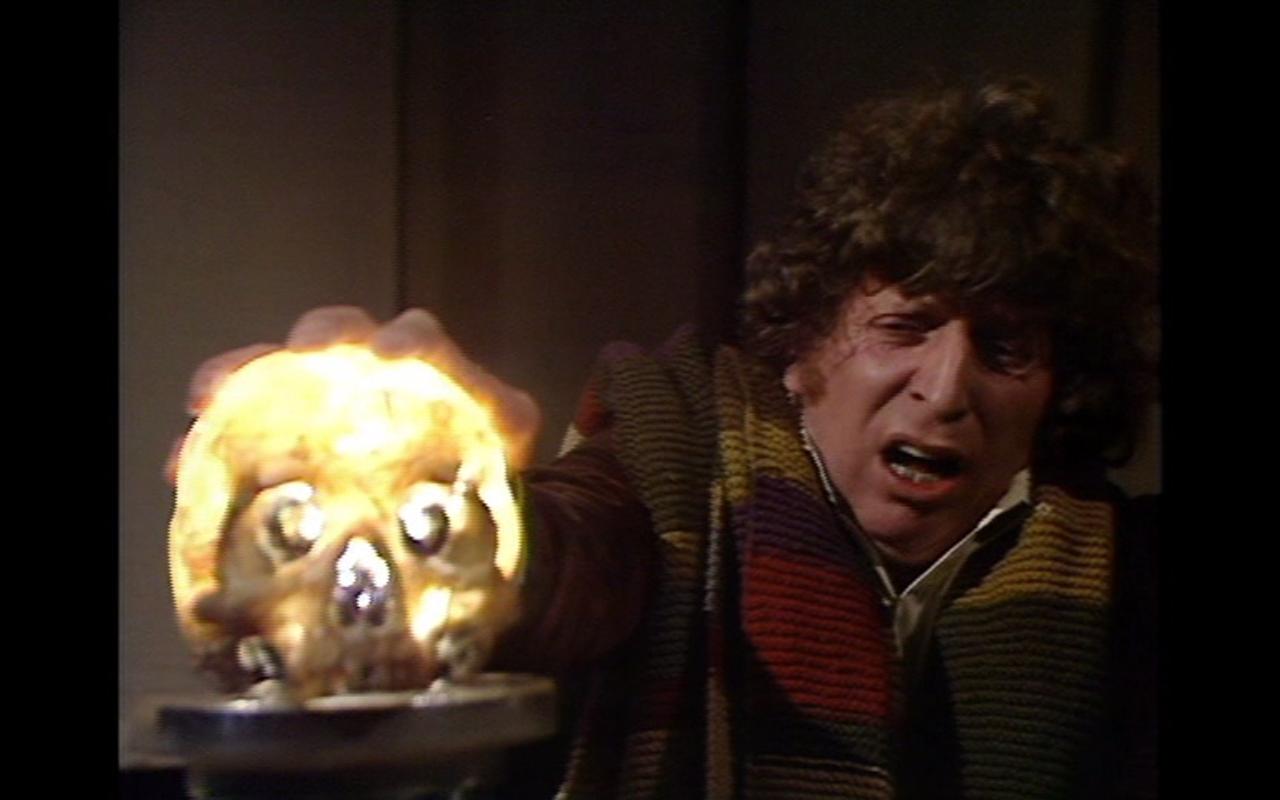
The Doctor is forced to grip the glowing ancient skull.
(Image of the Fendahl Part Two) ©BBC
The second part sees the Doctor and Leela more integrated into the action (and, as a random aside, Leela's hairstyle in this isn't very flattering -- allegedly the stylist took too much off and they had to put Louise Jameson's hair up to cover this), although it's Leela who seems to be doing better, as she's got a whole subplot with some locals and something about a coven or some such to deal with.  The Doctor seems to know a lot more about what's going on (note the way he instantly knows not to touch Thea, that Mitchell died the same way as someone else, and that the weird slug-like creatures that appear on Thea's fallen body look like embryo Fendahleen, "a creature from my own mythology"), but it doesn't really help, as he's quickly locked up in a storeroom and isolated from the rest of the house, with no way of getting out.  Well... except, in one of the great mysteries of Doctor Who, the door is unlocked and opened, without any indication whatsoever as to who did it.  (Although now we know it must have been Clara, as she traveled through the Doctor's timeline.)

Things aren't exactly going well in the meantime: Thea seems drawn to both the skull and Fendelman's machine, and Max Stael (the final researcher in the group) appears to be a member of that coven whose members were giving Leela trouble in the episode.  Interesting cliffhanger, though: after Thea switches the machine on, Thea is knocked out by Max and the machine is left on -- which means that the Doctor, who's been examining the skull102, suddenly feels compelled to grip it: an action which causes him some pain...


101 The second character on the show to bear the name Adam.  Well, I care.
102 As far as I can tell, this marks the first instance of the Doctor asking, "Would you like a jelly baby?" (in this case, facetiously to the skull) while actually offering a liquorice allsort.

August 19: The Invisible Enemy Parts Three & Four

Erm.

It's not that these two episodes are bad, it's just that they're not particularly interested in telling the story that the first two seemed intent on telling.  The majority of part three is focused on the miniaturized Doctor and Leela clones wandering around the Doctor's brain, looking for the Nucleus of the Swarm that's taken up residence inside.  It's not an terrible idea, and the sets are suitably imaginative, but the endeavour is somewhat thwarted by all the jokey bits inside.  It doesn't feel tense; it feels like a casual stroll through the Doctor's brain, as he makes facetious comments and shows off to Leela -- and the fact that no effort is made to make the countdown even close to being in real time doesn't help this sedate feeling any.

It also feels rather padded; Marius is infected by the virus and clones and miniaturizes Lowe so that he can also be injected in the Doctor and stop our heroes' clones, but this ultimately feels like an excuse to use up the episode's allotted time, rather than any sort of serious threat.  Then the whole episode ends ludicrously; after the Doctor and Leela confront the Nucleus of the Swarm, the infected Professor Marius takes whatever escaped from the Doctor's tear duct and brings it to full size.  Only it's not the Doctor and Leela -- it's the Nucleus, which looks like a giant mutated shrimp.  And it's not a very terrifying shrimp either.

The Doctor chats with the Nucleus of the Swarm and its minions.
(The Invisible Enemy Part Four) ©BBC
Part four has some running around as the Nucleus heads back to Titan to spawn, while the Doctor works out how to stop it.  It turns out that, no, it actually was an antibody in Leela's blood that made her immune, and they're able to successfully cure Marius with it.  Then it's off to Titan to stop the Swarm from spreading.  The Doctor is going to use the antibodies, but when those are destroyed, he just blows the whole place up instead.  So, that was easy, I guess -- it certainly didn't look like a life-or-death struggle.

Then it's back to the Bi-Al Foundation to return K-9 to Professor Marius -- only Marius can't take K-9 back to Earth with him, so he offers the metal dog to the Doctor.  The Doctor doesn't seem terribly thrilled (and it's worth nothing that Tom Baker seems to have no idea how to talk to this prop -- he's significantly less certain when addressing K-9 than any of the actual actors), but Leela is very pleased, and the TARDIS departs while Marius makes an excruciating "joke" about K-9 being "TARDIS-trained".

There's some good potential in this story, and the first couple episodes are quite good, but once we enter the Doctor's brain things go downhill.  The brain sets are imaginative, yes, but they really need to be spectacular to pull this off, and they're just not up to the task -- and the lack of suspense in these scenes doesn't help any, as the show starts to stop taking itself seriously.  There's a sense of Bob Baker and Dave Martin throwing in scenes because they think they'd be cool, rather than for any logical reason (which includes basically all of part three).  And, perhaps more egregiously, the ultimate solution to the problem is just to blow it up, rather than to do anything clever or memorable.  The Invisible Enemy certainly tries, and there are some good moments, but it can't quite achieve what it wants to do.  "Ambitious" is a suitable word to describe this story; so is "silly".

August 18: The Invisible Enemy Parts One & Two

So the first effects shot (the one of the shuttle weaving up and down through the asteroids) is rather dodgy, but after that they get much better -- the shots of the shuttle landing on Titan and being taken underground are particularly good.  And while the space shuttle interior isn't terribly exciting (though it's certainly not bad), the interiors of the base on Titan are quite lovely -- the bits that look like they've been hewn from the rock being especially nice.  Oh, and look, we've back to the old-style white console room -- no more wooden paneling (for practical reasons, it turns out -- the panels had warped while in storage and thus were no longer usable).

The plot isn't too shabby here, either -- that shuttle flies through an organism that sort of looks like a thundercloud in space, complete with lightning, which ends up infecting the shuttle crew.  We can tell because they've got some interesting-looking white scales/fungus on their faces, and they all utter another Bob Baker/Dave Martin catchphrase: "Contact has been made."  But what's more exciting than that is that the TARDIS also passes through the organism, and the Doctor is also infected.  So not only do we get a possession story, but we get one in which the Doctor himself has been compromised.  Of course, it being the Doctor, he's able to resist it somewhat, but even he's not totally immune.  Thus as we see the Doctor and Leela exploring the Titan base in response to a mayday signal, we see him losing the struggle against the Nucleus of that space organism as he prepares to shoot down Leela...

Leela, for some reason, is completely unaffected by this creature, and so she's able to help the Doctor, even as he continues to struggle against the Nucleus (he's able to stop himself from shooting down Leela, for instance).  His only help lies at the Bi-Al Foundation, on an asteroid in the main asteroid belt.  It's not as nice a set (being another one of those white "space" sets we tend to get in future stories), but it's still all right.  That said, the "reformed" English spelling on everything -- so, for example, the word 'exit' is realized as 'egsit' -- is not only rather poorly thought-out (such as with the letter 'i' representing two or three different sounds) but it's not even consistent -- Titan has an 'airloc', while Bi-Al has an 'airlok'.  So it's a nice idea but it hasn't been properly worked out, and thus the result is either just strange or simply awful (depending on your point of view).  Oh, and all the dialogue refers to things like "level X4", while the signs say '4X'.

Leela is told about K-9 by his owner, Professor Marius. (The
Invisible Enemy
Part Two) ©BBC
However, Bi-Al is where we meet Professor Marius, Bi-Al's "specialist in extraterrestrial pathological endomorphisms", and his robot dog, K-9.  There's something slightly off about K-9's introduction, to be honest -- he's sort of presented as a fait accompli, a way for the effects people to say, "Look what we can do," and thus is a bit hard to take seriously.  It also doesn't help that this is Doctor Who's first "cute" robot since the Chumblies in 1965, and that at this point in the story K-9 doesn't have anything worthwhile to do.  There's a bit of action toward the end, as Marius sends him out to protect the lab with the Doctor in it from the attacking possessed humans (who are trying to save the Nucleus from being destroyed by Marius and his people), but in general K-9 just sits there being vaguely smug and irritating -- declaring he's smarter than Marius and yelling repeatedly at Leela (but not doing anything else) until Marius tells him to stop.

There's also some stuff about "circus" cloning tricks ("circus" because the clones don't last very long) and using this to make duplicates of the Doctor and Leela that can be shrunk down and injected into the Doctor to take the fight to the Nucleus; a bit of confusion about why Leela is immune (the Doctor thinks it's because Leela is all instinct, and the organism needs intellect to thrive, while Marius seems to believe it might be a simple antibody); and the possessed humans smashing a shuttle into the Bi-Al Foundation (yeah, that will keep the Nucleus safe).  It's decently exciting, even if not particularly inspired -- we'll have to see what happens in the last two episodes, to learn if they achieve or squander the potential that this set-up has.  That said, injecting the Doctor and Leela clones into the infected Doctor isn't the most encouraging sign...

August 17: Horror of Fang Rock Parts Three & Four

Well, they all heard a scream from Reuben, but nevertheless he seems to be alive (albeit not very talkative) as he heads straight for his room and locks himself in -- where it becomes clear that all is not right with him.

This episode is primarily meant to increase the feeling of claustrophobia and dread, as Terrance Dicks delivers an old-fashioned base-under-siege story designed to scare the audience -- and so Palmerdale is killed outside after trying to bribe Vince, the young lighthouse keeper, to send a telegram for him.  Palmerdale is still obsessed with gaining money and ruining Skinsale, and will do anything to make that money.  But of course it doesn't matter, as the alien kills him -- Adelaide thinks Skinsale did it to protect his reputation, but we know better.  Then after that, Reuben starts gleefully killing people off, starting with Harker at the end of part three.  "Oh no!" Adelaide screams upon seeing the body.  "Get her out of here!" the Doctor growls, as he and Leela make a dreadful discovery: Reuben's body in the coal bunker, dead for several hours.  The Doctor realizes they're dealing with a shapeshifter, as part three comes to an end. "Leela, I've made a terrible mistake.  I thought I'd locked the enemy out.  Instead, I've locked it in, with us," he says grimly.

The Rutan Scout in the lighthouse stairwell. (Horror of Fang
Rock
Part Four) ©BBC
Part four shows the alien in Reuben's form killing off the rest of the survivors: first Vince, then Adelaide.  The Doctor comes up with a desperate plan which requires him to delay the alien while Skinsale and Leela do what they need to do.  This is the point where we learn that the alien is in fact a Rutan, the enemy of the Sontarans and a rare case (at this point in the show's life, at least) of taking a throwaway detail from a previous story and incorporating it into the current storyline.  This Rutan is a scout, "specially trained in the new metamorphosis techniques", and it's going to use Earth as a launching point in their assault against the Sontarans.  Leela manages to kill it (though not before it kills Skinsale, who's stopped to pick up some diamonds that the Doctor has tossed aside -- killed by his own greed, in a way) and then, in what's an impressive but slightly uncomfortable scene to watch, she heads down to gloat over the death of her enemy.  But the Doctor manages to destroy, thanks to the main lighthouse lamp and a diamond, the main Rutan ship that's preparing to land -- although the flash turns Leela's eyes from brown to blue (so that Louise Jameson doesn't have to keep wearing contact lenses to change her eye color).  With everyone in the lighthouse dead, the Doctor and Leela depart, the Doctor quoting one of the sources of the story: "The Ballad of Flanagan Isle".

There's no larger purpose behind Horror of Fang Rock: it's simply there to provide effective moments of terror and fear, and as such is one of the closest times Doctor Who has come to making an old-style suspenseful horror movie (as opposed to the more modern gorefests we now associate the term "horror movie" with).  It's not ambitious, but it is well-scripted, well-directed and acted (there are some fabulous moments from the cast), and very well-designed as well (right down to the filthy handprints on the well-used curved door to the crew room).  It's suspenseful, it's scary, and it never lets the side down: Horror of Fang Rock doesn't have the scope of other stories, but it's extremely successful in what it sets out to do.

August 16: Horror of Fang Rock Parts One & Two

It's a new season and a new producer, but it doesn't really feel that different from season 14.  Horror of Fang Rock feels like a holdover from the previous season, which makes its late replacement status for another Terrance Dicks story (The Witch Lords/The Vampire Mutation100) all the more surprising -- particularly if you know the direction the show is heading in.  But, as these two episodes make clear, the pressures of the script (combined with the unfamiliarity of working in the different location of Pebble Mill Studios in Birmingham -- Horror of Fang Rock is the only 20th century story not to be made in London) have led to an intense, effective tale.

The first part consists almost entirely of building up the atmosphere of fear that pervades the story.  After a brief glimpse of a "fireball" in the sky, everything else consists of a heavy fog rolling in out of nowhere and an effort to work out what actually killed Ben, one of the three lighthouse keepers stationed on Fang Rock in the early 20th century (judging from the newfangled electricity and comments in part two about when the Beast of Fang Rock appeared previously).  There's a feeling of dread that always present, as the Doctor tries to figure out what's happening, while the audience knows (thanks to some first-person shots) that some sort of alien is also on Fang Rock.

Interestingly, the first cliffhanger involves a ship breaking up on the rocks, which means that part two introduces four more characters into the mix: two politicians, a secretary, and a crewman from the doomed ship.  The younger politician, Lord Palmerdale, is desperate to get to London before daybreak for financial reasons, which means he couldn't care less about the problems of anyone else -- all he wants is money and (it seems) the chance to ruin the older politician, Skinsale.

Of course, while these new arrivals are bickering, the alien is still roaming the island.  The Doctor and Leela (dressed in a Barbara Wright-esque outfit this time around) are trying to track the thing down, while Reuben (the elder keeper) tells them about the Beast of Fang Rock.  The Doctor knows that, while there's no such thing as the Beast of Fang Rock, nevertheless something is out there that wants in -- it's already killed Ben and performed a post mortem on him, and the Doctor believes the people in the lighthouse are next.  "Gentlemen, I've got news for you," the Doctor tells the shipwreck survivors happily.  "This lighthouse is under attack, and by morning we might all be dead.  Anyone interested?" he adds with a grin.  It's a decidedly odd choice, but that's what makes it so brilliant, as it establishes the Doctor as being just as alien as the thing outside.

And then, in another interesting cliffhanger, Reuben goes down to stoke the boilers, and then we cut to Skinsale and Palmerdale's secretary, Adelaide, as they hear a blood-curdling scream from below...


100 This was a take on vampire stories, but the BBC had a high-profile adaptation of Dracula coming out around the same time and didn't want Doctor Who to upstage/satirize that, so The Witch Lords was scrapped -- at least until 1980, when they made it as State of Decay.