October 15: The Visitation Parts Three & Four

The sonic screwdriver is destroyed. (The Visitation Part
Three) ©BBC
Ah, a cliffhanger solved by someone shouting, "Wait!" and deciding to spare their lives for now.  Of course, this just means that the Doctor and Mace have another chance to escape -- although it doesn't actually happen until the Terileptils' android smashes through the wall where they're being held, and then it just takes them back to the manor house.

There's honestly not much that happens in this episode: Nyssa works on building that sonic booster with which to shake the android apart, and Tegan is placed under the Terileptils' control and made to move dangerous vials into portable containers.  The most interesting thing that happens is when the Doctor tries to unlock his handcuffs; he doesn't get very far at all, but nevertheless the lead Terileptil orders him to drop his sonic screwdriver, whereupon the leader destroys it.  "I feel as though you've just killed an old friend," the Doctor says sadly, and for a while he was right -- this was to be the end of the sonic screwdriver, as John Nathan-Turner thought it made things too easy for the Doctor, and it didn't make another appearance for the rest of the '80s.  But other than that, and the fact that we learn the Terileptils plan on wiping out mankind with a virulent plague carried by rats so that they can take over, little of note occurs in part three.

Part four is more engaging: we get to see Nyssa destroy the Terileptil android (with a quite impressive explosion), while the Doctor works on figuring out where the main Terileptil base is, so that he can stop their plan.  The best part of the episode, though, may be the Doctor's increasingly frustrated reactions to Tegan (and occasionally Adric), as she talks back and is generally unhelpful.  He's by turns exasperated ("Will you--?!" begins one irritated retort before he stops himself) and sarcastic ("Yes, that's why I'm searching," in response to a question wondering if he knows where the Terileptil base is), and it's a fascinating side to this Doctor's character that you really want them to explore more.  All that said, a close second for best moment is Adric's attempts to land the TARDIS, and when they don't work, Nyssa suggests he try to think what the Doctor would do -- after which Adric thumps the console, which causes it to work.

The Terileptils, gathered around their soliton gas emitter.
(The Visitation Part Four) ©BBC
But still, this episode is quite linear, and once the Doctor finds the Terileptil base it doesn't take long to take it out of action, thanks to a struggle with the Terileptils that knocks the torch out of his hand and causes the bakery they're in to go up in flames -- taking the Terileptils and their plague with them.  It's still entertaining, but there aren't any twists in the story to keep you guessing, and there's something of a sense of inevitability when, as the TARDIS departs, we see the sign for Pudding Lane: it seems the Doctor started the Great Fire of London.

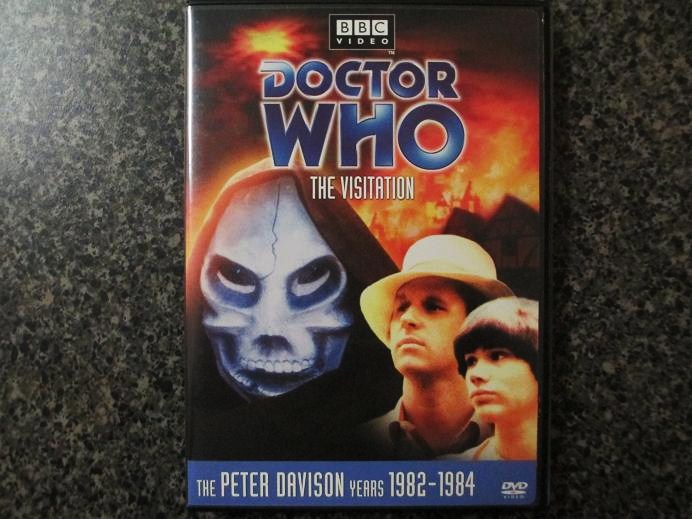
The Visitation is a very straightforward serial, to be sure; there aren't any new revelations or plot twists that challenge our previous understanding of what we thought we knew; here the aliens have a plan, they work on carrying it out, and then the Doctor stops them.  That's it.  But Peter Moffatt makes it work by keeping things interesting enough that the simplistic plot doesn't really bother you.  Plus it's fun to finally be back in Earth's past after five years, and the design work is really nice.  Ultimately, The Visitation isn't an ambitious story, but it is a competent one, and it's entertaining enough while it lasts.  That counts for something, surely?
October 14: The Visitation Parts One & Two

So, for the first time since 1977's Horror of Fang Rock (a quick trip to 1505 Florence in City of Death and Event One shenanigans in Castrovalva excepted), the TARDIS travels back into Earth's past, to 17th-century England and the future location of Heathrow Airport.  Well, the Doctor almost got Tegan back, even if she doesn't see it that way: "A broken clock keeps better time than you do!"

But before we quite get to the soap opera-esque TARDIS scenes (where the characters spend their time rehashing the events of Kinda in a decidedly less charitable light than when we last saw them), there are some establishing shots in a manor house, as a spaceship crashes down nearby.  This leads to a sequence where the residents of the house try to defend themselves against the alien interlopers but are presumably unsuccessful, as the next thing we see is the house abandoned weeks later.  It's a quite beautiful-looking android, though, with lots of glittering jewels and sharp elegant lines.  But this scene sets up the aliens as potentially dangerous, and this is what our heroes wander into, after avoiding plague-fearing peasants (complete with Adric spraining his ankle for no reason whatsoever) and meeting up with a highwayman/out-of-work actor named Richard Mace.119  The rest of the first episode is an exploration of the abandoned house, looking for the alien survivors that have left bits of their technology scattered about.  The first cliffhanger is completely unmemorable, though: the Doctor has disappeared.  Which might be all right if I didn't know what the resolution was (he reappears, having learned that a brick wall was in fact a fake wall), but I do, so it remains a very uninteresting cliffhanger.

Part two is a bit more interesting, because we finally get to see one of the alien creatures, and it's actually a pretty good design.  There's some nice detailing and some animatronics even, which give these lizard/fish creatures some extra realism.  The actual plot is still pretty straightforward, though; Adric and Tegan are captured, while the Doctor, Mace, and Nyssa escape, stopping to investigate the crashed escape pod that the Terileptils arrived in (and the Doctor must recognize the design, because he identifies the missing occupants as Terileptils with ease).  And while there's some fun interplay between the Doctor and Mace, as his entire worldview is repeatedly challenged (though, to his credit, he never completely cracks under the pressure), the plot is still remarkably linear; the Doctor and Mace head to the village, to work out how the miller can access the manor house (so that they can go the same way and rescue Adric and Tegan), but they're captured by the peasants, who decide to behead them.  "Not again," the Doctor moans, as for the second time this season an episode ends with a blade raised above his head...


119 Richard Mace was a character created by Eric Saward for a series of radio plays in the 1970s, where Mace was an actor/detective in the late 18th century.  Saward adapted the character for this story, despite Nathan-Turner's misgivings.

October 13: Kinda Parts Three & Four

I really like the cliffhanger resolution at the start of part three, where they open the box, only for a harmless little doll to jump out.  It's a nice way of defusing the situation, and it's therefore more awesome how it turns out that there's something else inside the box -- the same thing that turned Sanders into a harmless, ineffectual person.  However, the Doctor and Todd aren't driven mad, but instead are shown a vision that they decide to follow up on.

As I said before, Doctor Who is being shown twice a week in this period, and thus there's a sense in which the action is in episode pairs.  Thus, while the first two parts of Kinda took place inside the dome, the last two are concentrated in the forest outside.  It's a really nice set, by the way; lots of levels and good ground cover in the studio -- most of the time it's not obviously a studio floor.  Plus the cave set is well realized, and there's fun dialogue to go along with it (after learning that the Doctor was present at the opening of the box but wasn't driven mad, the old woman, Panna, is confused: "No male can open the Box of Jhana without being driven out of his mind.  It is well known.  Unless...  Is he an idiot?"  "Well, I suppose I must be," the Doctor replies reasonably).  And not just that; we also learn that Aris has been taken over by the Mara (thanks to Tegan's unsupervised dreaming), and that he now can speak, which causes all the other Kinda to obey him.  But the most striking thing about part three is the allegorical apocalyptic vision at the end, with lots of different types of clocks on columns all ticking toward 12:00, while the Kinda trickster trips and falls, where he's set upon by his fellow Kinda as time runs out: this, it seems, is the destruction that the Mara will once again bring to the Kinda ("Was what we just saw the future or the past?" Todd asks.  "Both," the Doctor replies) unless it can be stopped.

Todd, the Doctor, and Karuna find Tegan at the Place of Great
Dreamings. (Kinda Part Four) ©BBC
Part four is also full of engaging moments, such as the city that Hindle and Sanders have been making out of cardboard and other things lying around the base, complete with crude cardboard people to populate it (something Christopher Bailey disliked, as he had envisioned something far more intricate and lifelike -- but let's face it, it wouldn't be as interesting a scene if they actually looked like people).  "You can't mend people!" Hindle cries, after one of the cardboard people's heads is torn off.  And there's the way the Kinda have made their own Total Survival Suit, just like the dome has, except theirs is made out of wood and vines.  It's a really nice touch, showing how the Mara has taken over Aris for evil purposes but still must rely on the Kinda's know-how to actually do things -- and while they can mimic the form they can't mimic all the technology.

Really, the only things that are unsatisfying about part four are the clear padding scenes between Adric and Tegan (which don't provide new information and are full of the two of them sniping at each other -- so not only is it clear padding but it's not even entertaining padding) and the realization of the Mara in its true form.  Yes, Doctor Who often comes under fire for poor effects, usually unjustly, but the snake deserves everything it gets.  It's so fake-looking that you can't help but cringe, even if you choose to treat it in a more allegorical sense.  It probably wouldn't be as big a problem if the climax on the story wasn't hinging on it, but it is, and so the problem remains.  (There's a CGI option on the DVD that's rather more convincing.)  But the Mara is defeated (lyrically, because it's trapped in a circle of mirrors and evil can't bear to look at itself) and the Kinda's cycle has been broken -- Deva Loka will now be a paradise free from the Mara.

The impressive thing about Kinda is how well it's scripted -- other than the aforementioned padding, everything in this story is designed to lead into something else, even if it's not immediately obvious what that something else will be.  There's also a sense of wonder involved that gives the story an almost fairytale quality, and the direction plays this up, as with the clocks scene, the way the Mara moves from person to person, and the zoom all the way into Tegan's pupil to represent entering her mind.  It's not quite as perfect as is sometimes claimed, and it's not really the Buddhist allegory that is also often claimed (writer Christopher Bailey admitted he was mainly using the Buddhist names as a veneer on his own story, rather than intending to write a treatise on the topic through Doctor Who), but there's still quite a bit to like about Kinda; it's doing clever things in an era which is starting to become more straightforward in its storytelling -- something that the next serial will make quite clear.

October 12: Kinda Parts One & Two

You may recall that Nyssa collapsed at the end of the last episode, and here we see the Doctor constructing a "delta wave augmenter" so that she can get 48 hours of uninterrupted deep sleep -- in other words, Nyssa's not going to be in this story (just like they used to do in the '60s, although this time it's not because Sarah Sutton needed a vacation but because Nyssa was retained as a character late enough in the game that writer Christopher Bailey simply couldn't figure out a way to include her in the scripts he'd been working on).  And Nyssa's not the only one sleeping: Tegan also falls asleep beneath some chimes erected on the paradise planet of Deva Loka that the TARDIS has landed on, but unlike Nyssa, we're going to be privy to Tegan's dreams.  And they're quite stark-looking dreams, full of black spaces and high-contrast lighting, as someone who the credits call Dukkha (as in the Buddhist word for "suffering", but which also sounds a bit like "Doctor" -- although the fact that he resembles Christopher Eccleston is pure coincidence) tries to convince Tegan to let him take over her body and engages in all sorts of psychological trickery (such as having two Tegans trying to work out which is the real Tegan and which is the copy) in order to achieve his goals.  It's interestingly directed, and the moving snake motif is neat; moreover, it's clear when she wakes up, towards the middle of part two, that this is not the Tegan we know -- and Janet Fielding takes full advantage of the opportunity to play something more malicious and sexually charged than what she's been asked to play so far on the show.  The only real issue is that it seems disconnected so far from everything else going on.

So that means that the main focus of Kinda's storyline is on the Doctor and Adric's explorations through the forest, but fortunately for the audience it's quite a compelling plot thread.  The extraterrestrial explorers on Deva Loka (clearly based on the British Empire, with pith helmets and such on display) have been slowly losing team members, despite the natives, the Kinda, not being hostile.  The Kinda themselves are interestingly realized -- it seems only the women can speak, not the men (because for the Kinda, "voice is ... a mark of wisdom"), but they're all telepathic.  There are some intriguing hints about the Kinda, but for these two episodes we're confined mainly to the survey team's dome, where Security Officer Hindle looks increasingly likely to crack under the strain of things -- so it probably wasn't a good idea for the commander, Sanders, to put him in charge while he's out.  (The fact that when Sanders comes back he's changed from the gruff military man we saw to someone far more benign and passive is also bad news for our heroes, even if right before that we get a great display of Hindle's madness, as the world he's constructed in his head threatens to crash down around him: "Somebody make him go away!  Mummy!  Mummy, make him go away!")

It's a fascinating madness that Hindle displays; not the usual power-hungry madness that we see so often on Doctor Who, but instead something far more prosaic.  He's quite simply desperate to maintain control of things as they spiral away from him (something, it must be said, that Sanders' repeated needling of the man doesn't do much to help), and he's convinced that he's the only sane one around.  He provides an interesting contrast to their scientist Todd, who seems much more level-headed.  And in the midst of this is the Doctor, who seems to be hiding a probing curiosity behind the feckless charm he's exuding.  This makes the Doctor seem very much in control of the situation, even when he's locked up -- one gets the impression that he's simply waiting for the right opportunity to come along, while trying not to upset Hindle unduly.  Of course, by the end of part two that hasn't happened yet, and Hindle forces them to open the box that seems to have altered Sanders so dramatically and which he brought back for Hindle to open -- something that the Doctor seems very wary to do...

October 11: Four to Doomsday Parts Three & Four

It doesn't take long for us to learn what Monarch's really planning: according to Bigon, he wants to get rid of everyone on Earth, take all its silicon, and make more electronics in his quest to travel faster than light -- that way, he'll be able to travel back in time to meet the creator of the universe, who he believes to be himself.  Obviously the Doctor can't let this happen, so the rest of the last two episodes are about how he's going to stop Monarch from putting his plan into motion.

Of course, you need complications when something like this happens, and unfortunately much of these complications involve Adric and Tegan.  Adric continues his downward slide, being totally captivated by Monarch's "give everyone immortality by turning them into robots" plan for some inexplicable reason.  It feels an awful lot like the betrayal subplot in State of Decay, except here it's played for real.  The upshot is that you really want to smack Adric upside the head -- although his dressing down by the Doctor in part four (the conversation which begins with "Now listen to me, you young idiot.  You're not so much gullible as idealistic.  I suppose it comes from your deprived delinquent background") is made particularly entertaining because of Adric's prior behavior.  And Tegan is continually in hysterics, yelling at the Doctor and then running off and (somehow) causing the TARDIS to dematerialize and rematerialize out in space next to Monarch's spaceship.  It's not very pleasant or entertaining to watch her either.

The Doctor tries to spacewalk to the TARDIS. (Four to
Doomsday
Part Four) ©BBC
But at least Peter Davison can be relied upon to entertain as the Doctor, working his way through the situation without tipping Monarch off too much as to his intentions.  It's fun to watch him and Bigon disable monopticons and try to devise a way to stop Monarch, and even when they're found out (in a dramatic cliffhanger to part three that ends with the Doctor about to be beheaded) the Doctor still manages to turn the tables.  A good chunk of part four involves him trying to reach the TARDIS out in space, and even this is entertaining, even though it just involves several attempts to try and float to the TARDIS.  (I'll not comment on the feasibility of the cricket ball stuff, as plenty of people have discussed that elsewhere, but I will say that the effects are really nicely done.)

This attitude sums up Four to Doomsday -- it's entertaining even when it's not doing much at all.  Even the resolution of the story, while being rather abrupt (Monarch confronts the Doctor, who throws the shrinking poison at him and ends his threat), still feels much in keeping.  It's clearly not a story for everyone's tastes, but if you're willing to accept it on its own terms then there's a decent amount of enjoyment to be had here.  Davison impresses in his first serial in the role, even if he's not quite settled yet, and the guest cast do a great job of propelling the story along -- Monarch is a despot who acts kindly toward his antagonists because he knows they can't threaten him, and it's a nice change of pace (even when this changes as Monarch begins to take the Doctor seriously).  It's not an important or epic tale, but that's okay: Four to Doomsday may be a slight story, but it's certainly not without its charms.

October 10: Four to Doomsday Parts One & Two

It's often been pointed out, but Four to Doomsday doesn't quite seem like the Doctor Who we're used to; instead it's structured much more like a Hartnell story, with the TARDIS arriving in an unfamiliar environment and slowly working things out about it as they explore -- there's little in the way of establishing scenes for anyone outside the TARDIS, and the audience learns about things at the same time as the main characters do.  It's a refreshingly more sedate change of pace.  And in keeping with the Hartnell theme, there are also moments that seem designed to be educational in nature ("Pass the sodium chloride", the nature of the recreationals) -- it really does feel like a 60s story.  There are even four people in the TARDIS again.

Except that's where the parallel falls through.  The Hartnell crew had an old man, a young girl, and two middle-aged adults.  Here we have three youngsters and someone who's old but seems almost as young.  This actually wouldn't be a problem if it weren't for the fact that writer Terence Dudley seems to have given the three companions the most broad of characterizations.  He's read that Tegan is bossy, Nyssa is smart, and Adric is chauvinistic (for some reason -- he never seemed to feel that way before), and so that's what the actors get to work with.  Sarah Sutton comes off the best because she's sussed that if she plays the lines with a hint of detached amusement then it'll work out.  Janet Fielding has to spend all her time complaining (mainly about how the Doctor didn't take her back to Heathrow and that she doesn't like Monarch's spaceship), and Matthew Waterhouse comes off the worst because his lines are all designed to make him sound like a stuck-up, awful brat, and he's not experienced enough of an actor (to put it kindly) to play against them.  This is therefore really where the rot starts to set in for Adric -- when it was just him and Tom Baker he could play the bright-eyed inquisitive, but now he has to fight for attention between two other companions, one of whom has been written in much the same way as Adric had been.  Adding two other TARDIS crewmembers was probably the worst thing to happen to Adric's character, and it's sadly not going to get much better.  It doesn't help that Tegan and Adric don't seem to like each other very much.

Four to Doomsday is actually the first story filmed for the new TARDIS team, and you can sort of see it in Davison's performance.  He's energetically enthusiastic about everything, particularly in the first episode, and even his voice is at a higher pitch than it generally is.  But it's nice to see such ebullience -- makes everything seem more exciting, somehow.

The actual story in these first two episodes is rather slight -- we're as much in the dark as to Monarch's intentions as the Doctor is.  But the exploration of the ship is quite nice, and the slow revelation as to the nature of the humans inhabiting it is built up well.  Oh, and apparently Tegan is an accomplished draftswoman, with some really well done sketches as to what the well-dressed early 80s couple is wearing.  Less plausible is her ability to speak the dialect that the aborigine Kurkutji is speaking118.  However, as the rest of the story so far has been quite charming, we can forgive this.  And it's a great cliffhanger for part two, as Bigon the Athenian lifts up his face to reveal that he's a robot, and then pulls out a small circuit board from his chest.  "This is me," he says solemnly.  Of course, we're not really any nearer to understanding what's going on on this ship (beyond the idea that Monarch wants to take 3 billion of his fellow Urbankans to make a home on Earth); maybe we'll get some answers next time.


118 In the 1980s there were around 200 different Aboriginal dialects still in existence (according to Ethnologue), most of which only had a relative handful of speakers.  Even if we assume that she got lucky and Kurkutji spoke one of the more widespread dialects, like Warlpiri, there's still the matter of how Kurkutji (we later learn) is from roughly 33000 BC, so he should be unintelligible anyway (by way of comparison, only about 1000 years separates Modern English from Old English, and that's still largely unintelligible to current English speakers).
     But then, even from an internal logic point-of-view, this gets weirder when you think about it; on a ship full of Greeks, Mayans, Aborigines, Chinese, and Urbankans, only Kurkutji is singled out as requiring a translator.  So either the TARDIS translator is able to translate all the other languages on board except this particular one, or everyone else is speaking English and Kurkutji just refuses to conform.  Except that everyone presumably understood everyone else before the TARDIS arrived, so they must be speaking some sort of common tongue that the TARDIS is translating anyway.  Unless Urbankan is remarkably similar to English.

October 9: Castrovalva Parts Three & Four

So, starting with season 19, Doctor Who moved from its traditional Saturday time slot to a twice-weekly affair, on Mondays and Tuesdays.  What this means is that (although I admit I might be imagining things) there's a tendency for stories of this period to feel like a game of two-part halves, and Castrovalva is no different.  The first two episodes were almost chamber pieces in a way -- you essentially had a cast of the Doctor, Nyssa, and Tegan, with occasional appearances from Adric and the Master, and after part one's exploration of the TARDIS we got part two's exploration of the forest around Castrovalva.  But parts three and four are about Castrovalva itself, and the supporting cast increases appropriately.

Full marks to new Doctor Who director Fiona Cumming, by the way, for that marvelous tease of a wounded Doctor early in part three.  To recap: Tegan and Nyssa have discovered that the Doctor is missing, and that there's a trail of blood leading away from his last location.  Then Cumming gives us a shot of a long trail of blood which leads to a prostrate Doctor -- except it turns out that the Doctor is just listening to the ground to determine how many people there are ahead, and the blood is in fact irrelevant to his current condition.  It's a really nice touch in a story full of imaginative moments.

The new Doctor is surrounded by natives. (Castrovalva Part
Three) ©BBC
Part three has those moments, for instance, as it continually thwarts our expectations about what's going on; the Doctor is seemingly captured by unfriendly natives, but they're actually very civilized and have just gone hunting for the purpose of exercise.  The town's physician, Mergrave, offers the Doctor a suspicious-looking drink, but it seems to help exactly as it's said to do. There's the charming scene where a little girl teaches the Doctor that three comes after two (a result of him being unable to remember about Adric).  Castrovalva itself seems to be an idyllic, peaceful place, but the cliffhanger reveals that space itself appears to be folding in on itself, and there doesn't seem to be any way out.

Part four has some fine moments as well; the scene where the Castrovalvans try to draw a map for the Doctor is wonderful, and the effect of space-time collapsing is well realized.  Castrovalva, in case you don't know, is the name of an M.C. Escher print of a castle on a hill -- it's not one of his optical illusion prints, but that's clearly the inspiration for a lot of what we get here, with our heroes continually heading down and yet always ending up back at the square.  It turns out that's for a reason: Castrovalva is a trap deliberately constructed by the Master to trap the Doctor (with some help from Adric), with a fake village and fake inhabitants all designed to defeat the Doctor once and for all.  Boy, the Master plans ahead, doesn't he?

Davison does an outstanding job, playing the Doctor like someone waking up in a brand new body and taking nothing for granted.  There's a subtle nuance to how he behaves that really sells it, but there's also a brand new energy at play here -- witness how he bursts into his quarters to confront Tegan and Nyssa about Adric.  Janet Fielding and Sarah Sutton, as Tegan and Nyssa respectively, have a much more thankless task of trying to remain rocks in a sea of chaos, and while occasionally you get the impression that they're not quite sure how to play things (Fielding, for instance, often seems to default to outrage), in general they do a decent job with what they're given.  And Anthony Ainley's portrayal of the Portreeve gives lie to the complaint (from later in the series) that he all too frequently plays the Master as a two-dimensional cackling villain -- his Portreeve is wonderful and suggests that the problem with the Master lies in the scripting, not in the acting.  It is a bit of a shame when he reveals himself to be the Master, though, as he's just not as interesting -- particularly as it's the end of the episode, which means that after Shardovan, one of the Castrovalvans, sacrifices himself to end everything (with a great line: "You made us, man of evil, but we are free"), everyone hurries to escape the collapsing Castrovalva -- with the Master dragged back inside by his angry creations.

Castrovalva, in general, has a more relaxed feel than many of its predecessors -- even when people are frantically running around, there's still a sense of peace lurking just beyond the edges.  In large part this is because of Peter Davison's performance; he seems to be making an effort not just to explore what it means to be in a new body, but also to be as distinct from Tom Baker as possible.  So to that end he's considerably more accessible and less in control, and in this case it works.  And he's bolstered by a story which provides a puzzle for the Doctor to work through, rather than for a concrete threat to fight against.  In this respect, it's different from any regeneration story we've had yet -- the stakes are much lower and the story is focused firmly on the Doctor.  It's this approach, matched with the sheer charm of the piece and the talent in front of and behind the camera, that makes Castrovalva a success.