February 13: "Evolution of the Daleks"

Now "Evolution of the Daleks" -- that's a title!  Shame about the rest of the episode, though.

The Doctor talks to Dalek Sec. ("Evolution of the Daleks") ©BBC
All right, that's not fair.  There's a lot that this episode does right -- the "evolution" mentioned in the title is particularly interesting, and the suggestion that the Daleks might in fact dramatically change their way of life is fascinating.  "Do you trust [Dalek Sec]?" Laszlo asks the Doctor. "I know that one man can change the course of history," the Doctor replies.  "Right idea in the right place at the right time, it's all it takes.  I've got to believe it's possible."  In fact, for a while it looks like we might actually get a fundamental shift in the nature of the Daleks (or, alternatively, we're waiting for Dalek Sec to reveal his true colors and show that he's duped the Doctor -- but either way, drama), but the supreme nature of the unmodified Daleks takes over and we get a version of the original plan (make humans that are actually Daleks, even though they look externally human).  Still, the idea was fascinating for a while, and it's neat that they decided to push ahead with it as long as they did.  There's also an interesting subthread about the Doctor seeming to want to die (twice he basically orders the Daleks to kill him and braces for the shots that never come), as if he's finally decided that he's had enough and doesn't want to keep dealing with Daleks anymore.

The problem, however, lies in the sheer amount of technobabble that writer Helen Raynor (hey, our first female writer for the show since Rona Munro and Survival!) has to employ to get all her pieces in the right positions.  The DNA splicing between humans and Daleks is bad enough (and what, exactly, makes Dalek DNA spiky?), but fine, maybe there's some special chemical/technique we just don't about that would make this work.  But it's the moment where the Doctor is struck by a gamma radiation lightning bolt which passes his DNA down the cables to all the waiting would-be Daleks that makes you just throw your hands up in despair.  Unknown techniques are one thing, but electricity transmitting DNA sequences?  Those are two different things we know enough about to realize that they're completely incompatible.  That's a piece of technobabble too far, and it's so blatant a move to get us to a deus ex machina ending that it's incredibly frustrating as a result.

That's a shame, because for large chunks this story works surprisingly well.  We get some exploration of a new direction for the Daleks, we get some nice period stuff in New York, and a lot of the acting is top-notch.  But the resolution does overshadow everything, weakening the final product.  "Daleks in Manhattan" / "Evolution of the Daleks" is likely to be remembered more for that than any of the moves in its favor.

February 12: "Daleks in Manhattan"

So Martha's "one trip" has consisted of a trip to the past, a trip to the future... and now another trip to the past (albeit the more recent past) -- and our third extended visit to the United States (after The Gunfighters -- which is technically set in a territory, not a state -- and the TV Movie).  I'm not counting the brief American interlude in The Chase -- but maybe I should: that interlude included Daleks at the top of the Empire State Building, and it turns out we get the same thing here, even if it's 35 years earlier.  It seems the Daleks were involved in the Empire State Building's construction.

Of course, since we're talking the Empire State Building's construction, we're talking 1930 and therefore the Great Depression.  That brings us to one of the many shanty towns constructed around the country nicknamed Hoovervilles, after then-President Hoover.  It seems that people have been disappearing from New York's Hooverville in mysterious circumstances -- and all the while the construction of the Empire State Building is moving faster and faster.

The Daleks select people for processing. ("Daleks in Manhattan")
©BBC
But look!  It's Andrew Garfield as Frank, one of the Hooverville residents, right before he became better known as a movie star!  It's interesting to see him here in a minor role, interacting with David Tennant and Freema Agyeman as one of the people heading through the sewers.  Actually, I'd forgotten that he survived to the cliffhanger -- I'd thought the pig slaves had got him for good.

Oh right, the pig slaves.  It's not quite clear why they're around -- I think the idea is that the Daleks are practicing genetic manipulation on them before they do it to themselves, but that's never made clear.  Still, it's not a bad design, and it's certainly memorable.  Not quite as memorable as the cliffhanger, though, where the half-human/half-Dalek Sec steps out of his Dalek shell.  Now that's an image.

I like "Daleks in Manhattan".  There's a nice sense of building threat and mystery, and that cliffhanger definitely sends the story in a new direction.  I also like that we get a Dalek story that doesn't have any particular "event" significance attached to it -- it's just the next Dalek story (so it's like The Chase in another way).  We'll have to see how the second half is.

But let's be honest: "Daleks in Manhattan" is kind of a crap title, isn't it?

February 11: "Gridlock"

A trip to the past for Martha and now a trip to the future, as the Doctor takes her to New Earth and New...New York.  Martha is thrilled but also slightly peeved: "That's the view we had last time," the Doctor says, activating a scanner.  "This must be the lower levels, down in the base of the tower.  Some sort of under-city."  "When you say 'last time', was that you and Rose?" Martha asks.  "... You're taking me to the same planets that you took her?"  "What's wrong with that?" the Doctor asks.  "Nothing.  Just ever heard the word 'rebound'?" she adds under her breath.

The Doctor enters the Motorway. ("Gridlock") ©BBC
That's the set-up, but the actual storyline is so much more wonderfully mad than that.  Russell T Davies takes an annoyance from modern life, the traffic jam, and extrapolates a version that's worse by the nth degree.  In some ways it's a bonkers idea -- people being stuck in gridlock for over twenty years -- but because everyone on the inside of it treats it so seriously, we end up treating it seriously as well.

But what's especially nice about "Gridlock" is how everything seems to logically follow from that point, and Davies takes care to ensure that most of the viewers' questions about how this situation operates are answered.  Off-hand references to self-replicating fuel and muscle stimulants take care of some of it, and the businessman (the one who looks like Judge Dredd's Max Normal) describes how the ship's controls are locked off to the Doctor, which takes care of the big problem of "why don't people just drive illegally?"  So that takes care of some of the potential questions, and we're free to marvel at the society that exists inside the Motorway.

It's an interesting society, with each car consisting of its own microenvironment, tailored to the tastes of the occupant(s) who never leave the car.  But they can communicate with other cars and many seem to have established friendships that way -- and then they all join in singing the Methodist hymn "The Old Rugged Cross" for the Daily Contemplation.  Even when they're in their own vehicles they're still together.

All that and more from Russell T Davies, who brings back not just the Face of Boe but makes the strange creatures lurking at the bottom of the Motorway the Macra.  It's a bold move to bring back an alien species from a) 1967 and b) a completely missing story (I'm talking about The Macra Terror, if you need reminding), but it fits rather well into the context of "Gridlock" -- and if you don't know about The Macra Terror it doesn't matter, because it's not germane to the plot.  It's just a nice little present for long-time fans (and it retcons the Doctor's actions in that earlier serial to no longer be genocide).  We also get a really great action sequence, as the Doctor drops from car to car (which allows us to see a lot of different redressed versions of the same car, giving the story a sense of scope and individuality), and a nice triumphant ending, as the Motorway is opened and the cars leave.  Plus we get a final appearance from the Face of Boe, who expends his last remaining energy to help save the people in the Motorway and dies -- but not before providing the Doctor with one last mystery: "Know this, Time Lord: you are not alone."  Ooh, and a conversation between Martha and the Doctor, where the Doctor finally opens up to her (after some needling -- "You don't talk.  You never say," she tells him) about what happened to his people, and his description of Gallifrey matches the one given by Susan in The Sensorites (another gift to fans).

It's fast, it's fun, it's clever, and it's thoughtful.  It's also put together so well that it makes the whole thing look easy -- so easy, in fact, that if you're not paying attention you might not realize just how effortless "Gridlock" makes the show look.  Because it definitely looks effortless, but that's because they've done an amazing job of putting the work in ahead of time.  The result is that this is one of those overlooked gems -- but it's a gem nevertheless, and one of the best stories BBC Wales has given us yet.

February 10: "The Shakespeare Code"

And so this year's celebrity historical involves one William Shakespeare -- at a point before the Doctor ever met him it seems (in Shakespeare's personal timeline, that is -- see, among others, City of Death and The Mark of the Rani for suggestions that the Doctor has met Shakespeare before, albeit after 1599184).  It's also Martha's first trip in the TARDIS, and you can tell that writer Gareth Roberts (in his first official Doctor Who televised script -- he'd previously done "Attack of the Graske" and a number of the TARDISodes last series, but nothing that went out as part of the main series) is having a great time with it:
MARTHA: But are we safe?  I mean, can we move around and stuff?
DOCTOR: Of course we can.  Why do you ask?
MARTHA: It's like in the films.  You step on a butterfly, you change the future of the human race.
DOCTOR: Tell you what then, don't step on any butterflies.  What have butterflies ever done to you?
MARTHA: What if, I don't know, what if I kill my grandfather?
DOCTOR: Are you planning to?
MARTHA: No.
DOCTOR: Well, then.
Martha's worries about her race are also shrugged off: "Just walk about like you own the place," the Doctor tells her.  "Works for me."  Easy for him to say, he looks like a white man.  The bit about there being black people in Elizabethan England is historically accurate, though.  What's probably less accurate is how no one makes any sort of comment about Martha's race (beyond Shakespeare referring to her as a "Dark Lady", which is actually a reference to his sonnets) or about the strange clothing she's wearing (again, one passing comment from Shakespeare and that's it).  But I suppose there's only so much you can fit in in 45 minutes and Roberts in interested in other things.

William Shakespeare on the Globe stage after a performance of
Love's Labour's Lost. ("The Shakespeare Code") ©BBC
Those other things include witchcraft, with three witches (actually aliens, but it hardly matters) using their witchcraft to get Shakespeare to free their fellow witches, and Shakespeare himself, who's shown to be keenly intelligent (note how he's not fooled by the psychic paper when Martha is) and in love with life -- the way he yells at the audience in the beginning of the episode ("Shut your big fat mouths!") being a prime example.  Dean Lennox Kelly does a fine job of presenting Shakespeare as a person, rather than just a caricature.  Even if he's less bald than we might expect.

But the idea behind "The Shakespeare Code" is that words have power, and that thus Shakespeare has the power to bring the Carrionites back from where the Eternals (see Enlightenment and a brief mention in "Army of Ghosts") banished them at the beginning of time.  It's a fun script, with lots of witch elements (including the now-standard three witches gathered around a cauldron) and some mysterious deaths, like that of the Master of the Revels, who appears to have drowned in the middle of a dry street.  ("I've never seen a death like it," says the Doctor, who seems to have forgotten all about the death of Professor Kettering in The Mind of Evil -- and if Roberts is enough of a fanboy to slip one of David Whitaker's lines from The Crusade into the "text" for Love's Labour's Won ("The eye should have contentment where it rests"), you'd think he would have remembered this.)  The way the Doctor and Martha keep making Shakespeare references is also cute, particularly since they do play with it a little (such as the reference to Henry V: "Wait a minute, that's one of mine").

But yes, witches and Shakespeare and genuine lost Shakespearean plays; it's a fun script, and even when it's showing us genuinely alien moments (such as the trip to Bethlem Hospital) it moves along.  There are parts to quibble over (such as the Doctor being an oblivious bastard to Martha while they're sharing a bed: "No, there's something I'm missing, Martha.  Something really close, staring me right in the face and I can't see it.  Rose'd know."  (Ass.  Bet she wouldn't, anyway)), and I'm of two minds about the Harry Potter references: on the one hand I find it a bit crass to put them in the same category as Shakespeare, but it does get across the point of the popularity of Shakespeare's works in contemporary times and helps make the connection for younger audience members.  (That said, the "Expelliarmus" bit is a bit too far.)  It does a good job of keeping the viewer entertained, with a lot of energy and deftness on display, and it's not afraid to play with its subject a little, which makes him seem more human and alive, and thus more relatable.  "The Shakespeare Code" gives us Doctor Who in confident control, and it's hard not to join in with the fun.


184 Strictly speaking, they've screwed up the year, as Love's Labour's Won is mentioned in a book dated 1598.  But never mind.

February 9: "Smith and Jones"

The start of Doctor Who's third series sees us launch straight into the opening titles -- no teaser this time around (the first time that's happened since "Rose").  "Smith and Jones" also sees a new start for the show: Rose Tyler is gone and while David Tennant is still around, we have the debut of new companion Martha Jones.  But it's old in some ways, as we get a number of Who veterans in this episode -- Trevor Laird (Martha's dad) was in Mindwarp, Adjoa Andoh (Martha's mum) was in "New Earth", and Anne Reid (Florence Finnegan, the villainous Plasmavore) was Nurse Crane in The Curse of Fenric.  Even Freema Agyeman, the new companion, was in "Doomsday" as Adeola (here retconned as Martha's cousin).  And while Roy Marsden hadn't actually been in Doctor Who before, he seems like the sort of actor who should have been.  (Well, all right, he'd been in the Eighth Doctor audio Human Resources earlier in the year, but that's not what I meant and you know it.)

There's a lot to admire and enjoy in this episode.  Occasionally the revived show has felt rushed in its storylines, as it tries to cram in a lot of incident and action in a 45-minute slot, but "Smith and Jones" feels like it's just the right size.  We get lots of incident and action, but we also get quiet moments to breathe, to explore the characters a bit.  Obviously, there are a lot of introductions to get out of the way, but they never feel like it's too much too soon.  Instead we get a look inside Martha's life and we see how capable she is.  Freema Agyeman charms by being strong and sweet as Martha, with a nice helping of intelligence to boot.  Her interactions with David Tennant are good; they clearly have chemistry, and so their scenes together are very watchable.

The Judoon examine the overcharged MRI while Martha looks after
the Doctor. ("Smith and Jones") ©BBC
It certainly helps that they've got a clever little storyline to work with.  The Judoon are a cool creation, and the idea of them as slightly dim mercenary cops is entertaining.  I also like their solution regarding a lack of jurisdiction on Earth by taking the entire hospital up to the moon, which is the sort of mad idea that Doctor Who does so well.  Meanwhile, Anne Reid is so wonderful as the Plasmavore that you can't help but love to hate her.  The straw is a gloriously kitschy touch.

But it's really David Tennant who's in top form, from happily commenting on a little shop in the hospital to praising Martha for keeping her head in such a strange situation to his frankly marvelous performance as a confused mailman to get Anne Reid to suck his blood.  There's also the way he mouths "bigger on the inside" as Martha says it and then charges ahead: "Is it?  I hadn't noticed."  He is a joy to watch, and it's easy to believe he's the Doctor in this.  I also like the new blue suit and red Chuck Taylor's he's wearing, and the gag with the tie is great: "Crossing into established events is strictly forbidden.  Except for cheap tricks."

It's not perfect -- the bit with the Doctor shaking the radiation out of his body is a strange attempt at humor that takes you almost completely out of the story, and I'd like to know just how you could turn an MRI machine into a device that could kill half the planet from the moon -- but the confidence on display, matched with all the things that do work in "Smith and Jones", means that this is BBC Wales' most successful season opener yet.

February 8: "End of Days" (TW)

Sigh.  I suppose it was too much to hope for a decent ending to the season.

This deals with the fallout of opening the Rift last episode, and they give us a potentially interesting set-up of people from various times all showing up in modern Cardiff, bringing various diseases and things with them.  We even get some good drama coming out of it -- the Roman soldier is whatever (and why isn't he pronouncing all his /v/'s as [w]'s?), but the stuff with the Black Death is really nice.  Owen's worries about smallpox or future diseases is also worth exploring.  And at the heart of everything is Bilis, the caretaker from last time who makes a living bringing timepieces from their original eras into the 21st century and selling them as antiques (yes, just like Edward Waterfield back in "The Evil of the Daleks").  They could have gone in a lot of intriguing directions with this, and a show that was freely mixing and matching time periods could be fun.

But alas, that's not what we get.  Instead we get various people having visions of dead/missing loved ones telling them to open the Rift, but rather than attempt to work out what it all means or tell anyone about them, they just spend their time yelling at each other and not listening at all -- and apparently they're all more willing to listen to inexplicable visions than their leader.  So much for loyalty.  The way Owen shoots Jack is a bit shocking (and he gets a good line: "I'm sick of people doubting me"), but as we know he can't die it ultimately feels more convenient than anything else.

Jack prepares to confront Abaddon. ("End of Days") ©BBC
Look, all of this is just about OK.  The interpersonal dynamics among the team take significant steps backwards (all the yelling, remember -- and then there's Gwen's decision to tase Rhys and lock him in a filthy Torchwood cell), but at least there's some semblance of drama, even if some of it feels oddly manufactured -- in particular, Bilis's murder of Rhys (who's still the best character on the show) looks designed to make Gwen act than anything else.  But then, once they decide to open the Rift (which sends all the anachronisms back, apparently), things take a left turn into Stupidland.  Apparently, there's a giant crap CGI beast called Abaddon living under the Rift since "before time" who is the son of the "Great Beast" (so they're clearly trying to tie this in with "The Impossible Planet"/"The Satan Pit" for no obviously good reason), whose very shadow kills anyone it touches, and opening the Rift unleashed it.  How to stop it?  Make Captain Jack keep dying until Abaddon can't take it anymore.  "If Abaddon is the bringer of death, let's see how he does with me," Jack says. "If he feeds on life, then I'm an all-you-can-eat buffet."  Even though no one's mentioned that Abaddon feeds on life, or that he uses his shadow to feed, or that too much life will kill him, or that Jack's "can't die" ability will actually have any effect whatsoever.  Yeeeaaahhh...  There comes a point where you just have to accept that this isn't going to make any sense at all and to just go with it.  (Although, if we're going to discuss things that make no sense... why is Rhys back alive at the end of this?  He wasn't killed by an anachronism, he was stabbed in the gut by Bilis.  Why was that sufficiently Rift-y to be undone?)

But yeah, Jack saves the day (incredibly quickly, actually -- they brought up Abaddon just to take care of him in the next scene) and eventually comes back to life -- Tosh actually only says it's been "days" since he died and not actually "three days", but you get the idea -- just in time for an end-of-season cliffhanger: that severed hand starts beeping and bubbling, and then we hear the TARDIS materializing.  Next thing we know, Jack has disappeared.  Guess we'll have to wait for Doctor Who to find out what happens there.

This episode isn't very good, sad to say.  It could have been a lot more interesting than what it was, but instead a lot of potential was squandered in favor of a resolution with a terrible effect.  (Seriously, Abaddon is really poor-looking -- usually visual effects company The Mill is much better at this sort of thing.)  But while "End of Days" is really dumb, bordering on nonsensical, at least it's not offensively dumb.  That might make it Chris Chibnall's best script yet.

That brings an end to Torchwood's first series, and to be brutally honest, it hasn't been a very good run.  The scripts started out really really bad, and while things got a lot better by the end of the series, it wasn't enough to make this show really worthwhile.  Part of the problem lies in the characterization of the main characters.  I'm not sure why they thought it was a good idea to try and systematically make every member of Torchwood an unlikeable sod, but they did.  Gwen suffers particularly because of this, and while Owen's character improves greatly over the course of this first year, he's still kind of a dick.  But the biggest problem might be Captain Jack.  This isn't to cast aspersions on John Barrowman, who plays the character he's been given (and who gives the lines a twinkle here and there that they sorely need), but rather on Torchwood's conception of the character.  The reason Jack was so popular on Doctor Who was that he was a charming rogue who nevertheless was totally loyal to the Doctor.  Here they've turned him into a brooding, tragic character for some reason -- as if what we really wanted was John Barrowman doing his version of Buffy's Angel.

The ratings were good enough that Torchwood was renewed for a second series (and a shift from BBC Three to BBC Two), but it's hard to shake the feeling that they shouldn't have bothered.  The saving grace is that it does start to look as if they know what they're doing by the end of this series; if they stay on this trajectory Torchwood might become worthwhile.  But as is, it's sadly not really worth your time.

(Still, if you want to be cheered up after this, you can pull out your Ultimate Foe DVD and watch a young Chris Chibnall complain about The Trial of a Time Lord being too formulaic and clichéd on the "Open Air" special feature.  It's oddly satisfying, knowing he'd later be in charge of this.)

February 7: "Captain Jack Harkness" (TW)

After a couple days away it's back to Torchwood to finish up the rest of series 1.  This episode is written by Catherine Tregenna, who also wrote "Out of Time", and fortunately it's also a decent episode.  Seriously, it seems if you want Torchwood to come out all right, have a woman write it.

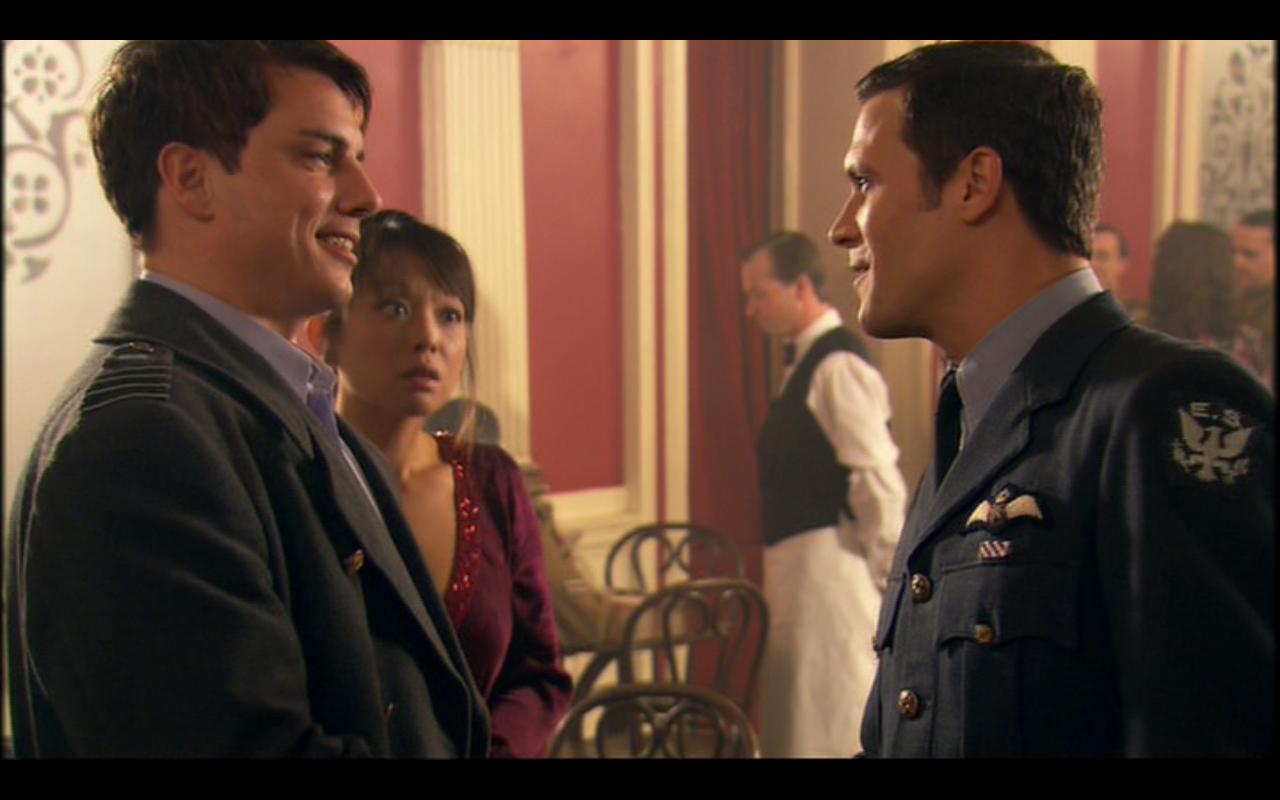
Jack and Tosh meet the real Captain Jack Harkness. ("Captain Jack
Harkness") ©BBC
Tregenna's script does two interesting things: first, it causes Captain Jack and Tosh to become victims of the Rift themselves, as they suddenly find themselves transported back to 20 January 1941 (hey, 44 years, to the day, before my brother's birthday!) and unsure of how to get back; and second, it brings Jack face-to-face with his namesake -- after all, the identity we've known since "The Empty Child" was an assumed one, a way for the con man to make his con easier.  It's an interesting move, and much of the episode focuses on the relationship between these two men, which starts out as almost fraternal but then changes into something more romantic.

This is the first concern with this episode; there doesn't really seem to be a good dramatic motivation for this burgeoning romance.  The fraternal aspect is fine, even laudable; Jack knows the real Captain's future, and he wants to ensure that he makes the right choices before he dies.  It's just not clear why this would cause the Captain (as the credits call him) to suddenly want to start kissing Jack.  If he thinks he's going to die (which might be the case, but if so it's very subtle), then fine, maybe, but it still seems both weird and superfluous -- the story doesn't gain anything from Jack sharing a kiss with his namesake.183  And what did the Captain's men think of this?  (Or the Rift suddenly opening up, for that matter.)

The other storyline involves Toshiko's attempts to provide the present-day Torchwood team with the mathematical formulas they'll need to safely open the Rift and bring Tosh and Jack home.  So while Tosh is trying to hide papers with numbers on them, Gwen and Owen are looking for ways to bring them back.  Owen seems hell-bent on getting them both back, to the point that he doesn't question any of the increasingly strange coincidences going on.  The 21st-century team realizes that the current caretaker of the building, Bilis Manger, is the same person as the one in 1941, which leads Owen to realize that Bilis can travel back and forth through the Rift.  (Or maybe he's incredibly long lived, like Jack, but that doesn't seem to have occurred to him.)  But does he interrogate Bilis, or grab and throw him into a holding cell?  No, Owen looks through Bilis's office, finds the missing piece of the Rift Manipulator (without stopping to consider why on Earth Bilis would have this in the first place -- and in fact this point isn't touched on at all), and decides he's going to use it to open the Rift.  There's loyalty and then there's blind loyalty, and Owen seems to be falling into the second category.

That stuff seems to be setting up the series 1 finale next episode, though; the primary focus of the episode is in 1941, in that relationship between Jack and the Captain.  And up until the point where it starts to turn romantic, it works really well.  There's an interesting exploration of what you do if you know someone's going to die but can't tell them, and there's also a nice discussion of what it means to be a leader, and does that mean you have to be brave in front of your squadron all the time?  Are you allowed to be scared, and is it OK to be scared?  It's a question deftly handled by the script.

Really, except for the strange resolution of the 1941 storyline and Owen's unquestioning use of specifically Rift equipment found in unlikely places (so, SOP for Torchwood members, then), "Captain Jack Harkness" does a good job of balancing its points of view in a way that doesn't make you hate everyone on screen.  It even takes a bit of time to indulge in some racism against Tosh, just to demonstrate that we really are in 1941 (compare with reactions to Martha in, say, "The Shakespeare Code").  It's not a knockout success, but it is another in a line of decent stories that you can watch without too much difficulty.


183 We later find out in "Fragments" that our Jack has super-charged pheromones, and so the Captain's response to Jack might just be because of that.  But obviously that explanation isn't anywhere to be found in this.