June 25: "Cold War"

An alien warrior, frozen in the ice for thousands of years, excavated by humanity and thawed -- revealing that the warrior was dormant, not dead.  A small group of people in a confined area, under siege from the resuscitated warrior.  That warrior threatening to destroy the world thanks to nuclear power.  Yes, Mark Gatiss has chosen to remake another Troughton story: this time it's The Ice Warriors.

I mean, I suppose if you're going to reintroduce the Ice Warriors after 39 years then why mess with success (although you start to wonder how many Ice Warriors were accidentally frozen on Earth -- but then maybe Varga and his group were sent to look for Grand Marshal Skaldak and they were also trapped), but it does mean you start forming comparisons between the two stories.  The Ice Warriors had an underlying theme of people versus computers; "Cold War" is (I think) exploring the idea of mutually assured destruction, but it hardly does anything with that idea beyond a basic threat.

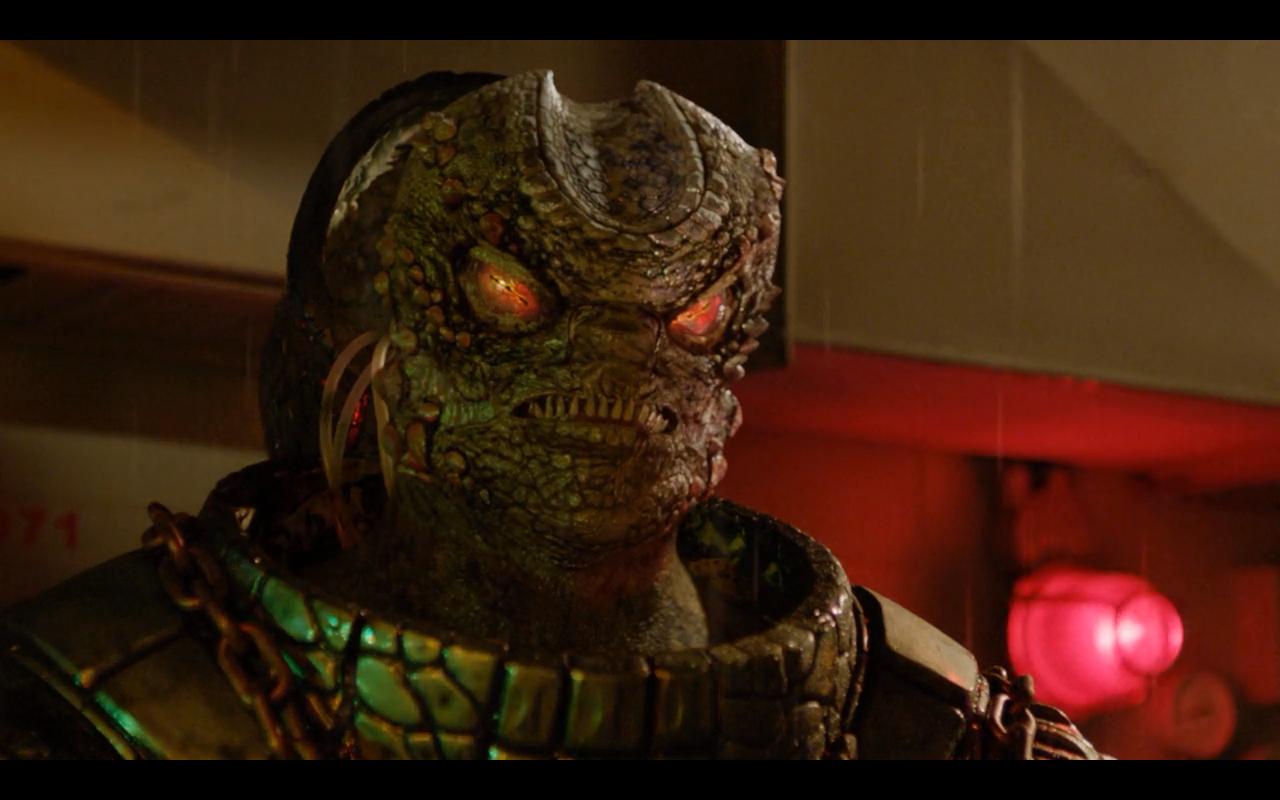
Grand Marshal Skaldak takes off his helmet. ("Cold War") ©BBC
The primary purpose of "Cold War" is indeed to bring back the Ice Warriors, and at this they do a good job.  The redesign is fairly minor -- the silhouette and colors are the same (beyond a more metallic sheen), although they've gotten rid of the "fur" -- and so Skaldak is instantly recognizable.  Gatiss has also incorporated some of the later character developments, so the Ice Warriors aren't evil per se, but Skaldak is portrayed as particularly militaristic -- but still with a sense of honor, which is in keeping with where we left the Ice Warriors.  (All that said, I still kind of miss the hissing voice.)  They even do one better, by finally confirming that the Ice Warriors wear armor and showing us the true face of a Martian.

Of course, that's where part of the problem lies; not the fact that they showed us an unarmored Martian, but that this leads to an extended sequence where Doctor Who "does" Alien.  In principle there's nothing wrong with that, but the fact of the matter is that they're going out at 6pm on a Saturday and so they can't make this as terrifying as it needs to be.  So while shots of the unarmored Skaldak creeping up on people and pulling them up into the ceiling are tense, they're not the pure unadulterated terror that's required to make this approach work.  We need to see the bodies and feel the fear for this to really come off, but they can't do that.

The other part of the problem is that Mark Gatiss gives us this background of heightened tensions between the US and the Soviet Union (this is explicitly set in 1983, the year of Able Archer and the Strategic Defense Initiative (aka "Star Wars")) and then hardly does anything with it.  There seems to be little in the way of rampant paranoia -- the only one who exhibits this is Stepashin, and he's portrayed as a warmongering nut -- and they don't draw any explicit parallels between the two situations (the global one and the one on the sub).  In fact, it looks like they start to go down a more interesting road, as Stepashin tries to convince Skeldak they're both alike and should help each other, but then Skeldak kills Stepashin off screen and leaves that road frustratingly untraveled.  So instead we get an unsatisfying Alien homage that leads to a standoff between the Doctor and Skaldak that could have happened at almost any point during the Cold War (the obsession with early '80s New Romantic music notwithstanding).

It's not all bad, of course; we've got a really great cast -- Liam Cunningham does a nice job as the more experienced Captain Zhukov, unwilling to push his men into war, and while Stepashin may seem overeager for a nuclear war, Tobias Menzies does a good job of playing this role -- to the point that you wish he'd stuck around a little longer (another reason to be annoyed by his unceremonious demise).  And they've finally gotten David Warner in front of the camera as Professor Grisenko (after his turn as the main villain in the animated "Dreamland" and a number of Big Finish stories (including an alternate universe Doctor)), and it's everything you'd want from him, a performance filled with dry wit and warmth.  (The best moment is when he questions Clara about the future: "Tell me what happens," he implores Clara.  "I can't," Clara replies.  "Well, I need to know," Grisenko replies mock-desperately.  "...Ultravox, do they split up?"247)  And Jenna-Louise Coleman continues to excel as Clara, being brave and scared at the same time and coming across as incredibly likeable.

If only there had been a more substantial plot to hang this all on, it could have been fabulous.  But here Mark Gatiss's urge to write pastiche falls flat here.  "Cold War" needed more than just reintroducing an old alien and giving us a new twist; it really needed to be about something.  The fact that it's not leaves you with an ultimately hollow feeling, craving something more substantial.


247 They do, but not for another four years.

June 24: "The Rings of Akhaten"

This is one of those stories that doesn't seem to get much love from fandom (233 out of 241 in the most recent Doctor Who Magazine poll), and I have to confess that I'm not certain why.  It's not like it's incompetently made or offensive or anything like that.  So why are people so down on it?

Merry the Queen of Years talks to Clara. ("The Rings of Akhaten")
©BBC
Is it to do with Clara's story, specifically the stuff before the titles?  What I mean by that is, the cold open shows the Doctor investigating Clara's history -- watching her parents meet, have Clara, followed by her mother's funeral246 -- and concluding that there doesn't seem to be anything unusual about her -- and yet she was also on a space cruise ship in the future and a Victorian governess in the past.  As the Doctor says, "She's not possible."  But then, after the titles run, this isn't touched upon again; the focus has completely shifted to Clara's first adventure in the TARDIS.  That's not to say that Clara doesn't do well with her first trip to a different time and place -- in fact, all things considered she copes astonishingly well -- but rather that the majority of the episode drops the exploration of the ongoing plotline in favor of the story around Akhaten.  If you were hoping for more revelations regarding the Impossible Girl, you would have been sorely disappointed.  But still, that's not the worst of problems, and it can't have been the deciding factor for everybody.  So what is it about the main story that people dislike?

Perhaps it's just the nature of the episode.  It isn't an action story, but it's not about the characters of our heroes either -- which does mean that quite a bit of time is spent exploring the environment, which I suppose can be dull if you're not in the right mood for such a thing.  And once we arrive at the threat, it does sometimes seem like it takes a while to get anywhere -- characters talk about what they should and shouldn't do rather than just doing it (which is an oddly retro style of television).  So perhaps you just wish they'd get on with it.

The "Old God" feasts on the Doctor's many experiences. ("The
Rings of Akhaten") ©BBC
If that's the case then I suppose there's not much to be done, but what, for me, makes "The Rings of Akhaten" work is that this is the least cynical Doctor Who story we've had in years.  Neil Cross's debut script for the show (well, sort of; he actually wrote "Hide" first, but this was broadcast ahead of that) is unabashedly about beauty and wonder and just experiencing things, and even when things are going wrong that philosophy pervades everything.  The people of Akhaten placate their god (which they refer to as "Grandfather") by singing to him (rather than anything more violent -- although I guess they do occasionally sacrifice people to him as well), and "Grandfather" is defeated via stories -- not just stories that happened, but the stories that will never happen, the potential left untapped.  It's a charmingly lyrical piece of storytelling.

And even beyond that, we're encouraged to look at this new world through Clara's eyes -- but not to stare; rather to experience the wonder of all these different peoples, to immerse yourself in the culture (prized possessions as currency, communal singing as prayer), and to marvel at how beautiful and wonderful the universe can be.

So yes, it's a bit slow at times, and it's hardly a strikingly original resolution, but "The Rings of Akhaten" is so invigoratingly optimistic and beautifully uncynical that it's hard not to be caught up in it.  It's not a standout story, but it's definitely a refreshing change of pace.


246 Clara's mother Ellie died on 5 March 2005, which happens to be the date that the ninth Doctor and Rose fought the Autons in "Rose".  Is there a suggestion that Ellie was killed by the Autons, or is it just a coincidence?

June 23: "The Bells of Saint John - A Prequel" / "The Bells of Saint John"

And now we've reached 2013 (Doctor Who's 50th year!) and the start of the second half of series 7.  And of course we have another internet prequel scene to pique your interest.  This one is simple -- it shows the Doctor on a swing, talking to a little girl -- but it drives home just how fabulously good Matt Smith is with children.  They have a nice little chat about how the Doctor is looking for someone ("Well, the first two times I met her, I just sort of bumped into her, so I thought maybe if I just wandered about a bit, I might bump into her again.  You know, like destiny, sort of," the Doctor says.  "That's rubbish," the girl replies.  "Yeah, I think it probably is," the Doctor agrees.  "Hey, maybe I could find a quiet room and have a good think about it instead" -- which we then see in the main episode is exactly what he does), and then the girl walks off, with neither of them aware that she's in fact Clara, the person the Doctor's looking for.  A quick but charming scene.

The main event, however, is "The Bells of Saint John": a cheeky title (the "bells" are the TARDIS's phone ringing -- the TARDIS, as you'll recall, having a "St. John Ambulance" sigil on the door) that nevertheless leads to an action-packed whirlwind of a tale.  This is our first proper look at the companion version of Clara (other than a brief moment at the end of the previous story), and fortunately she's not quite as perfect as the last two versions had been -- fortunately because that gives "our" Clara a chance to grow and develop and not be completely boring.  The Doctor finally finds her, after both trying the "random chance" and the "sit in a room and think" approaches (albeit in a room in a monastery in 1207 Cumbria), by pure chance -- Clara calls the TARDIS's phone after being given the number by "the woman in the shop"245, trying to get help with the internet on her laptop.  (Although Clara seems really helpless here -- is it really likely that a woman in her mid-20s in 2013 would be quite so hopeless with connecting to the Wi-Fi?)

That's the (deliberately contrived) setup, but what follows is really quite wonderful.  "There's something in the Wi-Fi," the Doctor tells us, and while it does seem somewhat fanciful, everyone treats it with sufficient seriousness to make you believe in the idea of a company out there stealing people's minds/souls via Wi-Fi, all for a sinister client: the Great Intelligence (we learn at the end) has been feeding off these minds to sustain itself.  (It's a link that's hinted at earlier in the episode, as the walking base stations -- the "Spoonheads" -- repeat back what's said to them, much as the Intelligence did with young Walter Simeon.)  This means that it has a lot of "agents" out in London, and it's not happy that the Doctor has pulled Clara out of their network before she can be fully downloaded.

(Incidentally, we get a slightly different outfit for the Doctor: the basic feel is the same (coat, bow tie, braces, etc.), but we get a longer purple coat and a darker bow tie.  Nevertheless, it still feels like a natural fit for Matt Smith's Doctor.)

The Doctor rides a motorcycle out of the TARDIS, ready to take
Clara to breakfast. ("The Bells of Saint John") ©BBC
From there it's a mad dash around, with possibly the best bit being all of London going dark except for the area Clara's in, which has a big plane heading for a crash landing -- which leads to the Doctor materializing aboard the plane (in a really wonderful shot from director Colm McCarthy, as they head into the TARDIS, dematerialize, and rematerialize and head straight into the plane) and stopping it from crashing.  But there's also the Doctor's confrontation with Miss Kizlet at the coffee shop, with Kizlet taking over the bodies of everyone in the shop.  Or the Doctor's motorcycle ride up the side of the Shard.  Or the reveal that he's gotten a Spoonhead to confront Miss Kizlet and her gang, while he's comfortably still in the shop.  Once this episode really gets going, it never stops, and all the set pieces link together in a very satisfying way.

In some ways, "The Bells of Saint John" has two jobs: introduce the companion version of Clara, and provide the equivalent of a spectacular series opener.  At both jobs it succeeds admirably.  This is Doctor Who as pure fun, with little angst and a lot of entertainment.  "The Bells of Saint John" is a great, highly enjoyable episode, getting the 2013 run off to a fabulous start.


245 The mention of this convenient arranged meeting is largely thrown away here, but they'll finally explain it in the series 8 finale.

June 22: "The Battle of Demons Run: Two Days Later" / "The Great Detective" / "Vastra Investigates - A Christmas Prequel" / "The Snowmen"

So I'm cheating a bit: strictly speaking, "The Battle of Demons Run: Two Days Later" didn't air until shortly before "The Bells of Saint John", three months after "The Snowmen" -- but as it makes more sense to view it here, that's what I'm doing.  It's not even that exciting a scene, to be honest; it shows Vastra and Jenny talking to the revived Strax and offering him a choice to go with them (back to 1888, so four years before "The Snowmen"), so that he won't be alone.  It's probably not a scene that needed to be explicitly stated, but I suppose it's nice to have the bases covered.

The next couple mini-episodes, "Vastra Investigates" and "The Great Detective", explicitly precede "The Snowmen".  "The Great Detective" aired during 2012's Children in Need telethon, and features the Paternoster Gang (as Vastra, Jenny, and Strax are referred to here) in Victorian London, trying to interest the Doctor in investigating weird happenings around the town, but he'll have none of it: "Why do you keep doing this?  What is the point?  I have told you.  I keep telling you, I don't do this any more.  I've retired."  This sets the stage for the Doctor's attitude in "The Snowmen".  The other prequel, "Vastra Investigates", simply shows that the Paternoster Gang helps Scotland Yard with their more unusual investigations (almost like a proto-UNIT), and that the Doctor still is unwilling to help out.

All this sets the stage for the 2012 Christmas episode, "The Snowmen", which is the first Steven Moffat Christmas special to not explicitly be about Christmas.  It's set at Christmas in 1892, but this is simply a backdrop for a more typical Doctor Who tale (as opposed to the previous couple, which really have been all about Christmas).  Steven Moffat appears to be taking an old rejected Douglas Adams idea -- that of the Doctor retiring but people keep bothering him for help -- as his starting point.  This is a much more somber Doctor than we're used to, one who appears to still be grieving over the loss of Amy and Rory and who has largely isolated himself from society (although it's worth nothing that he nevertheless chose a place with friends nearby, rather than complete hermitage).  His costume also reflects the change, as he's wearing a long purple coat with fur lapels, a necktie instead of his trademark bow tie (at least, until he finally comes down from his cloud and starts helping again, realizing along the way that he'd unconsciously put the bow tie on again), and a rather crumpled top hat.  He's also still wearing the round Lennon-esque glasses that Amy had in "The Angels Take Manhattan".  This is a Doctor who seems older and less inclined to stick out.

In contrast, we have a "new" character, Clara.  I say "new", but it's Jenna-Louise Coleman again, playing a similar character to Oswin in "Asylum of the Daleks".  Here she's shown as just as clever as Oswin was, albeit in a different way -- she's a lower-class barmaid who's also an upper-class governess, and thus highly adept at fitting into her surroundings and being the best at whatever she puts her mind to.  This includes tracking down the strange man who's just suggested that perhaps a suddenly appearing snowman happened because "it remembers how to make snowmen" -- a facetious answer, although we learn that's actually the truth.  Clara is unwilling to simply let this person slip away, so she chases him and learns he's called the Doctor.  And from there it's straight into the opening credits.

Dr. Simeon and his snowmen. ("The Snowmen") ©BBC
There's definitely a sense of change in the air in this episode.  A new title sequence (which is both contemporary and oddly retro, with what looks like bright orange lava lamp patterns mixed with magenta starfields -- and there's a deep-seated thrill at seeing Matt Smith's face in the titles, marking the first time the Doctor's face has appeared since 1989), subtly new logo (this one looks like snow -- the last time they'll do this), new theme arrangement (this one is much more percussive-feeling, with the bass line given greater prominence than the last time), an utterly gorgeous new console room (making it look less "whimsical" than the previous version and far more like a proper ship), and other changes dotted throughout the episode give this one a feeling of importance, of something waiting on the horizon.  This is a theme that's reflected throughout the episode, as we constantly get the impression of a hush before the storm, instead of running through the middle of it.  Part of that might be because the main villain, Dr. Walter Simeon (as played by former almost-Doctor Richard E. Grant (Scream of the Shalka)), spends much of the episode waiting for the right moment, for the Ice Governess to emerge from the frozen pond, rather than hatching elaborate plans for the Doctor to thwart.  It's also likely because the Doctor and Clara spend a lot of the episode not-quite-meeting after their initial encounter (which includes a humorous sequence involving Strax and something called a memory worm), which means the plot dances around the two, with Clara trying to enlist the Doctor's help and encountering Madame Vastra instead.

This isn't an explosive, action-packed Christmas special; instead, like most of the stories this series, it's a more intimate affair, concerned with characters and their relationships.  Clara is presented as an ideal companion for the Doctor, one to pull him out of his "sulk", and while this might be almost unbearable in the wrong hands, in Jenna Coleman's it becomes charming and somehow right -- of course she should travel with the Doctor.  Which is why (given her chemistry with Matt Smith and the fact that she'd been announced as the new companion) it's something of a shock to see her die in this.  "Asylum of the Daleks" was a one-off, a teaser, but this was supposed to be the proper debut of the new companion, so it's a genuine surprise to learn that it's not, that it's another mystery -- albeit one connected to the last, as the Doctor finally realizes that Clara and Oswin ("SoufflĂ© Girl") were the same person (thanks to them both saying the same thing as they died: "Run, you clever boy, and remember").  It's an interesting way to make the audience intrigued and curious about the upcoming second half of series 7, and it works.

None of this, mind, marginalizes the main enemy of this story, Dr. Simeon and his mimicking snow.  It's a conceptual threat that ends up being something of a prequel to two Troughton stories (those with sharp eyes and HD televisions might have made out the words "Great Intelligence" on Simeon's business card early in the episode, but for everyone else it's made explicit at the end ("The Great Intelligence.  Rings a bell..." the Doctor remarks thoughtfully afterwards).  Richard E. Grant is suitably sinister as Simeon, even if he does seem a bit underutilized (he's largely there to repeatedly ask for the Ice Governess and to talk to the telepathic snow), and it's a joy to have Sir Ian McKellen as part of the show, voicing the Great Intelligence.  The scene with the Doctor confronting the two of them at the end is nice (even if the "snow turns to tears" resolution doesn't quite feel right), and it's cheeky to have that reference to The Web of Fear in there (the London Underground stuff).244

It's a strong story, with some fabulous characters and a lot of great direction (including our first-ever pass from outside the TARDIS to straight inside the doors into that new console room in one shot) that contributes to a very satisfying atmosphere.  The mystery of Clara is set up well, and the use of the Great Intelligence is quite lovely.  This is definitely the best Christmas special of Matt Smith's era, and possibly the best one of them all.


244 It does kind of look like the production team knew about the discovery of four of the five missing episodes of The Web of Fear, but if so, it would mean they knew about it well in advance -- the readthrough for "The Snowmen" was in August 2012, while the announcement of the recovery wasn't until October 2013.  It's perhaps more likely that they'd heard some of the rumors flying around (combined with Neil Gaiman's original idea that "House" in "The Doctor's Wife" was actually the Great Intelligence, which would have put the thought in Moffat's head) and decided to bring the Intelligence back.
June 21: "The Angels Take Manhattan" / "P.S."

(Our last look at this title sequence, with a lot of blues and silvery greys and a logo tinted verdigris...)

It's got logical problems and plot holes you could drive a truck through (how can the Statue of Liberty make it to Winter Quay -- how can there be no one in the City That Never Sleeps looking at the statue for the duration of its walk to Manhattan?  If the Doctor can't get back to New York to rescue Amy and Rory, why can't they just go somewhere else instead so the Doctor can pick them up?), but it doesn't really matter.  Steven Moffat has chosen to send Amy and Rory out not on a big epic daring story, but on a quietly creepy one that is utterly determined to yank on your heartstrings as hard as it can.

Having provided us with an army of Weeping Angels gathering their strength in "The Time of Angels" / "Flesh and Stone", here Moffat chooses to go back to a different idea from "Blink": that Angels feed off your time energy by sending you back in time (presumably to a time and place where you won't make much difference) and harvesting the potential left behind.  To that end we're presented with a human "battery farm" for the Angels to feed off of: they grab you, stick you in a big apartment building, and force you to live your life there.  It's a creepy idea that lies at the heart of the story.

But since we're in New York City (For real!  Actual proper NYC!), we also get a nice dose of that film noir feel, with '30s detectives, dark wet New York streets, and an overweight, rich collector (Mike McShane), who's probably the closest thing to Sydney Greenstreet they could get.  (This is after a sequence in 2012 New York -- you know, the sequence with the least realistic thing ever in Doctor Who242 -- that's designed to show off New York's cosmopolitan side as much as they can.)  We even get a pulp-y narrative in the form of Melody Malone's book, which also serves as a clever plot point; because it's narrating things that are currently happening, looking at the book constitutes solidifying history, making it a fixed point.  ("This isn't any old future, Amy, it's ours," the Doctor says.  "Once we know what's coming, it's fixed.")

Rory and Amy prepare to jump. ("The Angels Take Manhattan")
©BBC
This is of course Amy and Rory's last story, but nevertheless it's Matt Smith's performance that is the most riveting.  Not that he's exactly a slouch in other stories, but here he's a whirlwind of frustration and pain, trying desperately to change history and ultimately unable to do so.  His scenes with Amy and the book are wonderful, his foot stamp of frustration after he's learned that River's wrist is broken and she's angry at him for using regenerative energy to heal her (presumably because she's (sort of) part-Time Lord), his utter anguish at the thought of losing Amy forever... it's incredibly good.  Smith sells the emotional climax of the story possibly more than anyone -- and given that Karen Gillan isn't exactly phoning it in in her last scene, you get a sense of just how good this cast is.  From Arthur Darvill's terrified-yet-brave performance as Rory ("If this place never existed, what did I fall off of?" he says, standing on the ledge.  "You think you'll come back to life?" Amy replies heatedly.  "When don't I?" Rory replies, with a touch of sardonic wit) to Alex Kingston's reined-in River Song ("Never let him see the damage.  And never, ever let him see you age.  He doesn't like endings"), the acting alone makes "The Angels Take Manhattan" a fabulous piece of work.

And that's really what this episode is about: the relationships and the performances that this cast has built up over the past three years.  To have defeat snatched from the jaws of victory is a cruel trick, but it feels right -- and as the Angels "kill you nicely" (as the Doctor noted in "Blink"), Amy and Rory are allowed to live out the rest of their lives.  Isolated from friends and family, but nevertheless together.  It's a bittersweet moment, but it's fitting (particularly given the way the Doctor has been coming and going into the Ponds' lives -- a simple parting would never feel right) -- and that's when the episode really goes for it, with the final "afterword".  It's a beautiful way to end Amy's story, to reveal that the Doctor did actually go back to the young Amelia after she waited that night, that he didn't leave her completely hanging.

So this is goodbye to Karen Gillan and Arthur Darvill, and it is sad to see them go.  I wasn't quite sure about Amy in the early days, but she quickly settled down to become a really outstanding companion -- she and the Doctor always felt like a great team, one that just naturally fit together.  And with the supremely talented Darvill thrown in (Rory is personally one of my favorite companions), the dynamic didn't shift too far in one direction or the other but instead cohered into a smooth, natural fit.  It is genuinely sad to see them go, but that's the nature of the show: always moving forward.  And while "The Angels Take Manhattan" brings an end to Amy and Rory's story (and to the first half of series 7 -- or "Series Pond", as Doctor Who Magazine took to calling it, given the large gap between the two halves243), it does so in a supremely confident (even if not always logical) way.

But there's one last piece to get view.  The original plan for the series 7 boxset was to include a brief scene called "P.S.", but ultimately this fell through due to "actor availability clash" (according to author Chris Chibnall's Twitter account) -- which almost certainly means Mark Williams was unavailable.  But somebody liked this enough to show us some storyboards, with narration by Arthur Darvill, and it was released online by the BBC as such.  It's not even a deleted scene, really, but it gives some nice narrative closure to Rory's dad Brian, who was essentially left hanging at the end of "The Power of Three".  "P.S." shows us Brian reading a letter from Rory, explaining that he and Amy have gone away and won't ever be coming back but that he loves his dad very much, and the gentleman delivering this letter, Anthony, is their adopted son -- and therefore Brian's grandson.  ("He can tell you everything," Rory writes in his letter.  "He'll have the family albums, and I realise having a grandson who's older than you is so far beyond weird, but I'm sorry.")  It's a short scene, but it does provide a nice sense of closure for Brian (and is rather fitting for today, what with it being Father's Day in the United Kingdom and the United States).

Next up: Christmas 2012 and "The Snowmen"...


242 The New York Record (not a real newspaper)'s front page headline reads "Detroit Lions Win Superbowl [sic]", which feels like a cruel joke at the state of Michigan's expense.  (Although admittedly, in our universe the Lions did have their first winning season that year since 2000, so things were at least looking up, but if you know anything about the Detroit Lions you can immediately see how implausible this is.)
243 You sort of see their point, but the entire series was commissioned and filmed in one unit, which is why just about everyone else treats it as a single series.

June 20: "The Power of Three"

This week, a time vortex recolored in shades of blue and magenta, with lots of little cubes in the Doctor Who logo...

So yes, the big reveal of the purpose of the cubes is rather vague, and there's a sense of things being unresolved at the end (as the Doctor has stopped the cubes, but not the Shakri themselves), but that's not really the point of "The Power of Three".  No, this story is explicitly about the relationships between the characters, what it's like for Amy and Rory to essentially have two lives, and what's it like for the Doctor to hang around for a while.  And unlike other episodes that have examined some of these questions, "The Power of Three" is emphatically determined to have fun along the way.  As such, the alien plot is almost secondary.

Admittedly, it's that "alien invasion?" angle that motivates much of what we get here, as a huge number of small black cubes suddenly appear one day all over the planet, leading the Doctor to wonder what's going on, but this is much more interested in the effect on our heroes.  Amy and Rory have become used to having these two lives -- "real life and Doctor life", as Rory puts it -- but it's fascinating watching the Doctor try to adapt to "real life", because he's rubbish at it.  Well, it's more that he can't stand the waiting, but either way, it gives us an insight into the Doctor's mind, how he'd much rather charge around than just sit back.  Meanwhile Amy and Rory are trying to live their lives ("What?  You've got a job?" the Doctor asks Rory, somewhat incredulously.  "Of course, I've got a job," Rory replies.  "What do you think we do when we're not with you?"  "I imagined mostly kissing," the Doctor says), while trying to handle the Doctor and the cubes at the same time.  It's presented humorously, with a deft touch, and so it never strays too far one way or the other.

Plus we get introduced to a new character, Kate Stewart241, who now seems to be the head of UNIT.  It doesn't come as any great surprise to learn that she is in fact Brigadier Lethbridge-Stewart's daughter (she dropped the "Lethbridge" because she "didn't want any favours"), but it is slightly surprising, given her father, that she's of a scientific bent.  It's good that she seems to have repositioned UNIT as more of a force for good again (as opposed to the UNIT we'd heard about in earlier stories and particularly in Torchwood), and Jemma Redgrave plays Kate with a slightly sardonic wit, as if she's only tolerating much of UNIT's goings-on and still hasn't completely gotten them to where she wants them (her opening speech points at this), and it's really all rather wonderful.  "I like her," Amy remarks, and I have to agree.

After 361 days, Brian sees one of the cubes move. ("The Power of
Three") ©BBC
And of course we also see the return of Rory's dad Brian (who's thus the only Pond/Williams family member to make a return appearance -- they go to all that trouble of giving Amy a mother and father in "The Big Bang" and then we never hear from them again), who's surprisingly willing to help the Doctor out -- maybe all that traveling he did (as we learned at the end of "Dinosaurs on a Spaceship") made him grateful to the Doctor.  In any event, Brian is presented as loyal and persistent and unwilling to give up -- note how he goes through almost a year of his video log about the cubes, presumably without fail -- but also concerned about his family.  "What happened to the other people who travelled with you?" Brian asks the Doctor, after he notices that Amy and Rory have been gone in the middle of their anniversary party (an excursion that apparently included an adventure in 1890 with Zygons -- something of a tease at the time, as Zygons were high up on many people's wish list for returning aliens).  "Some left me.  Some got left behind.  And some -- not many, but -- some died," the Doctor replies.  It in fact seems to be this conversation that convinces the Doctor to stay behind, to try and experience life through his friends' eyes, rather than have them experience life through his eyes.  And happily, Brian is willing to see the other side of things -- unlike, say, Jackie Tyler or Francine Jones -- as he says at the end, "It's you they can't give up, Doctor.  And I don't think they should.  Go with him.  Go save every world you can find.  Who else has that chance?  Life will still be here."

Of course, this is a bittersweet moment, because we know Amy and Rory are leaving in the next episode, so Brian's command to the Doctor ("Just bring them back safe") is loaded with more irony than it otherwise would have been.  And while the stuff with the cubes is actually quite entertaining, there's still that Shakri problem left dangling.  (Did blowing the ships up solve everything?  Or will they be back to wipe out humanity?)  But as a celebration of Amy and Rory, showing them happy and content and comfortable, as we get us an episode viewed primarily through their eyes, "The Power of Three" provides us with a lovely time before the end.

Mind you, that last line is pretty terrible.


241 Kate Stewart actually began life in a semi-official video called Downtime (there played by Beverly Cressman), which featured the return of an awful lot of people but especially Victoria Waterfield and the Great Intelligence -- she cropped up a few more times in novels and such before reappearing in "The Power of Three", but she seems to be intended to be the same character, making her one of the few to successfully transition from non-televised Who to the main show.

June 19: "The Making of the Gunslinger" / "A Town Called Mercy"

The episode's prequel gives us a look into how exactly the "Gunslinger" came about, with Kahler scientists and doctors (including Dr. Kahler-Jex) augmenting him under the false pretext of being "selected for peacekeeping missions on off-world colonies".  It's interesting because it gives us a look into Kahler-Jex's thought processes before any regrets subsequently appeared, and it gives us a good lead-in for "A Town Called Mercy".

One thing I keep forgetting to mention is how the title sequence has been changed.  A re-tinted time vortex (now in frankly hideous shades of blue and green), new font for the credits, and a slightly different logo -- no more DW TARDIS, and in fact a slight alteration for the logo every time thus far to reflect that particular episode: bronze with Dalek bumps for "Asylum of the Daleks", green scales for "Dinosaurs on a Spaceship", and this time, a rough woodgrain pattern for "A Town Called Mercy".  Yes, 46 years after The Gunfighters, it's time for Doctor Who to tackle another Western.

It helps that it looks utterly gorgeous.  They've gone off to AlmerĂ­a, Spain, where an awful lot of Westerns have been filmed (include Sergio Leone's Man with No Name trilogy240), and the result is fabulous.  No soundstage or Cardiff locations substituting for the American West here; instead we get beautiful landscapes and a convincing frontier town.  And they've even gotten some American actors to help sell things (instead of the more typical practice of having British actors fake a Transatlantic accent), which is nice.

Kahler-Jex prepares to be killed by the Gunslinger. ("A Town
Called Mercy") ©BBC
But what's also interesting about "A Town Called Mercy" is the moral arguments that pervade the piece.  Kahler-Jex is a war criminal, but one who's attempted to atone in some small way for his crimes, helping the town of Mercy with a cholera outbreak and rudimentary electric light and heat.  It seems in some ways that Kahler-Jex wants to put the actions he performed during his war behind him, that he's unhappy about the choices he's made ("You think I'm unaffected by what I did?" he says.  "That I don't hear them screaming every time I close my eyes?"), but as the Doctor points out, "You committed an atrocity and chose this as your punishment ... but justice doesn't work like that.  You don't get to decide when and how your debt is paid."  But then the Doctor is hardly blameless -- he's willing to hand Kahler-Jex over to the Gunslinger, to be the judge and jury, ready to turn him over to the executioner.  (Admittedly, this is apparently because Kahler-Jex gets under the Doctor's skin -- "Looking at you, Doctor, is like looking into a mirror, almost.  There's rage there, like me.  Guilt, like me.  Solitude.  Everything but the nerve to do what needs to be done.  Thank the gods my people weren't relying on you to save them" -- but it's still a surprising decision.)  Rory is on the Doctor's side, so it's up to Amy to stop him:
AMY: This is not how we roll, and you know it.  What happened to you, Doctor?  When did killing someone become an option?
DOCTOR: Jex has to answer for his crimes.
AMY: And what then?  Are you going to hunt down everyone who's made a gun or a bullet or a bomb?
DOCTOR: But they keep coming back, don't you see?  Every time I negotiate, I try to understand.  Well, not today.  No.  Today, I honour the victims first.  His, the Master's, the Daleks', all the people who died because of my mercy!
AMY: You see, this is what happens when you travel alone for too long.  Well, listen to me, Doctor.  We can't be like him.  We have to be better than him.
And fortunately Amy is able to bring the Doctor back to sanity -- Jex should face justice, but that doesn't mean vigilante justice.  It's not their place to try Kahler-Jex, but it is their place to keep the inhabitants of Mercy safe.  ("This is their home, not the backdrop for your revenge," the Doctor tells the Gunslinger later.)  This does mean that the ending of the episode sags ever so slightly (as people in the town disguise themselves as Kahler-Jex by painting the tattoo on their faces, to confuse the Gunslinger long enough for Kahler-Jex to escape) but it's frankly done so well up to this point that it's easy to forgive.

"A Town Called Mercy" is a surprisingly nuanced episode, interested in examining the moral dilemmas it presents and unwilling to provide any genuinely easy answers -- even Kahler-Jex's "escape" at the end is by committing suicide, enough of a coward to not simply hand himself over to the Gunslinger and unwilling to see another group of people caught in the crossfire.  It's a thoughtful episode, nicely introspective but with enough excitement to keep things moving.


240 A Fistful of Dollars, For a Few Dollars More, and The Good, the Bad, and the Ugly.