August 26: The Invasion of Time Parts One & Two

The first thing that strikes you about The Invasion of Time is how fast it moves.  (Well, all right, maybe not the first thing, but close.)  This story flies in comparison to Underworld: we move from the Doctor forming an unholy alliance of some sort to being inaugurated as President in the space of 24 minutes.

That alliance is also particularly intriguing, as it seems to set up the Doctor as the villain of the piece.  "You promised complete control over the Time Lords," he says to the mysterious party he's meeting with.  "... I'm honoured to be allowed to serve your glorious cause."  And from this moment on, the Doctor is behaving distinctly erratically, with sudden mood swings from friendly to near-apoplectic to deadly calm.  He refuses to let anyone know what's going on, preferring instead to boss everyone around as he demands to be installed as the President of the Supreme Council of the Time Lords (being, at the end of The Deadly Assassin, the only viable candidate remaining).  It's a fascinating approach -- we know the Doctor must be up to something (right?), we just don't have any idea what.  It certainly looks like he's planning to betray the Time Lords...

The Invasion of Time is one of those rare things in early Doctor Who: a loose sequel to an earlier story (The Deadly Assassin -- but you already knew that).  Of course, other than using events from The Deadly Assassin as a jumping-off point, there's not too much overt sequelness on display: some of the sets look similar (even if they're lit significantly differently), and Borusa is back (albeit as a different actor), and there's some reference to the Matrix.  And that's about it.  It's slightly surprising that they didn't try to get any of the actors from the earlier story back (well, they apparently did try to get Angus Mackay back as Borusa, but he was busy), as it might have made the connections stronger.

But that's okay.  These first two episodes are ultimately Tom Baker's, and while there is the occasional misstep (such as the infamous "even the sonic screwdriver won't get me out of this one" line, which Baker delivers to the audience), for the most part he excels, continually wrongfooting the audience as to his motives and holding us entranced with his performance.  That uncertainty as to his motives also keeps things moving, and moments such as the one where he discusses with K-9 the probability of his plan succeeding, which almost look like it could go either way as to his loyalties, go a long way in maintaining interest.

Plus, episode two features one of the all-time best cliffhangers (and my personal favorite) in the entire series: after K-9 destroys the barriers that keep Gallifrey isolated from the universe, the Doctor calls a meeting of the High Council.  "Gentlemen, this is no ordinary meeting," he declares.  "I'm privileged to introduce to you your new masters."  And as odd-looking shimmering shapes appear, we see the Doctor laughing evilly, and we really start to wonder just what is going on.  Has the Doctor really become a villain?  You really want to tune in next time to find out.

August 25: Underworld Parts Three & Four

The Doctor and Leela listen to Idas's plight. (Underworld
Part Three) ©BBC
Part three might be the best episode of the bunch -- it certainly seems to have the most going on, with the Doctor, Leela, and a local Trog called Idas breaking into the Tree at the End of the World at the center of the planet (which has a convenient shaft that they're able to gently float down (due to the low gravity), complete with incredibly inappropriate elevator-style incidental music) while the Minyans try to make their way to the race banks in the P7E.  This means there are some acceptable battles, such as Herrick's defense of the retreating Minyans, and the scene where the Doctor gets everyone out of the control room of the P7E and then rallies them together to figure out how to get back inside the P7E to the race banks gives one a glimpse of how epic this story wants to be (despite being on another CSO backdrop -- but again, none of them are that bad here, and in fact the "can't tell which tunnel is which" problem has gone away).  The interrogation of Herrick is also a nice touch, and the revelation that the servants of the Oracle are robots is a good one.

Unfortunately, part four spoils it rather by solving things too early, giving Herrick the race banks without a fight.  Of course, this turns out to be a ruse, but it means that there's a lot of doubling back with the real race banks and the false race banks (actually fission grenades) that feel more like padding than genuine incident or peril.  This does mean that this last episode therefore drags a bit, even if it does mean that the Doctor is able to rescue all the Trogs before the P7E is destroyed.  Nice planet explosion though.  But yes, everyone is saved, and in case not everyone's worked out what's going on, the Doctor points out the similarities between this story and that of Jason and the Argonauts.

And maybe that's the main problem with this story.  The Hinchcliffe years took older Gothic horror tales (Frankenstein, mummies, those sorts of things) and similar stories and used them as jumping-off points to tell their own stuff.  Underworld wants to do the same type of thing with an older, more epic story, but unfortunately it doesn't really have anything to add to the original.  If this is indeed supposed to be the Argonautica or a related story, it has an odd way of going about it -- we see almost nothing of the problems encountered by the Argonauts on the journey to and from Colchis, and the Golden Fleece has been reduced to a couple small cylinders.  It's also a rather jumbled version -- it's not clear what Persephone and the underworld have to do with Jason's quest, and a lot of it just feels like a hodgepodge of Greek myths just for the hell of it.  There's no sense of import to events here; it's as if they've decided that taking an ancient Greek story and chucking SF elements in it is good enough.  It isn't.

And, perhaps most frustratingly, Bob Baker & Dave Martin miss a huge trick in the relation between the Doctor and the Minyans.  The Time Lords are the Minyans' gods!  That means that one of their gods is walking among them, assisting them and chatting with them, and yet none of them react as if this is in any way unusual or awe-inspiring.  No, instead it's just business as normal as the Doctor wanders around some tunnels and eventually saves the Minyans and their future.  Not once does anyone bow down in worship, or treat the Doctor as special in any way.  If they'd gone this path, even a little, it might have lent the story the epic quality it's lacking.

But look, there's not really anything wrong with Underworld.  There are some dodgy effects shots, and it's occasionally clear that most people are uncomfortable acting against plain blue backcloths.  Plus the script is often frustratingly unambitious at times.  But it's not the worst thing ever, and there are some nice moments scattered throughout to keep you interested.  Part three is actually pretty good, and Baker & Martin's knack for catchphrases appears here as well ("the quest is the quest").  And Alan Lake is clearly having a good time.  Yes, it's a bit silly and a bit dull at times, but what's perhaps more surprising is how well it works in places (the sacrifice scene in the P7E is nicely atmospheric, and the Doctor and Leela's cliffhanger at the start of part four is far better than it has any right to be).  It'll never top any polls, but Underworld is better than its reputation would have you believe.

August 24: Underworld Parts One & Two

Boy, Underworld sure takes a beating from fans, doesn't it?  It's one of those stories that seems to be almost universally reviled for some reason.  But, at least on the basis of these two episodes, it's a bit hard to see why.  Surely everyone can't be offended by the bad science?

Of course, the science is definitely...odd, to put it mildly.  You can just about swallow the idea of planets forming by all the rocky bits being attracted to pieces with more mass, thus causing more gravitational pull.  Almost.  A bit.  However, the fact that planets form on the edge of the cosmos when matter spews out of the nothing beyond the edge is rather harder to swallow.  The whole thing's like this too, but you quickly reach a point where you just have to suspend all disbelief and let it wash past you, so it seems unlikely that that's the reason so many people are cool toward this story.

It could be all the CSO that starts in episode two, but honestly, it's not really that bad (even allowing for the fact that the DVD has been cleaned up by the Restoration Team to lessen the fringing).  The main problems with it are that it's rather apparent that they're not really in cave sets, as the lighting's not quite right between the actors and the CSO backgrounds (although, to be fair, this is a problem that still crops up from time to time even today -- yesterday's episode "Deep Breath" having a couple examples of this), and that they only seem to have a handful of backgrounds to drop in, which occasionally makes it difficult to work out the geography of the place.  But that's about it, and if you can accept the other occasional questionable effects on Doctor Who then surely you can accept that?

Of course, none of this is to say that the episode is perfect.  There's a brilliant idea at the beginning of part one, where the Doctor reveals that the Minyans (the people crewing the ship the TARDIS has landed in) were affected by the arrival of the Time Lords.  "Well, the Minyans thought of [the Time Lords] as gods, you see, which was all very flattering and we were new at space-time explorations, so we thought we could help.  We gave them medical and scientific aid, better communications, better weapons," the Doctor says.  "What happened?" Leela asks.  "Kicked us out at gunpoint," the Doctor replies.  "Then they went to war with each other, learnt how to split the atom, discovered the toothbrush and finally split the planet."  That's such a good idea that they should have made the whole story about that, but instead it's used to give the Minyans some regeneration technology so that they can have plausibly lived for a hundred thousand years.  And this might be fine, except James Maxwell, as the ship's captain Jackson, has to tell the Doctor about how long they've been searching, and while it's intended to sound rather futile, Jackson sounds so intensely bored that it's hard to be interested in his story.  And, sadly, this seems to be the speed that all the guest characters are operating at -- with the exception of Alan Lake as Herrick, who's just about the best thing on display in Underworld thus far.  Well, that and the Doctor telling K-9 to shut up.  Not that I mind K-9 that much (despite his initial introduction in The Invisible Enemy), but it's an entertaining moment.

But come on, being a bit dull and squandering some potential aren't the worst of sins.  I suppose Underworld could take a hard turn for the worse in parts three and four, but as of right now its greatest problem is it's not as exciting as it needs to be.  And if that's the biggest problem you've got (and we're still leagues ahead of The Web Planet here), seems to me you're doing okay.

August 23: The Sun Makers Parts Three & Four

Today's Saturday, and while Peter Capaldi is making his debut tonight as the twelfth Doctor, I'm finishing up The Sun Makers.

Having established this society and its woes in the first two episodes, Robert Holmes sets about engineering a revolution via the Doctor and his new friends.  Of course, it's not just for altruistic, "humanity should be free" reasons: the Company has captured Leela (in a sequence that highlights the problems with shooting interiors on location on film, as it makes them obviously locations and thus there's less of a sense of being inside a building, at least according to the visual grammar of the show in this era) and prepared to execute her publicly via steaming, a particularly gruesome, non-fantastical-sounding death.  And that's largely it for this episode.  Part three also gives us some nice moments with the Doctor and his friends taking over Main Control (where the anxiety-inducing drug PCM is pumped through to all the work areas) and quickly convincing the two technicians working there to join the revolution, and there's also a subtle effort to make the people living in the Undercity more sympathetic and less nasty, so that we'll be more inclined to be on their side by the end.  Plus, this episode gives us a lot more of the Collector, as he gleefully looks forward to Leela's death ("This is the moment I get a real feeling of job satisfaction.  Are the microphones wired in?" the Collector asks.  "All round the condenser, most Merciful. We're looking forward to excellent duodecaphonic sound," Gatherer Hade replies, making, it seems an oblique reference to then-popular Quadraphonic sound (an early form of surround sound).  "Then we shall hear within a few seconds," the Collector responds happily) and slyly arranges for the Doctor's capture via an incentive of 5000 talmars paid to anyone who has information about him -- 5000 talmars out of Hade's account, which Hade seems none too pleased about.  Nasty cliffhanger, though, as Leela looks about to be killed by the steaming.

The Doctor confronts the Collector. (The Sun Makers Part
Four) ©BBC
Fortunately, she survives and heads back to Main Control with the Doctor (which includes, near the end of the sequence, an utterly bizarre moment where everyone calls out for K-9 for roughly thirty seconds before he reappears), and the revolution begins in earnest, as the PCM wears off and the workers start to go on strike.  This does lead to a genuinely unpleasant moment, though, as the workers grab Gatherer Hade and throw him off the roof to his death.  This might have worked better if Hade had been genuinely unpleasant, but we just see him act a bit like a buffoon and not really doing anything evil (beyond the excessive taxation).  It's thus a shock to see him killed so unpleasantly.

Meanwhile, the Doctor heads off to the Collector's palace and sabotages things before having a nice long chat with the Collector about things, and so we get a nice info-dump as a result: "Tell me, how did you get control of humanity?" the Doctor asks.  "A normal business operation," the Collector replies.  "The Company was looking for property in this sector, Earth was running down, its people dying.  We made a deal. ... We moved them all to Mars, after our engineers had made that planet habitable for their species."  "And then taxed the life out of them," the Doctor says reasonably.  "I mean, to recover your capital costs."  "Quite so, quite so.  Then, when the resources of Mars were exhausted in their turn, we created a new environment for them here on Pluto," the Collector says.  It's too late for the Collector, though; the Doctor had already fed into the system a "two percent growth tax into the computers; index linked," which ruins the economy and sends the Collector into such a shock that he dissolves in his chair and down into the workings inside; as a Usurian, see, the Collector is a type of poisonous fungi that looks "sea kale with eyes", and his human form was an affectation.  Still, humanity is no longer under the Company's thumb, and they can get on with resettling the Earth.  A petty moment in the TARDIS later (where the Doctor causes a tremendous lurch inside, causing the chess game he was losing against K-9 to topple over) and it's off to the next adventure.

It's not a terrible story by any means, but the tone of The Sun Makers is definitely uncertain.  The cast is starting to latch on to the jokes (and this is by no means the witty tax satire you've been led to believe -- other than a few moments in part one and the occasional reference here or there, the whole thing unfolds more or less the way one would expect a typical Who story to), and while it's not quite at the expense of everything else yet, it does lead to some odd and wholly unnecessary moments (such as the aforementioned K-9 "joke").  The problem is that, under that humorous surface material, there's a much darker story lurking.  The idea of being taxed to death (and beyond) is a new one for Doctor Who, and a lot of mileage could have been derived from exploring this further.  But because there's been an edict from above to make the show less scary, and because the design looks frankly rather cheap, the impact of this has been minimized, and what we're left with is a fairly well-written but ultimately generic story. 

August 22: The Sun Makers Parts One & Two

There's a school of thought that says that The Sun Makers is a political satire about taxation.  There are some jokes and references on the surface, sure, but at its heart (at least based on these first two episodes) it's about an oppressed society, like a number of other stories: the only difference here is that the main tool of oppression appears to be heavy taxation, rather than just troops with big guns stationed everywhere.

This is in many ways a bleak couple of episodes.  Citizen Cordo would rather commit suicide than be in debt to the Company, and there's some indication of how much disparity exists: Cordo is completely unable to come up with the outstanding balance of 31 talmars to pay for his father's death, while Gatherer Hade is willing to give the Doctor 1000 talmars in order to sustain an illusion of mistaken identity long enough for the Doctor to reveal the location of the other rebel leaders (Hade believes).  Meanwhile, the rebels living in the Undercity are just as despicable (if not more so), with the leaders more interested in self-preservation at any cost than in any more noble acts against the Company.  Only Goudry (as played by Michael Keating, soon to become rather more well-known as Vila in Blake's 7) has any sort of redeeming qualities, and he's just as concerned about not drawing attention to himself as anyone else.  The only honorable people we meet are Cordo and Bisham, the man being held in the Correction Centre with the Doctor.

The problem, however, is that that surface layer of jokes has led to a much lighter feel for this story than might have been intended.  Now obviously some scenes (including basically anything with Gatherer Hade) are meant to be lighter.  But one never really gets the sense that the people living underground are in any danger, and the Doctor and Leela never really feel like they're in danger either (not even in either cliffhanger).  And so we get a sense of a society that we're told is bleak and being controlled by drugs in the air, but we never really get to see any of the effects.

The other odd thing about this story is how we're on Pluto in the far future, surrounded by six artificial suns, and yet this becomes a background element almost immediately.  It obviously didn't help that it was miserably overcast on the days they shot outside, but there's a story in the mix about how even the light is something the citizens have to pay for, but it's never brought up.  All this and the haphazard set design (though, to be fair to designer Tony Snoaden, the design thought processes seem to have been changed halfway through the design stage, which leads to some odd juxtaposition of elements -- Aztec faces, giant fake-looking animal rib cages, and blown up circuitry (from AMD, you may have noticed) all fight for screen prominence, with little rhyme or reason) make this a story that seems like it's been put together in a rush.  Hopefully things improve in the last two episodes, but right now this feels like a story that's hoping that the tax jokes will distract people from the fact that this is a roughly-sketched-out oppressed society with no real threat or danger behind it.

August 21: Image of the Fendahl Parts Three & Four

The Doctor is saved by Leela, and off they go to regroup at Ma Tyler's cottage.  After establishing both that Ma Tyler is all right and that she has precognition (which the Doctor puts down to living near a time fissure -- "it's a weakness in the fabric of space and time.  Every haunted place has one, doesn't it?  That's why they're haunted.  It's a time distortion" -- and thus gives the viewers an offhand, pseudo-scientific explanation for ghosts), it's off to the fifth planet for some reason (padding, most likely -- we learn almost nothing from this side trip).  The bit in the cottage is still nice though.  "How do 'ee know so much?" Ma Tyler asks him.  "I read a lot," the Doctor replies.

The bits back at the Priory are much more interesting.  Max Stael seems to think that, by using Thea as a medium and bringing along some of the locals to help him, he'll be able to "conjure and control the supreme power of the ancients."  He noticed that the sonic time scanner woke up the power and Thea seems drawn to it, so he's all set.  And obviously he's not going to let anyone get in his way, so Adam Colby and Dr. Fendelman are taken down to the cellar at gunpoint and tied up to some columns.  Colby responds, rather wonderfully, by being more sarcastic than usual, while Fendelman seems more despondent -- possibly because he realizes what's going to happen -- particularly when he sees that Stael is using the ancient skull (with a pentagram in the crown -- another offhand explanation for something) as a power source. "You don't understand," he tells Stael urgently.  "I see now what will happen. ... The Doctor asked if my name was real.  Fendelman.  Man of the Fendahl.  Don't you see?  Only for this have the generations of my fathers lived.  I have been used!  You are being used!  Mankind has been used!"  (And never mind that Fendelman doesn't seem to have been around for any of the explanations about what the Fendahl is, it's still a good, well-delivered speech.)  This is where the story really starts to get into Quatermass and the Pit territory, with the implication that mankind's development has been influenced by this ancient skull in order to turn us into something for its own purpose.  Stael won't listen, though -- he shoots Fendelman in the head (off-screen, but there's a trickle of blood on Fendelman's temple when we cut back) and gets ready to claim the ancient power.

The Fendahl core and a Fendahleen. (Image of the Fendahl
Part Four) ©BBC
It all goes horribly wrong, though; Thea turns into a glowing golden figure, and a number of slug-like creatures called Fendahleen appear.  The Doctor and Leela are able to rescue Colby, but when it comes to Stael, it's too late -- he can't move, and he begs for a gun so he can end his life.  It should be a horrific moment, but it's played in such a way as to lessen the impact of what's happening: Tom Baker in particular seems incredibly unaffected by the gravity of the situation as he gives the gun to Scott Fredericks, but one wonders if that was to downplay this element for the audience (after all, The Deadly Assassin incident was only last year and new producer Graham Williams has been specifically told from above to tone things down).  Still, you can definitely see what Chris Boucher was getting at when he wrote it.

We finally get some answers from the Doctor as to what's happening in his conversation with Colby, as he rewires the time scanner to cause an implosion.  We learn that twelve million years ago, the Fendahl evolved on the fifth planet as a creature that fed on all forms of life, and the Time Lords tried to stop it by destroying and/or time-looping the fifth planet (it's not exactly clear which) -- only one of them escaped and made its way to Earth:
COLBY: Then it got itself buried, but not killed.
DOCTOR: The Fendahl is death.  How do you kill death?  No, what happened was this.  The energy amassed by the Fendahl was stored in the skull and dissipated slowly as a biological transmutation field.  Now, any appropriate lifeform that came within the field was altered so that it ultimately evolved into something suitable for the Fendahl to use.
COLBY: Are you saying that skull created man?
DOCTOR: No, I'm saying it may have affected his evolution. ... That would explain the dark side of man's nature.  But it's just a theory. ... Oh, if you want an alternative explanation, the Fendahl fed into the RNA of certain individuals the instincts and compulsions necessary to recreate.  These were fed through the generations till they reached Fendelman and people like him.
COLBY: Well, that's possibly more plausible.
DOCTOR: Or on the other hand, it could all be just a coincidence.
Thea's transformation into the Fendahl core (the Fendahl being a gestalt entity composed of a core and twelve Fendahleen) is pretty impressive; the large eyes painted on her eyelids works surprisingly well, particularly at a distance -- it's only in close-up shots that the effect is spoiled somewhat.  It's also an interesting choice to make something that's pure death look so beautiful and almost god-like, and it's one of the decisions that makes this story so compelling.

Fortunately, the Doctor is on hand to save the day, by taking the Fendahl skull and putting in it a lead-lined case and then rigging a gigantic implosion in the Priory to take care of the Fendahleen that exist -- the Fendahl being unable to gain full strength since two of the people needed to turn into Fendahleen were killed.  The universe is safe.

Image of the Fendahl is just about the last stab at Gothic horror in this era of the show, but it's a very effective piece of television.  The decision to make so much of this look like a high-quality science-fiction teleplay (as opposed to a typical episode of Doctor Who) elevates this, and the comparisons with Nigel Kneale's works are intended as a compliment.  It's so good, in fact, that you could take the Doctor out of things completely and still have a good story that would be almost unchanged until the final episode.  It's an intelligent script and a good production; it's not as wonderful as The Face of Evil, but this is another unfairly neglected story that's well worth your time.

August 20: Image of the Fendahl Parts One & Two

This first episode feels very unusual for Doctor Who.  The Doctor and Leela are barely in it, and the times when they are present, they're essentially divorced from the main plotline.  That plotline feels more like a Nigel Kneale piece (and the ancient, impossible skull has obvious parallels with Quatermass and the Pit), and all the characters involved feel fully formed, as opposed to foils for the Doctor to react against.  They're scientists who've discovered a homo sapiens skull buried in 12-million-year-old volcanic ash, and they're trying to work out why it was there.  Meanwhile, the body of a dead hiker has been found in the grounds nearby ("What sort of corpse?" asks the group's leader, Dr. Fendelman.  "A dead one.  What other sort is there?" replies Adam Colby101, the one who found the hiker), which Dr. Fendelman wants to keep hushed up for some reason -- as if they're doing something so terrible at the Priory that they don't want anyone to associate the death of a hiker with archaeology.  It's an odd position to take, is what I'm getting at.

This first episode is really all about establishing the mood.  We know there's a seemingly impossible skull, we know that Fendelman is working on a device that will let him see images of the past (due to a "sonic shadow"), and it seems that when the device is operating, the ancient skull reacts -- and seems to affect fellow researcher Thea Ransome (Wanda Ventham's second role on the show, and apparently her first since the birth of her son Benedict Cumberbatch) in strange ways.  There's an uneasy feeling about all this, and the lack of music actually heightens this feeling -- other than the titles, there's no incidental music at all in the first episode, and only a small amount in the second part.  But where that's been a hindrance in other stories (The Web Planet springs to mind), here it adds a feeling of verisimilitude that leads to that aforementioned sense of unease -- it's ever so slightly harder, given what we see, to dismiss this as simple fiction.

Weird cliffhanger, though: the skull is superimposed over Thea's face while she turns on Dr. Fendelman's machine, Leela is shot at with a shotgun, and the Doctor stands motionless in a field.  And the resolution is even stranger: the Doctor talks his legs into moving and he's able to run off.  Oh, and Leela dodges the shotgun blast.

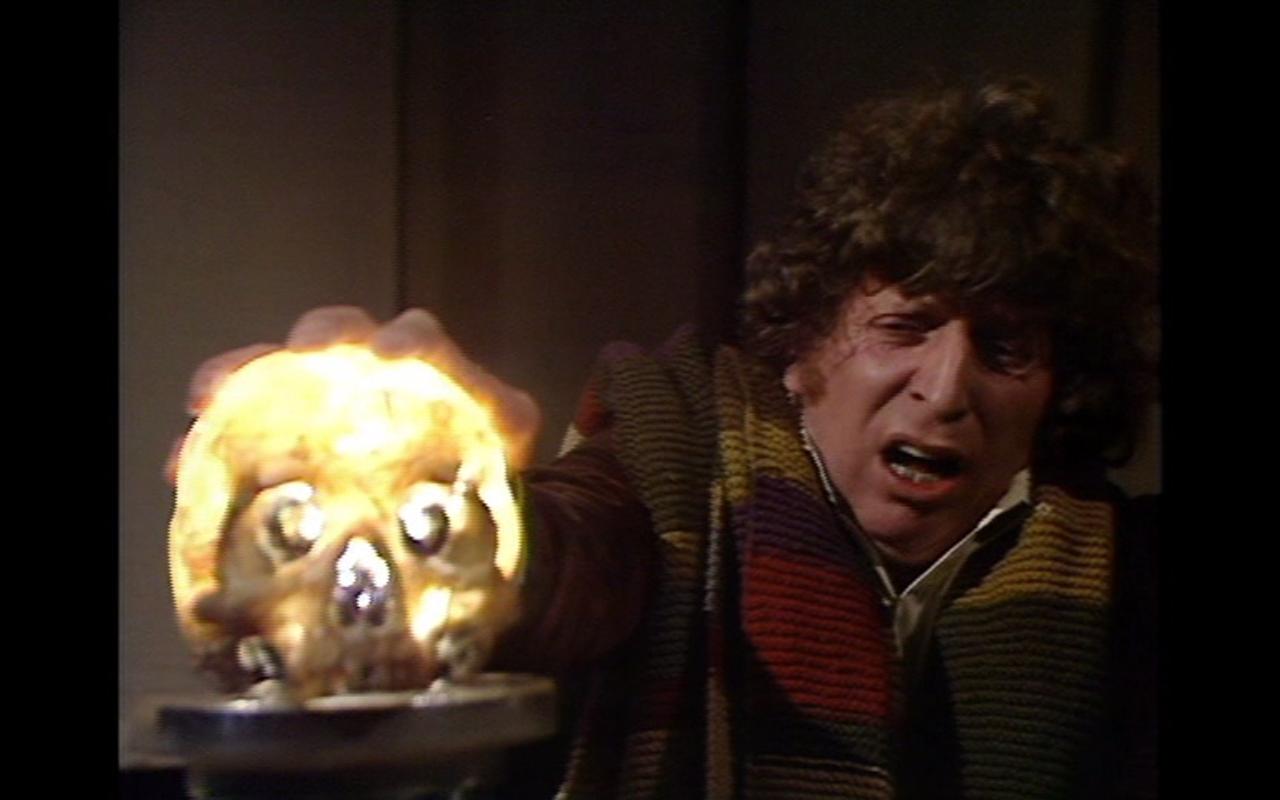
The Doctor is forced to grip the glowing ancient skull.
(Image of the Fendahl Part Two) ©BBC
The second part sees the Doctor and Leela more integrated into the action (and, as a random aside, Leela's hairstyle in this isn't very flattering -- allegedly the stylist took too much off and they had to put Louise Jameson's hair up to cover this), although it's Leela who seems to be doing better, as she's got a whole subplot with some locals and something about a coven or some such to deal with.  The Doctor seems to know a lot more about what's going on (note the way he instantly knows not to touch Thea, that Mitchell died the same way as someone else, and that the weird slug-like creatures that appear on Thea's fallen body look like embryo Fendahleen, "a creature from my own mythology"), but it doesn't really help, as he's quickly locked up in a storeroom and isolated from the rest of the house, with no way of getting out.  Well... except, in one of the great mysteries of Doctor Who, the door is unlocked and opened, without any indication whatsoever as to who did it.  (Although now we know it must have been Clara, as she traveled through the Doctor's timeline.)

Things aren't exactly going well in the meantime: Thea seems drawn to both the skull and Fendelman's machine, and Max Stael (the final researcher in the group) appears to be a member of that coven whose members were giving Leela trouble in the episode.  Interesting cliffhanger, though: after Thea switches the machine on, Thea is knocked out by Max and the machine is left on -- which means that the Doctor, who's been examining the skull102, suddenly feels compelled to grip it: an action which causes him some pain...


101 The second character on the show to bear the name Adam.  Well, I care.
102 As far as I can tell, this marks the first instance of the Doctor asking, "Would you like a jelly baby?" (in this case, facetiously to the skull) while actually offering a liquorice allsort.