October 19: Time-Flight Parts One & Two

I think it was Jonathan Blum who pointed out that it was in the previous episode that Adric died in a freighter crash in the late Cretaceous period, and although this story takes place in the late Jurassic (quite a time span away, but still), no one even mentions Adric's death after the opening TARDIS scene.  Even though there's a crashed spaceship nearby.

I bring this up because it illustrates one of the inherent problems with the show at this point in time: it wants to have more interconnectedness between stories, to have a longer-running story than just the four episode serials, but it does it in a shallow way.  There's a scene of grieving at the beginning, with the Doctor declaring that he can't go back and save Adric, and then it's on to business as usual; Adric might as well have been dead for months, for all Tegan and Nyssa seem to be subsequently broken up about it.

There are some nice ideas at work in Time-Flight proper; the thought of Concorde disappearing back in time is rather interesting, and there's some nice back-referencing to UNIT in part one, of the sort that's pleasing for long-term fans but not required for more casual fans to understand.  But the issue is that because this is the last story of the season, there's not much money left to spend on sets, and because this is such an ambitious script, the results look particularly cheap.  Air traffic control is one guy in a small windowless room, for instance, and while the Plasmatons aren't the worst creations ever, their appearance effect is an overlayed smoke funnel, and the effect of holding people prisoner consists of soap suds.  And you can hear everyone walking around the wooden rostrums "outside" in the Jurassic wilderness.

One thing that's pleasingly odd is the Arabic magician who brought them all back in time, Kalid.  There's something wonderfully bizarre about his performance, with his incantations and his threats toward the Doctor, and I find him terribly watchable.  And his death in part two is particular gruesome, with all the green slime bubbling out as Kalid dies.  It's actually a bit disappointing, since no one else in this production is really worth watching.  And then, in the part two cliffhanger, it's revealed that Kalid is in fact the Master!  Oh.  Well, ok then.  Now I don't understand where this story is going.

October 18: Earthshock Parts Three & Four

Today one of my best friends is getting married.  Congratulations Jason and Elizabeth!  I got you guys a dead companion!

Hold on, let's back up.

A Cyberman is frozen inside a door. (Earthshock Part Three) ©BBC
It turns out that most of the problems I have with Earthshock have to do with part four.  Part three continues to excite and interest, as we see the Cybermen on the move onboard the freighter, while the Doctor and Adric try to convince Captain Briggs that they're not responsible for the deaths of the crewmembers.  And there's also a subplot involving Lieutenant Scott and his troopers, accompanied by Tegan, working their way through the ship, trying to find the bridge while dodging Cybermen.  It coheres rather well -- although you can see why Beryl Reid takes flak for her performance; there are definitely times when she seems unsure of the dialogue she's being asked to deliver.  But I still think she does a nice job.

The Doctor's confrontation with the Cyberleader is also interesting; there's this curious moment where the Cyberleader says, "So, we meet again, Doctor," despite the fact that, as far as we've seen, no Cyberman has survived an encounter with the Doctor.  And we get that great cliffhanger, as a huge number of Cybermen begin marching through the freighter, all in sync.

"Now I'll never know if I was right." (Earthshock Part Four) ©BBC
Part four, as I mentioned, is where the problems really set in.  Things start happening for no obvious reason, and it's rather frustrating.  Why, for instance, is the second wave of Cybermen activated?  It looks like it's a fault, but there's also the question of why they weren't activated at the same time as the first wave; is the Cyberleader really okay with letting a large number of his troops be killed unnecessarily?  And how exactly does hooking an alien computer up to the freighter cause it to travel back in time?  If time had been spent coming up with some sort of explanation for these events, this could have been something special, but as it is it's just aggravating instead.

One thing that works better than it should is Adric's death.  Adric has, unfortunately, become superfluous to the needs of the TARDIS crew, and so his time had come to leave the show.  But what a way to leave!  Obviously one of the companions had to die, to show that traveling with the Doctor doesn't necessarily mean you're safe.  Matthew Waterhouse reportedly wasn't very happy with his character's fate.  But it's certainly a memorable way to leave, and the ending is quite affecting.

There are a lot of things to like about Earthshock.  The first three episodes are quite good, with good acting and some really great direction from Peter Grimwade, and some outstanding design work in both sets and costumes.  If the entire script was of the same caliber it would be great, but the plot holes make this an ultimately frustrating experience.  I really want to love it, but I just can't quite do it.

October 17: Earthshock Parts One & Two

There's a sense of tension and suspense that's immediately noticeable as Earthshock begins, with futuristic troops concerned about the deaths of archaeologists and geologists in a recently discovered cave system.  Scanners indicate nothing down there, but something must have been responsible for those seven deaths...

The use of caves also gives a claustrophobic feel that serves Earthshock well -- we get narrow passages and effective lighting, with lots of shadowy figures and such.  It's so good, in fact, that it's a bit of a letdown to shift to the by-now-standard TARDIS interior establishing scenes.  Adric, it seems, feels unappreciated, so he and the Doctor have a fight about it, one which leads the Doctor to storm off into the cave system that the TARDIS has just materialized in.  I understand why the production team wants to add these more "soap opera" elements, and while I like the idea of having a sense of continuity, to show the interpersonal relationships between the main characters, I feel like squabbling isn't the way to go about it.  I want to like the main characters, I really do, but things like Tegan's constant sniping and Adric's repeated petulance make it really hard to.

Still, it does settle down after a bit, and the business with the troopers in the caves is more than enough to paper over any problems with the other scenes.  This is also a fairly gruesome episode; while we don't actually see troopers being killed by the mysterious androids wandering the caves, we do see the aftermath of steaming goo and ruined uniforms -- it doesn't look like it was a pleasant death.  And once the Doctor, Nyssa, and Tegan are introduced to the main action (complete with the usual suspicion regarding their presence in places where people keep disappearing), things really start moving.  And then that cliffhanger, where we see that those strange androids are being controlled by... Cybermen!  What a surprise that must have been to the initial viewing audience, to see the return of the Cybermen not just after seven years, but also without any sort of advance publicity whatsoever (Nathan-Turner in fact turned down the chance at a Radio Times cover -- which the show hadn't had since 1973 -- to preserve the surprise).120  All these factors combined mean that Earthshock Part One is one of the best episodes the show has ever produced.

The high standards continue in part two, with some frantic scenes of the troopers fighting off the androids as well as the Doctor trying desperately to defuse a bomb before it's exploded by some unseen force (aka the Cybermen, but the Doctor doesn't know that yet).  Oh, and we get our first use of the phrase, "Brave heart, Tegan," by the Doctor.  There's also the nice use of old clips to remind viewers of previous Cybermen stories (even if it also serves as an indication of the state of the archives by this point, as the Cyberleader describes the events of The Tomb of the Cybermen (then missing) but uses a clip from The Wheel in Space to illustrate the second Doctor).  And the redesigned Cybermen are fantastic-looking (and in fact are my favorite Cyberman design), a sleek mix of parts to suggest a powerful cybernetic organism -- and I love the transparent jaw, with the silver chin that can be glimpsed moving inside.

Soon the action moves from caves to a freighter heading toward Earth, and things do start to get a little silly.  No, I'm not talking about Beryl Reid as the freighter captain (at this point in the story she seems in control of events and totally competent), but rather about the fact that three crewmembers have vanished without trace and yet only one crewmember, Ringway, seems remotely concerned about this.  Let's be clear: three crewmembers have disappeared, and almost no one cares.  What's wrong with these people?

And, of course, two more crewmembers are offed while the Doctor and Adric are exploring the cargo hold, and their timing is unfortunate enough to be discovered by Ringway as they're examining the bodies.  "On this ship we execute murderers," he declares, pointing a gun at them...


120 Although there's no ratings surge to suggest that people were interested -- the next episode, shown the following day, had lower ratings than part one.  Parts three & four were up a bit though, so maybe it just took some time for the news of the Cybermen's return to circulate.

October 16: Black Orchid Parts One & Two

Two stories in a row featuring trips to Earth's past!  That's almost unique in the show's history: the only comparable occasion is The Talons of Weng-Chiang followed by Horror of Fang Rock, and that involved multiple seasons.

But Black Orchid is a decidedly different beast; it's a shorter story (our first two-parter since The Sontaran Experiment), it's an historical story with no SF elements beyond the TARDIS (our first since The Highlanders), and the theme of the TARDIS's trip to the 1920s is decidedly whimsical.  We see the Doctor playing cricket, Tegan dancing the Charleston, Nyssa involved in some "you look just like me!" antics, and Adric stuffing his face (well, he is Alzarian, with super-fast healing properties; presumably he has a high metabolism).  There's a definite sense, particularly in the first episode, of the TARDIS team relaxing -- they're noticeably happier around each other, and even Tegan and Nyssa's ribbing of Adric about his food comes off as more good-natured than you might expect.

Of course, this is Doctor Who, so it can't all be a lark, and the trouble this time around comes in the form of a disfigured man who's roaming the halls of Cranleigh Hall and breaking people's necks (although he does appear to be tied up much of the time, so it's hard to tell if he's killing people as a result of being tied up, or if he's tied up to stop him killing).  This actually leads to another case of mistaken identity; not only does Nyssa look like Charles Cranleigh's fianceĆ© Ann Talbot, but the disfigured man (or "The Unknown", as the credits style him) dresses up in the Doctor's fancy dress costume and kills someone else in front of Ann.  But, as he was wearing the Doctor's costume, Ann thinks the Doctor was responsible, and thus most of part two consists of the Doctor trying to prove he didn't do it.

The Doctor tries to reach George Cranleigh, who's holding Nyssa
hostage. (Black Orchid Part Two) ©BBC
It's a bit of a grim turn in such a lightweight story, but it turns out that this is a secret being kept in the family: the Unknown is in fact Charles's brother George, who went up the Orinoco River to find the black orchid and was mutilated by the local tribe as a result, as they considered the flower sacred.  This does lead to some awkward questions, though; why are Lady and Charles Cranleigh keeping George locked and tied up in a wing of the hall and essentially treating him like a leper, rather than trying to help him in some way?  And how did George finish the book he wrote about finding the flower if he was disfigured, and in a way that no one knew his final fate?  And how were the Cranleighs explaining the presence of the actual black orchid in their sitting room, and not how they got it?  (A possibility: they were claiming that George had returned and then died in England, rather than that he was lost in the rainforest -- well, except Lady Cranleigh explicitly says that he never returned from his last expedition.  Hmm.)

This family tragedy does feel slightly at odds with everything else, because Black Orchid ultimately wants to be a fun and charming story and they don't quite get the balance right.  There's also the issue that the TARDIS crew's involvement is rather slight; the Doctor provides George with the opportunity to roam the house, and Nyssa is mistaken for Ann at the end, in the events that lead to George's death, and that's really about it.  There's no impassioned plea from the Doctor to reveal George's presence (in the event, it's Charles's unwillingness to see the Doctor take the fall for George's action that leads to the Cranleighs revealing their secret) or anything like that; this is a story in which the Doctor and his friends are very much observers.  But the story is done well, and it's nice to see them have a bit of fun between more weighty events -- and at only two episodes, this is a story that doesn't outstay its welcome.  It's exactly the sort of tale that would fit into modern Who very well.

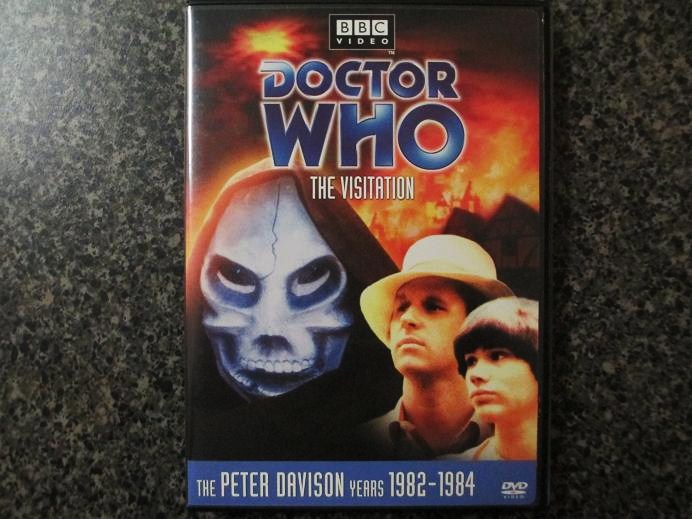
October 15: The Visitation Parts Three & Four

The sonic screwdriver is destroyed. (The Visitation Part
Three) ©BBC
Ah, a cliffhanger solved by someone shouting, "Wait!" and deciding to spare their lives for now.  Of course, this just means that the Doctor and Mace have another chance to escape -- although it doesn't actually happen until the Terileptils' android smashes through the wall where they're being held, and then it just takes them back to the manor house.

There's honestly not much that happens in this episode: Nyssa works on building that sonic booster with which to shake the android apart, and Tegan is placed under the Terileptils' control and made to move dangerous vials into portable containers.  The most interesting thing that happens is when the Doctor tries to unlock his handcuffs; he doesn't get very far at all, but nevertheless the lead Terileptil orders him to drop his sonic screwdriver, whereupon the leader destroys it.  "I feel as though you've just killed an old friend," the Doctor says sadly, and for a while he was right -- this was to be the end of the sonic screwdriver, as John Nathan-Turner thought it made things too easy for the Doctor, and it didn't make another appearance for the rest of the '80s.  But other than that, and the fact that we learn the Terileptils plan on wiping out mankind with a virulent plague carried by rats so that they can take over, little of note occurs in part three.

Part four is more engaging: we get to see Nyssa destroy the Terileptil android (with a quite impressive explosion), while the Doctor works on figuring out where the main Terileptil base is, so that he can stop their plan.  The best part of the episode, though, may be the Doctor's increasingly frustrated reactions to Tegan (and occasionally Adric), as she talks back and is generally unhelpful.  He's by turns exasperated ("Will you--?!" begins one irritated retort before he stops himself) and sarcastic ("Yes, that's why I'm searching," in response to a question wondering if he knows where the Terileptil base is), and it's a fascinating side to this Doctor's character that you really want them to explore more.  All that said, a close second for best moment is Adric's attempts to land the TARDIS, and when they don't work, Nyssa suggests he try to think what the Doctor would do -- after which Adric thumps the console, which causes it to work.

The Terileptils, gathered around their soliton gas emitter.
(The Visitation Part Four) ©BBC
But still, this episode is quite linear, and once the Doctor finds the Terileptil base it doesn't take long to take it out of action, thanks to a struggle with the Terileptils that knocks the torch out of his hand and causes the bakery they're in to go up in flames -- taking the Terileptils and their plague with them.  It's still entertaining, but there aren't any twists in the story to keep you guessing, and there's something of a sense of inevitability when, as the TARDIS departs, we see the sign for Pudding Lane: it seems the Doctor started the Great Fire of London.

The Visitation is a very straightforward serial, to be sure; there aren't any new revelations or plot twists that challenge our previous understanding of what we thought we knew; here the aliens have a plan, they work on carrying it out, and then the Doctor stops them.  That's it.  But Peter Moffatt makes it work by keeping things interesting enough that the simplistic plot doesn't really bother you.  Plus it's fun to finally be back in Earth's past after five years, and the design work is really nice.  Ultimately, The Visitation isn't an ambitious story, but it is a competent one, and it's entertaining enough while it lasts.  That counts for something, surely?

October 14: The Visitation Parts One & Two

So, for the first time since 1977's Horror of Fang Rock (a quick trip to 1505 Florence in City of Death and Event One shenanigans in Castrovalva excepted), the TARDIS travels back into Earth's past, to 17th-century England and the future location of Heathrow Airport.  Well, the Doctor almost got Tegan back, even if she doesn't see it that way: "A broken clock keeps better time than you do!"

But before we quite get to the soap opera-esque TARDIS scenes (where the characters spend their time rehashing the events of Kinda in a decidedly less charitable light than when we last saw them), there are some establishing shots in a manor house, as a spaceship crashes down nearby.  This leads to a sequence where the residents of the house try to defend themselves against the alien interlopers but are presumably unsuccessful, as the next thing we see is the house abandoned weeks later.  It's a quite beautiful-looking android, though, with lots of glittering jewels and sharp elegant lines.  But this scene sets up the aliens as potentially dangerous, and this is what our heroes wander into, after avoiding plague-fearing peasants (complete with Adric spraining his ankle for no reason whatsoever) and meeting up with a highwayman/out-of-work actor named Richard Mace.119  The rest of the first episode is an exploration of the abandoned house, looking for the alien survivors that have left bits of their technology scattered about.  The first cliffhanger is completely unmemorable, though: the Doctor has disappeared.  Which might be all right if I didn't know what the resolution was (he reappears, having learned that a brick wall was in fact a fake wall), but I do, so it remains a very uninteresting cliffhanger.

Part two is a bit more interesting, because we finally get to see one of the alien creatures, and it's actually a pretty good design.  There's some nice detailing and some animatronics even, which give these lizard/fish creatures some extra realism.  The actual plot is still pretty straightforward, though; Adric and Tegan are captured, while the Doctor, Mace, and Nyssa escape, stopping to investigate the crashed escape pod that the Terileptils arrived in (and the Doctor must recognize the design, because he identifies the missing occupants as Terileptils with ease).  And while there's some fun interplay between the Doctor and Mace, as his entire worldview is repeatedly challenged (though, to his credit, he never completely cracks under the pressure), the plot is still remarkably linear; the Doctor and Mace head to the village, to work out how the miller can access the manor house (so that they can go the same way and rescue Adric and Tegan), but they're captured by the peasants, who decide to behead them.  "Not again," the Doctor moans, as for the second time this season an episode ends with a blade raised above his head...


119 Richard Mace was a character created by Eric Saward for a series of radio plays in the 1970s, where Mace was an actor/detective in the late 18th century.  Saward adapted the character for this story, despite Nathan-Turner's misgivings.

October 13: Kinda Parts Three & Four

I really like the cliffhanger resolution at the start of part three, where they open the box, only for a harmless little doll to jump out.  It's a nice way of defusing the situation, and it's therefore more awesome how it turns out that there's something else inside the box -- the same thing that turned Sanders into a harmless, ineffectual person.  However, the Doctor and Todd aren't driven mad, but instead are shown a vision that they decide to follow up on.

As I said before, Doctor Who is being shown twice a week in this period, and thus there's a sense in which the action is in episode pairs.  Thus, while the first two parts of Kinda took place inside the dome, the last two are concentrated in the forest outside.  It's a really nice set, by the way; lots of levels and good ground cover in the studio -- most of the time it's not obviously a studio floor.  Plus the cave set is well realized, and there's fun dialogue to go along with it (after learning that the Doctor was present at the opening of the box but wasn't driven mad, the old woman, Panna, is confused: "No male can open the Box of Jhana without being driven out of his mind.  It is well known.  Unless...  Is he an idiot?"  "Well, I suppose I must be," the Doctor replies reasonably).  And not just that; we also learn that Aris has been taken over by the Mara (thanks to Tegan's unsupervised dreaming), and that he now can speak, which causes all the other Kinda to obey him.  But the most striking thing about part three is the allegorical apocalyptic vision at the end, with lots of different types of clocks on columns all ticking toward 12:00, while the Kinda trickster trips and falls, where he's set upon by his fellow Kinda as time runs out: this, it seems, is the destruction that the Mara will once again bring to the Kinda ("Was what we just saw the future or the past?" Todd asks.  "Both," the Doctor replies) unless it can be stopped.

Todd, the Doctor, and Karuna find Tegan at the Place of Great
Dreamings. (Kinda Part Four) ©BBC
Part four is also full of engaging moments, such as the city that Hindle and Sanders have been making out of cardboard and other things lying around the base, complete with crude cardboard people to populate it (something Christopher Bailey disliked, as he had envisioned something far more intricate and lifelike -- but let's face it, it wouldn't be as interesting a scene if they actually looked like people).  "You can't mend people!" Hindle cries, after one of the cardboard people's heads is torn off.  And there's the way the Kinda have made their own Total Survival Suit, just like the dome has, except theirs is made out of wood and vines.  It's a really nice touch, showing how the Mara has taken over Aris for evil purposes but still must rely on the Kinda's know-how to actually do things -- and while they can mimic the form they can't mimic all the technology.

Really, the only things that are unsatisfying about part four are the clear padding scenes between Adric and Tegan (which don't provide new information and are full of the two of them sniping at each other -- so not only is it clear padding but it's not even entertaining padding) and the realization of the Mara in its true form.  Yes, Doctor Who often comes under fire for poor effects, usually unjustly, but the snake deserves everything it gets.  It's so fake-looking that you can't help but cringe, even if you choose to treat it in a more allegorical sense.  It probably wouldn't be as big a problem if the climax on the story wasn't hinging on it, but it is, and so the problem remains.  (There's a CGI option on the DVD that's rather more convincing.)  But the Mara is defeated (lyrically, because it's trapped in a circle of mirrors and evil can't bear to look at itself) and the Kinda's cycle has been broken -- Deva Loka will now be a paradise free from the Mara.

The impressive thing about Kinda is how well it's scripted -- other than the aforementioned padding, everything in this story is designed to lead into something else, even if it's not immediately obvious what that something else will be.  There's also a sense of wonder involved that gives the story an almost fairytale quality, and the direction plays this up, as with the clocks scene, the way the Mara moves from person to person, and the zoom all the way into Tegan's pupil to represent entering her mind.  It's not quite as perfect as is sometimes claimed, and it's not really the Buddhist allegory that is also often claimed (writer Christopher Bailey admitted he was mainly using the Buddhist names as a veneer on his own story, rather than intending to write a treatise on the topic through Doctor Who), but there's still quite a bit to like about Kinda; it's doing clever things in an era which is starting to become more straightforward in its storytelling -- something that the next serial will make quite clear.