March 8: "A Day in the Death" (TW)

It's funny; when this episode began I was not at all on board with it.  It seemed like a rather generic script -- admittedly about an unusual subject, but still.  But by the end I was completely engrossed by Joseph Lidster's script, and the ending was quite lovely and charming.

The framing story -- Owen talking to a girl who's preparing to commit suicide by jumping off a building -- is done reasonably well, and Lidster does a good job of changing the audience's perceptions of why Owen is up there as the story progresses.  It's the internal storyline -- the part that Owen is ostensibly narrating -- that starts off problematically.  Jack seems to be treating Owen a lot more harshly than he was at the end of the last episode, and it's understandable that Owen ends up feeling like a useless spare part.  (And we should probably assume that there's some narrative bias at play, as this is intended to be Owen's version of events.)  The problem is that it's hard to sympathize with Owen.  Yes, he's suffered a bizarre tragedy, and he has to deal with the consequences of that, but he still acts like a brat -- being a real dick to Ianto and Tosh, and generally morose around everyone else.
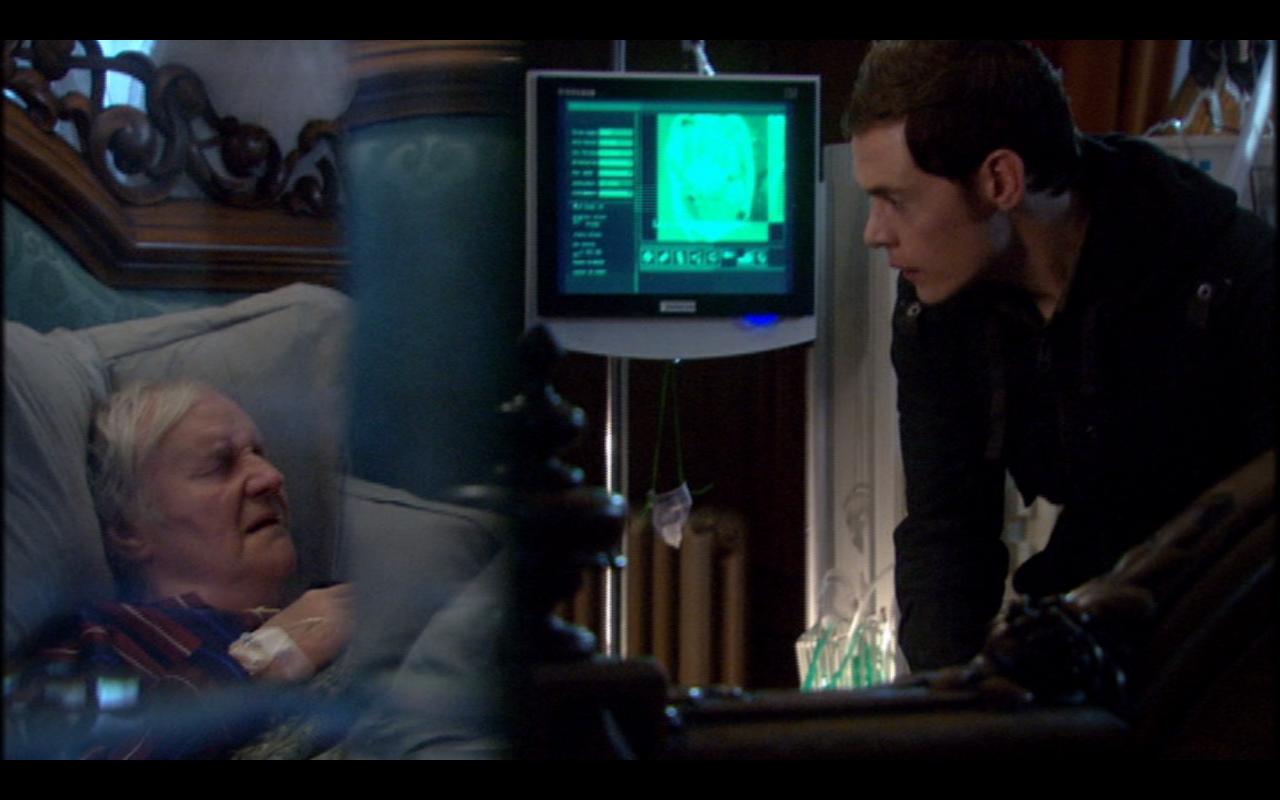
Owen finds the dying Henry Parker. ("A Day in the Death")
©BBC
But one suspects that's the point -- to bring Owen to his lowest point, so that during the climactic break-in sequence we see him have a bleak purpose (he seems to enjoy taunting the security guards with his state of being dead), but still a committed one.  This leads to his conversation with Henry Parker (as played by Richard Briers), where Parker reflects on his life and wonders if it was all for nothing.  And then Parker dies and Owen can't perform CPR because he can't provide any breath (er, except he can talk just fine, which also involves exhaling air...), and Owen is ready to sacrifice himself by absorbing the energy from the alien artifact that it was his goal to retrieve in the first place.  And when he realizes what the artifact is -- a reply to one of the "hello" signals mankind has sent into deep space -- he suddenly finds that there's still wonder in the world he can experience.

It sounds somewhat clichéd, but it works for two reasons -- the first is that framing sequence, where Owen uses his experiences to help convince Maggie that things do in fact get better, even if it might not seem like it.  The second is Andy Goddard's direction, which really pulls you into the story, and the performance of Burn Gorman, who knows exactly what Goddard is going for and is able to match it in every scene.  It's really a fabulous job.

It's not the most flashy of episodes, but that's a strength for "A Day in the Death".  Rather than try to shoehorn an "end of the world" plot into a character-driven episode (like, say, "Sleeper"), they've provided an organic story that ties in nicely with the themes being grappled with.  In its own quiet way, "A Day in the Death" may be one of the best episodes Torchwood has turned out.

March 7: "Dead Man Walking" (TW)

Ah well.  I guess the good fortune had to end sometime.

But the thing of it is, "Dead Man Walking" isn't even that bad.  It's just a sign of how good series 2 has been that this feels like a come down.  There's nothing terribly wrong with this episode; it just has an unfocused feel.  The best bits involve Owen and his return from the dead, sort of.  Jack retrieves the other Resurrection Glove, the mate of the one that caused so much trouble with Suzie Costello (in "Everything Changes" and "They Keep Killing Suzie", if you've forgotten), in order to bring Owen back -- except instead of for two minutes it brings him back indefinitely, albeit in more of a half state.  He can think and move and talk (and breathe, it seems, although that one probably can't be helped), but he can't eat, sleep, or use the bathroom.  (One of the more memorable moments involves Owen standing on his head to drain the beer he's drunk out of his body, while Jack looks on in horror.)

Owen fights Death. ("Dead Man Walking") ©BBC
Where the story is less interesting is when it tries to shoehorn a standard Torchwood plot into the proceedings.  So Owen ends up being possessed by the Grim Reaper, complete with black eyes and some demonic language193, and we get some stuff about Death wanting to claim 13 victims so that it can walk the Earth forever.  (This, it seems, is what Suzie was worried about, and not Abbadon as it seemed at the time.)  This part of the episode is less successful because it pulls us away from the drama with Owen and into a frankly uninteresting storyline.  They try desperately hard to make us care about this part, with a number of hospital patients dying, a withered Martha Jones, and a young boy with leukemia, but they never really get the audience to connect emotionally with this part.  Maybe if they'd followed through and had Owen sacrifice himself to stop the Reaper, to be actually gone at the end, this might have worked, but they pull that punch and so Owen merely drains Death's energy away.  Full marks for making the Grim Reaper's cloak actually a billowing cloud of smoke though.

So when "Dead Man Walking" is trying to present us with another potential "end of everything" scenario, it's a rather pedestrian affair.  Where this episode succeeds is when it deals with the effects of Owen's death and his sort-of resurrection: things there are a lot more interesting.

Huh.  Owen is one of the best things about this episode.  We really have come a long way since the beginning.


193 This isn't an invented speech, but actually comes from Stephen R Donaldson's The Chronicles of Thomas Covenant -- although in that it's a good thing.

March 6: "Reset" (TW)

The successes keep on coming for Torchwood, as "Reset" provides another strong episode for series 2.  It's got a strong plot and strong characterizations, which make for a great combination.

Martha is readied to become the next subject in the Mayfly
clinical trial. ("Reset") ©BBC
One of the key components this time around is the introduction of Martha Jones.  It's a pleasure to see her back, even if it's without the Doctor.  This is clearly a Martha that has moved on since "Last of the Time Lords" -- she's now working for UNIT and is called in to assist Torchwood with some unusual deaths.  It's also great to see her and Jack interacting -- they're two people with a shared experience that the others can't even imagine, and the bond that therefore exists is easy to see.  This also means that she fits in with the group rather effortlessly, and we don't have to worry about a lot of tedious "but can she be trusted?" nonsense.  And Freema Agyeman continues to be great, which means any scene she's in is that much better -- particularly when she is sent undercover to infiltrate the Pharm.  (The fact that her cover name is Samantha Jones -- the same name as the eighth Doctor's first companion in the BBC books -- is probably a coincidence rather than some sort of deliberate in-joke.)

But as I said, it helps that they've provided her with a strong plot to work with.  I really like how the plot develops, from a deadly conspiracy to a pharmaceutical company that's using alien things to try and cure diseases, only the alien stuff is going wrong.  So not only does their conspiracy plotline logically expand out to cover alien issues, but it also provides a convenient way to get Martha in on the main action, as well as flirting with the issue of medical ethics.  If you could cure any disease and "reset" someone back to their "factory settings", so to speak, but you ended up killing patients because your "cure" is actually an alien parasite that will kill its host, would it be worth continuing the trials in the hope of isolating the "reset" part?  The people at the Pharm think so -- in fact, they have a number of aliens chained up and isolated so that useful chemicals can be extracted, regardless of how the aliens feel about it.  It's nice to see Jack on the side of the aliens ("Combating hostile aliens is one thing," Jack tells Dr Copley, "but this is slavery, exploitation, a war crime") -- series 2 seems to be making an effort to pull Torchwood back from the rabid xenophobic position it held in series 1 -- and it makes it a lot easier to root for them when they shut the Pharm down and essentially euthanize all the aliens inside.

This is a smart, fast-paced, strong episode -- Martha fits in well from the very start, and the assassination of clinical trial subjects leading Torchwood to enslaved aliens is very well handled.  And then, just when you think it's all done, Copley shoots Owen dead.  Not just wounded, or on the verge of dying, but actually dead.  That's a hell of a lead-in to the next episode (and the trailer is all about his autopsy and things like that, so it doesn't seem like there's any sort of fast one being pulled here).  The quality of series 2 just keeps going up.

March 5: "Adam" (TW)

Oh, come on!  It's not bad enough you have to name your failed companion Adam, now we're naming alien monsters Adam too?

Of course, if you're going to share a first name with a parasite, you could do worse than the one we get in this episode.  "Adam" the episode is an entertaining, intriguing tale.  I like the way shots of Adam are inserted into the opening "this is Torchwood" montage (although they missed a trick by not putting him into the closing slow-motion walking shot -- but maybe it was too difficult to do for such a quick moment).  And it's clear that there's something vaguely creepy about Adam, even before it's clear he's manipulating people's memories -- so kudos to Bryan Dick for an engaging performance.

It's a really well-constructed episode -- Catherine Tregenna does a great job of inserting Adam into Torchwood's day-to-day operations and only making it apparent that something's wrong later, as Gwen fails to remember Rhys and Ianto can't find any trace of Adam in his diary, even though he's supposedly been around for three years.  The scenes between Gwen and Rhys are surprisingly powerful -- Eve Myles does a great job of acting frightened by this stranger in her apartment, who's gone around putting up pictures of himself, while Kai Owen is lovely as the confused and hurt Rhys.  The scenes where Jack tapes Rhys remembering some of their experiences together is sweet and moving.

Adam implants unpleasant false memories in Ianto's mind.
("Adam") ©BBC
And in fact, Adam's true nature is rather clever, of a type we haven't really seen in Doctor Who or any of its spinoffs before: he's a being that exists purely based on memory, by implanting false memories that enable him to survive and thrive.  He also has the power to change people's personalities by suppressing some memories and implanting others -- so Tosh is confident and self-assured, and Owen is nerdy and meek (and we see how much of Burn Gorman's performance as Owen is just that, a performance).  It's an interesting change that adds some new dynamics to what we've been getting.  And Adam has additional powers -- not only can he implant unhappy memories (such as making Ianto believe he's a murderer), but he can insert himself in existing memories -- in particular, Jack's childhood memories, where we learn more about the "Gray" that John Hart mentioned in "Kiss Kiss, Bang Bang".  Adam possesses an impressive power, and it's only when things keep failing to add up that Jack becomes suspicious and works it out.

This is a clever, solid episode, with some nice elements that keep it from being similar to a lot we've gotten before.  The relationships are well-balanced, and the drama is definitely present.  It's a way to get "alternate universe" performances without having to construct an alternate universe, and the episode is stronger for that.  So I guess if you're going to share a name with an amoral alien, you certainly could do far worse than "Adam".

March 4: "Meat" (TW)

Look how responsible a driver Rhys is, pulling over to the side of the road before answering his phone...

So, like the last two episodes, "Meat" is interested in examining the human cost of these strange alien occurrences.  It just happens to be the case that the person affected this time around is Rhys, who stumbles across Torchwood's activities when one of his lorries overturns and he spies Gwen at the scene investigating.  And frankly, it's about time that Rhys found something out about Torchwood's activities -- he's been kept in the dark so long that it's nice to finally see him learn something.  It also gives Kai Owen a chance to shine -- he's been one of the best things about Torchwood, and it's nice to finally see him take center stage in an episode.  He's particularly good in this, tailing Gwen and then getting involved in the alien goings-on, which leads to him acting undercover and even taking a bullet for Gwen.  It's also wonderful to see him so enthused about the thought of alien life out there in the universe.  It's little wonder Gwen refuses to retcon him.

The alien creature, tied down in a warehouse. ("Meat") ©BBC
But the ostensible main plotline is about an alien beast that's fallen through the Rift which is composed almost entirely of flesh -- hardly any bones in its body -- and which some unscrupulous people have decided to start harvesting while it's still alive, as the creature keeps growing.  Oh, and look, it's Criminal Minds: Suspect Behavior and Constantine's Matt Ryan as the leader of the criminal operation.

What's nice about this plotline is that, for once, Torchwood wants to help the alien lifeform rather than kill it or lock it up.  "We see enough death," Jack comments.  Of course it doesn't work out, and Owen is forced to euthanize the creature instead of being able to save it, but it's nice that they tried.  It's also worrying that the creature was seemingly sentient, which makes the criminals' actions even more heinous, despite their protestations that the creature is just "meat".  Jack and Owen both seem particularly affected by this.

If there's a downside to "Meat", it's that the main storyline doesn't have a larger point behind it, other than the now-standard one of "people are the real monsters".  But that doesn't really matter -- by focusing sufficiently on Rhys (but not to the point of exclusion), this is the best character-driven episode series 2 has provided yet.

March 3: "To the Last Man" (TW)

Like "Sleeper", this is an episode that attempts to put a human face on the more abstract, SF-ish issues Torchwood wants to deal with.  But because there's not an action break in the middle, "To the Last Man" is more successful in its aims than the previous episode was.

And so while the SF part deals with two time zones colliding and intermingling (er, just like "End of Days", albeit without the giant demon), "To the Last Man" chooses to focus on the human element, in the form of Private Tommy Brockless, a shellshocked soldier taken away by Torchwood and frozen, to be awoken once a year, until the hour that he's needed to go back to 1918 through the Rift and seal it up behind him.  We get some interesting exploration of the nature of warfare -- such as Tommy seeing tanks driving through Iraq and commenting, "First year they woke me up, 1919, they told me it was all over.  We won.  The war to end all wars, they said.  And then three weeks later, you had the Second World War.  After all that.  Do you never wonder if we're worth saving?" -- and some bitter recriminations of the way soldiers used to be treated.  Tommy's outburst when he learns he has to go back is rather pointed -- "I know what'll happen.  They'll send me back to the Front.  I'll be back in the trenches. ... You're no better than the generals.  Sitting safely behind the lines, sending us over the top.  Any one of you lot could go, but you're not, are you?  You're sending me. ... I've been shoved from pillar to post all my life by the Army, by Torchwood.  All this time I've had, it means nothing" -- and the discovery that he's going to be executed for "cowardice" (aka PTSD, essentially) three weeks after he returns is distressing.  (Incidentally, this is where the episode title comes from: Field Marshal Haig announced in response to the German Spring Offensive of 1918 that "Every position must be held to the last man", which meant that shell shocked soldiers would be sent back to the front.)

Toshiko convinces Tommy to use the Rift key. ("To the Last Man")
©BBC
The problem, though, is that a lot of this is territory that Torchwood has already explored (most notably in "Captain Jack Harkness", although it's not the only episode), and it's not clear what "To the Last Man" can contribute to the argument.  This means that much of the burden of the episode lies squarely on Tommy's shoulders, and while Anthony Lewis does a commendable job with the material, and the relationship between Tommy and Tosh is interesting, not enough time is given to examining this element, to discuss what it's like to have a relationship that has essentially only lasted four days.  It seems like a missed opportunity; there's a lot they could have done with that scenario, but they elected not to, in favor of more familiar grounds.

And so maybe that's why "To the Last Man" ultimately feels somewhat underwhelming.  There's a really lovely human element at the heart of it, and some intriguing anti-war commentary, but the best ideas are relegated to the background, while the episode moves on to its safer (albeit depressing) conclusion.  There's a lot that you can admire about "To the Last Man", but there's not quite enough there to make it truly compelling.

March 2: "Sleeper" (TW)

This episode is an odd beast.  At the basic level, it's about the discovery of an alien sleeper cell, and what happens when the cell activates.  This is the level that the direction is operating on -- Colin Teague chooses to shoot a lot of this in a faux-documentary style, with lots of handheld shots and close zooms for reaction shots from our main cast.

The mind probe reveals Beth's true identity. ("Sleeper") ©BBC
But what James Moran wants to do with his script is focus on the human cost.  To that end, "Sleeper" spends a lot of its story concentrating on Beth Halloran, one of the sleeper agents whose cover is so good that she's not remotely aware she's not human, until her alien part defends itself by killing two burglars.  This leads to the revelation of Beth's real nature and the discovery of the existence of the sleeper cell.  We also get discussions on what it means to be human -- is it enough that Beth feels human and thinks she's human, if her biology makes her alien?  Can she live a normal life now, knowing that she might be activated at any time, erasing her personality as Beth?  It's something of an intriguing discussion, and the episode doesn't provide any strong answers, which is on the whole a good thing.

Incidentally, this episode is where the Ianto Jones we all know and love really starts to snap into focus: he's full of dark humor (the part where he describes what happened to the last person they used the mind probe on), he's wonderfully sarcastic ("And I thought the end of the world couldn't get any worse," he says after Owen suggests they all have sex while the world goes up in a nuclear holocaust), and he's just generally entertaining:
GWEN: Why would anyone want to kill him?
IANTO: He's also the city coordinator.  Takes charge of the city during major emergencies.  Has all the security protocols.
OWEN: How do you know that?
IANTO: I know everything.  And it says so on the screen.
But because "Sleeper" tries to have it both ways, to be both an examination of the human condition and how these events affect Beth, and a taut suspense-filled episode about an alien terrorist attack as the prelude to an invasion (well, sort of; the implication is that the aliens will let the humans destroy themselves and then come in and take over what's left), we get wide variations in tone.  While they're partially successful -- certainly enough that we can easily see what they're getting at -- it is sometimes jarring to have both approaches in the same episode.  This is perhaps most apparent when the action/suspense portion first starts; up to this point it's been a character drama about Beth, but then the cell activates (presumably because Beth went offline) and suddenly we have murders and terrorist attacks in Cardiff.  This is fine, except when that part's over they try to go back to the character drama, where Beth decides she doesn't want to live as a sleeper and commits suicide by threatening Gwen and forcing the rest of the team to shoot her.  "She wanted you to shoot her," Gwen says.  "She used her last shred of humanity to do this."  "We couldn't take that chance," Owen replies.  "She must have known that."  "She did," Jack says.  "She just wanted to make it easier for us."

So as I said, it's an odd episode -- it tries to be both a character drama and an action story, and while it does a decent job at both, the juxtaposition of the two (matched with Teague's direction, which occasionally feels inappropriate for the quiet moments) makes "Sleeper" a difficult episode to really like.  But you can't blame them for trying, and we're still far ahead of where we were for much of series 1.