March 20: "The Unicorn and the Wasp"

I dunno.  I understand that "The Unicorn and the Wasp" wants to be silly and absurd and fun, without too much angst or drama getting in the way, while it pastiches the murder mysteries that Agatha Christie is famous for.  I even think it does a good job with them.  I just don't find it particularly funny.

The nice thing about this episode is that it imagines to be both a trip back to the 1920s, with some elements of flappers and large estates throwing parties thrown in just like we've seen on TV in other shows (or Black Orchid, if Doctor Who is the only thing you ever watch), and a loving tribute to Agatha Christie's novels (along with some of the dafter installments of the Doctor Who strip that TV Comic put out in the 1960s, in case you're wondering what giant wasps have to do with Roaring '20s England).  We also get Felicity Kendal, Christopher Benjamin, and Fenella Woolgar, and a host of other actors who've been in period pieces like this before, so they hardly put a foot wrong as they go through this unusual murder mystery.  And it is a lot like an Agatha Christie mystery -- deliberately, we later learn -- with guests being bumped off in isolated circumstances and everyone keeping secrets from each other.

The Doctor faces the Vespiform.  ("The Unicorn and the
Wasp") ©BBC
The culprit of this mystery, however, is an alien wasp called a Vespiform which can take human form, and which formed a psychic link with its human mother while she was reading The Murder of Roger Ackroyd.  It's an odd and silly idea, but as it's deliberately designed to be absurd it's hard to be mad at it.  Plus they do a nice job with their CGI wasp -- the Mill certainly have come along since "The Lazarus Experiment".

But for me, at least, it never fully coheres into a unified story.  There are definitely funny moments (Colonel Curbishly admitting he's not crippled is a good one, but I also really like the moment where the Doctor chases the Vespiform down a hallway: "There's nowhere to run!  Show yourself!" the Doctor cries, only for six people to emerge from various doorways), but they never feel like they're part of the main event -- rather, it's like an interlude before we get back to the main plot.  (It doesn't help that a couple of the jokes -- like Donna giving Christie ideas -- were used before in Roberts' last Who script.)  And by necessity, the resolution has to be more serious in nature, which does weaken the more good-naturedly silly bits.

I know a number of people who quite adore "The Unicorn and the Wasp", and while I can admire what it's trying to do, it just doesn't come together for me the way it should.  For me, it tends to look a lot like someone trying to be clever and not quite pulling it off.  You can applaud the attempt, but you wish it had gone better.

March 19: "The Doctor's Daughter"

Oh, what a letdown.  That fun build-up at the end of last episode is completely squandered before the credits even roll here, and we learn Jenny is the Doctor's daughter by way of technobabble rather than anything more meaningful or interesting.

The last time Stephen Greenhorn wrote for the series, we got "The Lazarus Experiment", which looked more like the general public/lazy critics' version of Doctor Who than what usually happens.  This is better than that, a bit, but it still has some major problems.  Full marks for another alien planet, though, and a conflict between humans and the alien Hath who are occupying the same space.  It's not exactly original, but it is the sort of thing we haven't seen nearly enough of as of late.  It's also nice to have an alien species who aren't immediately hostile and/or evil and can, in fact, be reasoned with.

Donna shows the Doctor that Jenny has two hearts. ("The Doctor's
Daughter") ©BBC
But the major problems with "The Doctor's Daughter" start early.  The script and direction really want us to like Jenny, even though we're not given much of a reason to -- indeed, it's easier to side with the Doctor and his misgivings about how she has the knowledge of a soldier but not a Time Lord in her head.  (Oh, and while we're here... Georgia Moffett is the daughter of fifth Doctor Peter Davison (real name Peter Moffett) -- so the title is both technobabble and an in-joke.)  It doesn't help that we're not allowed to draw our own conclusions, forced instead to watch her do clever and amazing things and have that, it seems, be enough.  Then there's the huge problem lurking at the center of this: the (superficially nifty) twist that the war has only been going on for one week.  It's a nice idea, but if you think about it at all it falls apart rather spectacularly.  It's not just the matter of General Cobb being played as someone far too old for this to work (which suggests that either he came out of the machine really old and they made him their leader, or that all these clones are subject to highly accelerated aging and they'll all be dead in a few days anyway -- or that he's been alive the entire week and just really hates the Hath), but that this idea requires the complete and total annihilation of something like twenty generations of soldiers in the space of a day or so (so that nothing but myths and legends survive).  At the very least, what happens to all the bodies?

(There's also the matter of the Hath travelling with Martha who falls into some quicksand and dies, even though it's not breathing the outside air in the first place.  To be fair, someone's realized this and placed a smashing glass sound over the shot, even though there's no good reason why the Hath's respirator would have been destroyed in the first place.)

On the plus side, many of the performances (particularly from the regulars) are very good.  You can see the hurt and confusion on David Tennant's face as he grapples with this new "daughter" of his, and he does a great job of selling scenes like the one in the prison cell, where he talks a bit about the Time War, that don't actually provide us with any new information.  The scene where he watches Jenny die, and then points a gun at Cobb's head, is also really powerful, and you get the impression that he might actually pull the trigger, even though he subsequently says he "never would".  Catherine Tate is also good as the Doctor's foil, teasing him about becoming a father and working out what the dates mean (even if the description of this ("like it is in America") is strange, as Americans don't put the year first -- and why does Donna think the first two numbers in "60120724" are some sort of space date and not simply the 61st century?), and Freema Agyeman is great working with the Hath.  Georgia Moffett also does the best she can with the material she's given, even though the script largely requires her to be doe-eyed and innocent, even when she's shooting at people.

But it's not enough.  Despite some interesting bits here and there, there's a sense of tiredness about "The Doctor's Daughter", as if it's acceptable to go through the motions once they've come up with their plot twist.  It even ends the way you might expect, with Jenny coming back to life (thanks to terraforming gas, though, not regenerative energy -- note the colors) and heading out into the universe for a sequel-hunting exit.  Not that anyone has taken them up on this.197  This is easily the weakest episode of this series so far, and generally not worth your time.


197 All right, except for a brief appearance in IDW's Prisoners of Time comic book and a brief mention in the in-universe reference book The Doctor: His Lives and Times.  That hardly counts, though.

March 18: "The Poison Sky"

So I remembered not being terribly impressed by this story, the first few times I watched it.  This time around, though, I found myself reasonably entertained.  It's not the greatest story out there, and it's not even necessarily anything more than an average tale, but then again it's not trying to be clever or inventive.  No, what "The Sontaran Stratagem" / "The Poison Sky" wants to do is tell a fun action story that reintroduces the Sontarans, and at that it succeeds quite well.

Yes, there are some problems with "The Poison Sky" in particular.  Luke Rattigan went from annoying to downright distasteful in this second part -- it's incredibly hard to have any sympathy for him even before he starts pulling guns on his students.  You sort of get the impression that they want this to be like Tobias Vaughn getting his revenge on the Cybermen in The Invasion ("They destroyed my dream", if you remember), but Ryan Sampson is no Kevin Stoney.  Not that that stops the episode from trying really hard to make you care about Rattigan and his fate.  Oh, and speaking of strange things like this... why do the script and episode really want us to care about the death of Martha's clone?  It's like they flip a switch from having her doing covert things for the Sontarans to suddenly being a real person dying in front of us.  (Well, actually, dying in front of the real Martha, which makes it even stranger.)  Never mind that she's been working for the enemy -- because she looks like someone we like, we should care.  (Under this logic, some viewers are going to be very upset rewatching this episode and seeing Dan Starkey die just because he looks like Strax.)  And some minor quibbles: it feels odd that the Sontarans are so vulnerable to bullets -- though admittedly, there's nothing in any of their previous appearances, to the best of my knowledge, to suggest they're not -- because you'd think that armor they're wearing would do something.  And I wonder about a device that ignites the toxic gases in the atmosphere but not anything anywhere else.  Or did a huge number of wildfires spring up in the American West (say) that we just don't hear about?

Commander Skorr and his troops. ("The Poison Sky") ©BBC
So those are the problems.  But, balanced against this, we've got some great scenes in "The Poison Sky". It's great how the Doctor immediately works out that Martha is a clone, so that we don't have to worry too much about "oh no, there's a traitor in their midst" and can get on with business as usual.  The Doctor gets to be nice and moral, objecting to guns ("If I see one more gun," he says as he casually disarms Luke and throws the gun away without missing a beat) and insisting that he give the Sontarans a choice between death and retreat, even though he knows they'll choose death.  And while there aren't quite as many little jokes in this episode, there are still fun moments such as Donna sneaking out of the TARDIS to knock out a Sontaran guard, or her continual mispronunciations of the word "Sontaran", with emphasis on the first syllable instead of the second.  (And this is an in-joke as well, reflecting conversations between Kevin Lindsay and director Alan Bromly about the pronunciation during the first Sontaran story, The Time Warrior.)  It's also really lovely how Wilf is firmly on the Doctor's side, telling Donna to go with him over Sylvia's objections -- it's a nice change from family members being firmly anti-Doctor.

But ultimately this is a relatively uncomplicated action story, and while it's not doing anything spectacular, it's telling its tale in a largely entertaining way.  As I said, it's not perfect (even if he's meant to be a prat, what were they thinking by including a character like Rattigan?), but it's definitely an improvement over Raynor's last tale.

And an interesting cliffhanger (the TARDIS suddenly takes off, with Martha still inside with the Doctor and Donna), and a very intriguing trailer for next time, as we meet... the Doctor's daughter?

March 17: "The Sontaran Stratagem"

Back to contemporary London for our first two-parter of series 4, and so far it's shaping up to be a good one.  The title, of course, means it's not exactly a secret that the Sontarans are returning, for the first time since 1985's The Two Doctors, but director Douglas Mackinnon has some fun just showing a gloved hand here and an off-screen voice there, until he reveals them in their redesigned glory.  It's mainly the uniform that's changed, looking more like plate armor than before and with a generally bluer tinge -- the "potato head" is more or less the same, albeit more natural-looking (thanks to advances in makeup and latex over the past 24 years).
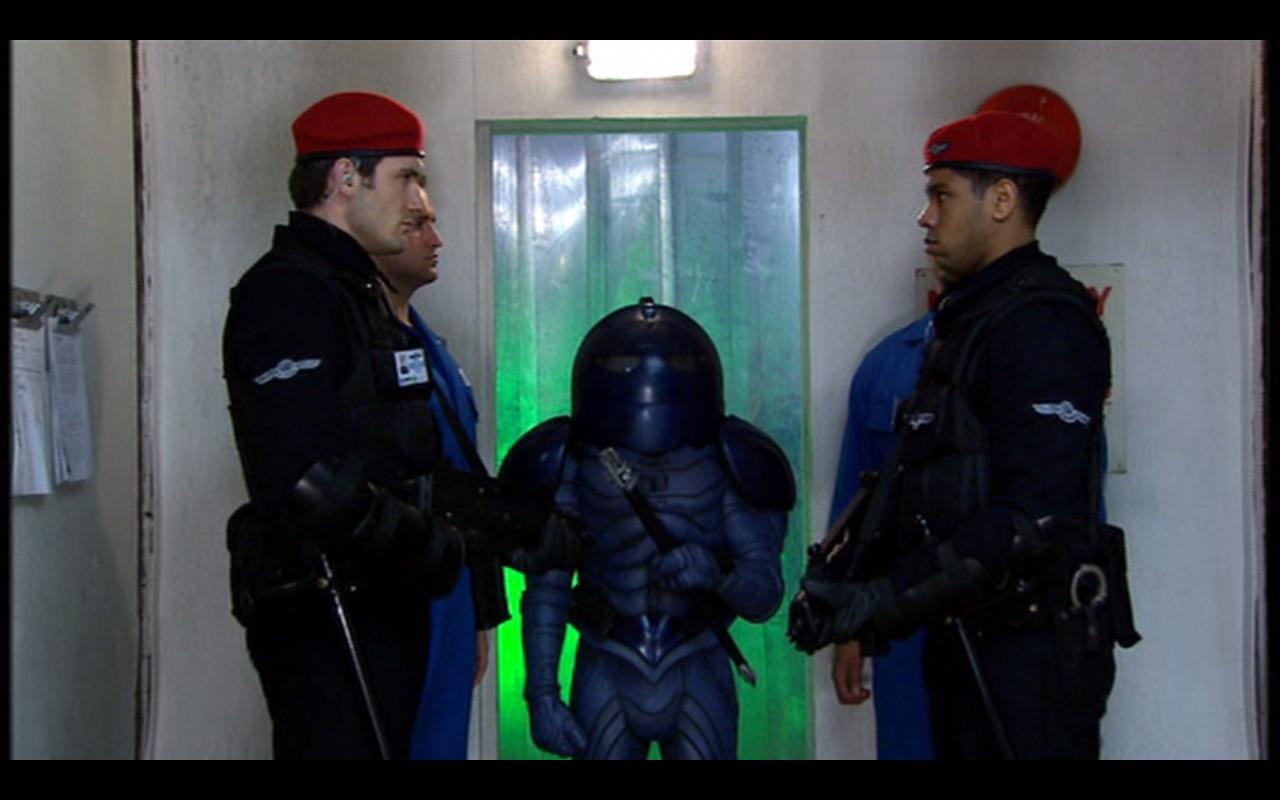
Commander Staal gives orders to his hypnotized minions. ("The
Sontaran Stratagem") ©BBC
It is nice to see the Sontarans back in action, even if they're skulking about rather than making a glorious attack or anything like that.  (Although, come to think of it, every time we've seen them they've been devious and subtle and willing to use other races as patsies/servants, despite what the Doctor says about "typical Sontaran behaviour".)  Christopher Ryan's voice is immediately identifiable as Mike from The Young Ones (or, if you're like me, Kiv from the Colin Baker story Mindwarp), and he does a great job of giving Staal just the right amount of bombast and arrogance.  The Sontarans all seem much shorter than before, though.

There are also lots of jokes scattered throughout, which are really lovely.  The scene where the Doctor says goodbye to Donna is both touching and funny, and I utterly adore the part where the Doctor and Jenkins rush out of the jeep before ATMOS explodes, which does so with a tiny fizzle ("Oh, was that it?" says the Doctor, somewhat disappointedly).  It's also great to see how Donna's granddad Wilf reacts to Donna's stories, and then to the Doctor when he finally shows up at the Noble house.  Oh, and some more offhand references to past stories: Martha is described as having a weak thorax, just like Sarah Jane in The Time Warrior, and the Doctor describes the UNIT of the '70s ("Or was it the '80s?" he wonders, for the handful of fans still holding on to late '70s/early '80s dating) as being more "homespun" than what we see here, which is true.  UNIT here is a lot more disciplined (and, frankly, intimidating) than they were during the Pertwee era.  Oh right, and Martha Jones is back, working for UNIT and having called in the Doctor to help with this ATMOS device.

Actually, this leads to the one major problem with "The Sontaran Stratagem" (well, this and the fact that everything looks purple for some reason -- but that's clearly a design decision), and that is the character of Luke Rattigan.  He's bratty and snotty and basically the television stereotype of the wunderkind, which makes him intensely unlikeable as a result.  (Still, at least he's intended to be unlikeable -- so we're still ahead of Wesley Crusher and the rest of his type.)  As such, it's rather entertaining to watch the Doctor get the better of him: "If only that was possible," Rattigan says, after the Doctor points out he could colonize a new planet with the technology he's developing.  "'If only that were possible.'  Conditional clause," the Doctor corrects him.196  Rattigan tries to get his own back, but it comes off as weak and petulant, as he tries to criticize the Doctor's use of "ATMOS System".  "It's been a long time since anyone said 'no' to you, isn't it?" the Doctor says mildly (and, somewhat ironically, using the wrong verb -- "isn't" instead of "hasn't").  This is the weakest part of the episode, and one does wonder a bit what's going to happen in the second part.

But so far, "The Sontaran Stratagem" has been an entertaining, solid episode.  The only real hesitation here is that "Daleks in Manhattan" (Helen Raynor's last Doctor Who story) was much the same way and then turned into a damp squib in its second half, "Evolution of the Daleks".  But if this story can avoid the sins of the past then they'll be in good shape.


196 The Doctor is technically correct, but Rattigan is actually just part of the linguistic trend that's getting rid of the subjunctive were in counterfactuals.  Or, in other words, having was there is becoming increasingly acceptable.  For instance, I'll bet you didn't even notice it until the Doctor pointed it out.

March 16: "Planet of the Ood"

Hooray!  Another alien planet!  That makes four of any note since the series came back in 2005.  Perhaps Russell T Davies finally thinks the audience won't disappear if we spend a week somewhere other than Earth.  Oh, and another Hartnell reference, as we learn that the Ood Sphere is close to the Sense-Sphere (The Sensorites).

But I'm not quite sure what this story wants to be.  In some ways it wants to be a straightforward action story, with evil guards against the righteous Doctor.  There's even a (frankly silly) sequence where the lead guard, Kess, tries to play a giant version of the crane game with the Doctor.  But it also wants to be a pointed commentary about the Ood, to explicitly address the problem of slavery that was brought up and then set aside in "The Impossible Planet" / "The Satan Pit".  But because it wants to be both this and the action plot, it ends up pulling some of its punches.  So of course all the humans are generally terrible people -- the bit with the PR representative Solana calling the guards over rather than helping the Doctor is a nice reversal of how these things normally work, with the Doctor completely failing to win her over, but it does lump her in with the rest of the nasty humans.  Commander Kess literally cackles with delight at the thought of killing the Doctor and has no qualms with gassing the red-eye Ood, and even Halpen appears to be looking forward to the thought of killing the main Ood brain and starting over in another business, with no second thoughts about the fate of the Ood.

An unprocessed Ood with his hindbrain. ("Planet of the Ood") ©BBC
As such, there's no question whatsoever that humanity is in the wrong.  I'm not trying to argue that slavery is ever a good thing, but it might have been more interesting to have had a race of beings who genuinely wanted nothing more than to serve others (which is sort of what "The Impossible Planet" / "The Satan Pit" was getting at) -- what then would be the answer?  Would the Ood be better off with their freedom?  But I suppose there wasn't enough time in a single episode to explore something more nuanced, so instead we get evil humans and oppressed Ood.  And while there's an effort to be pointed in the commentary ("Who do you think made your clothes?" the Doctor asks, after Donna says she doesn't have slaves), they back down -- Donna gets snarky and the Doctor apologizes.  All this and weird alien biology to boot.  (They have a second, exposed brain that they have to carry in their hands?  How did they possibly survive on their own with something like this?)

The other thing to note about "Planet of the Ood" is how little the Doctor and Donna's presence actually matters.  Nothing they learn is a revelation to the people in power or to the Ood, and none of their actions make any difference until the very end -- and even then, it's not like Ood Sigma couldn't have deactivated the bombs and shut off the telepathic barrier around the big shared Ood brain.  The events we see here were set in motion before the Doctor and Donna arrived (i.e., Dr. Ryder's actions and the slow conversion of Halpen into an Ood... er, yes...) and almost certainly would have happened without them running around.  And yet Ood Sigma says "the Doctor-Donna" will be revered forever because of what they did there.  Hmm.

It's not a bad episode -- there's a lot that this does right -- but it never quite gels into the story that it should be.  It's not exciting enough to work as an action story, and it's too straightforward to work as a political drama.  It's a good effort, but "Planet of the Ood" never quite makes it to the place it wants to end up at.

March 15: "The Fires of Pompeii"

There's a part of me that hoped, just for a minute, that this would be a straight historical about the destruction of Pompeii, à la the Big Finish audio The Fires of Vulcan.  Alas, it wasn't to be; the aliens (rock creatures who live in Mount Vesuvius) show up pretty quickly.  Still, shouldn't blame episodes for not being something they're not trying to be.  And there are some nice jokes scattered about, like the recurring "I don't speak Celtic" bit, or the reference back to "The Empty Child" / "The Doctor Dances": "We're in Pompeii.  And it's volcano day."  Oh, and an offhand reference to The Romans: "Before you ask, that fire had nothing to do with me.  Well, a little bit."

But what's up with the cast of this episode?  I don't mean the performances -- they're generally rather good (even if the efforts to make Caecilius's family seem "just like us" feel a little strange and out of place -- it's like they don't think we can relate to a family unless they behave like a modern one195).  No, there must have been something in the air, as we get not just a future companion (Karen Gillan, who will be Amy Pond, is the first of the Sibylline Sisterhood that we see), but also a future Doctor, as Caecilius is played by Peter Capaldi.  It's initially a bit difficult to get past that, actually, as you notice mannerisms that will become more familiar as twelfth Doctor ones, but you get used to it soon enough.  Oh, and as long as we're discussing production things...  Look!  It's our first overseas filming of the 21st century (well, except for some brief background plates shot in New York for "Daleks in Manhattan"), and it's really wonderfully impressive to see what the team did in Italy.  There are some shots that were definitely not taken in Cardiff, and the episode is better for it.

Metella, Caecilius, and the Doctor look at the obliterated
Pompeii. ("The Fires of Pompeii") ©BBC
As far as the actual content, though, there are some minor problems.  The discussions between the Doctor and Donna about whether or not the people of Pompeii can be saved are really nice, and we get some small insight into what it's like for the Doctor as he travels: "Some things are fixed, some things are in flux.  Pompeii is fixed."  "How do you know which is which?" Donna asks.  "Because that's how I see the universe," the Doctor replies.  "Every waking second, I can see what is, what was, what could be, what must not."  (This also seems to be the episode where the term "fixed point" really gains traction as a convenient way to wave away the problems with changing history (or not).)  Donna just wants him to save the people, even though the Doctor knows he can't.  I do like how it turns out that it's the Doctor's actions that cause established history -- it's a good move that doesn't happen often enough (except as a quick joke/reveal, frequently at the end of an episode -- see, for instance, The Romans or The Visitation).  It's a bit odd, the "everyone has to die" dilemma though, as the fatality rate for Pompeii, while high, wasn't 100%.  (Oh, and while we're quibbling: the Romans had seen volcanoes before Vesuvius erupted, so the word wasn't created on 24 August 79.)  Still, it gives us a nice dilemma that shows that Donna does have an effect on the Doctor.  "You were right," he tells her afterwards.  "Sometimes I need someone."

But when you take out the main "condemning everyone to die" part, the rest is rather weak.  I've mentioned the concerns with Caecilius's family, but the stuff with the Pyroviles also feels awkward, as if we need a monster in this story just for the sake of having an alien monster.  There's only the thinnest veneer of motivations given, in order to force the Doctor to doom Pompeii -- and the reasoning behind the accuracy of the Sibylline prophecies is also just technobabble and unsatisfying as a result.

Still, there's not much actually wrong with the episode -- much that could have probably been done better, but few actual missteps.  There's enough that's right with "The Fires of Pompeii" to maintain your interest, even if it's not likely to be one of your favorite episodes of the show (or even of series 4).  And it's fun to watch Capaldi in Doctor Who before he became the Doctor, so there's that at least.


195 The family comes from the Cambridge Latin Course -- although in that Caecilius and Metella die in the eruption, and only Quintus survives.  (Evelina is a new creation for this episode.)

March 14: "Partners in Crime"

It took me longer than it probably should have to realize "Partners in Crime" is meant to be a farce.

In retrospect, all the signs are there.  There are definitely genuinely funny moments in this -- the mime between the Doctor and Donna is truly wonderful (and Miss Foster's dry interjection -- "Are we interrupting you?" -- is superbly delivered), and there are tons of funny moments and lines scattered throughout.  The first clear sign that this is meant to be less than serious is the way Donna and the Doctor keep just missing each other in the Adipose Industries office.  The whole episode has moments like this as a result -- and in particular, Miss Foster's fate (where she remains suspended in the air for a moment before falling) looks incredibly strange without this piece of information.

Donna gives the Doctor a second pendant. ("Partners in Crime")
©BBC
Part of the problem, I suspect, is that "Partners in Crime" isn't only a farce -- there are also more serious emotional moments as well.  Donna is redefined as a more nuanced character than she was in "The Runaway Bride" -- she's thankfully significantly less shouty and abrasive than she was there, and her interactions with the Doctor are far more varied as a result.  Her conversation with her grandfather (as played by national British treasure Bernard Cribbins, last seen in "Voyage of the Damned") is really lovely -- even if I'm utterly sick of parts of this speech, thanks to them being in the series 4 trailer that I've been seeing off and on for fifteen months now.  Nevertheless it's still a nice conversation, and both Cribbins and Catherine Tate do a great job with the material.  (Oh, and it's nice how the episode is dedicated to Howard Attfield, who played Donna's dad in "The Runaway Bride" and started to film scenes for this episode before he died.)

It's this blend of styles, though, that makes it difficult at times to see what "Partners in Crime" is trying to do.  It's not as much of a problem as it was in Torchwood's "Something Borrowed" -- though that's possibly because the jokes are better here, and everyone is more committed to making them work.  Catherine Tate obviously excels here, but even a character like Penny Carter194 works well by actress Verona Joseph being fully committed to her role.  But nevertheless the seriousness of some scenes, and the bizarre horror of the Adipose being formed from people being fully converted into Adipose children, does mean that the juxtaposition can be jarring, and the farcical nature of the episode isn't as strong as it was intended to be.

Still, repeated viewings lessen that jarring sensation, and what's left is a very entertaining season opener.  "Partners in Crime" does well with what it's given, and the end result is very satisfying.


194 Before Catherine Tate agreed to come back to Doctor Who Russell T Davies created a provisional new companion named Penny Carter, although her character didn't get very far before Donna Noble was confirmed.  But the character's name lives on.