June 28: "The Crimson Horror"

It's something of a milestone today: "The Crimson Horror" is the 100th episode of the BBC Wales run of the series.

For me, there tends to be a slight sense of trepidation when approaching a Mark Gatiss script.  Maybe it's because I've seen what he can accomplish with Doctor Who when he nails it (such as his books Nightshade and Last of the Gaderene), and so far he hasn't quite made it to those levels on the actual show -- "The Unquiet Dead" probably came closest, but even it had the unpleasant subtext about immigration bringing things down.  But now, finally, Gatiss has achieved his full potential: "The Crimson Horror" is a delight from start to finish.

It helps that Gatiss is on comfortable ground here: "The Unquiet Dead" already demonstrated his affection and affinity for the Victorian period, and "The Crimson Horror" cements that, with shenanigans in 1893 Yorkshire involving a woman preaching fire and brimstone (Dame Diana Rigg, in an exquisite performance) but also a chance at salvation.  And meanwhile, people keep turning up dead, their skin colored crimson.  This is also Gatiss's chance to use the Paternoster Gang (formally introduced in "The Snowmen", although "A Good Man Goes to War" features all three of the Gang), and you can tell that he's thoroughly enjoying the opportunity.  In fact, the decision to sideline the Doctor for the first third of the story is a smart one, as it allows the Gang to take center stage, and they prove just how good they are -- the three of them have genuinely wonderful chemistry that elevates any scene they're in.  We also get a sense of how independent they are, and how comfortable they are doing their thing -- if anyone deserves a spinoff series, it's them: it's only because they spot an image of the Doctor in a dead man's eyes that this turns into a Doctor Who story in the first place.  Jenny is clearly at home in hand-to-hand combat (in what is clearly an homage to Diana Rigg's most famous character, The Avengers' Emma Peel), and Strax is having such a good time shooting up the place that it's hard to begrudge him it (although Vastra certainly does: "Strax!  You're overexcited.  Have you been eating Miss Jenny's sherbet fancies again?"  "...No..." Strax replies guiltily).

Jenny helps the semi-preserved Doctor. ("The Crimson Horror")
©BBC
Good move, by the way, making the Doctor the "monster" behind the locked door -- it's the sort of expectation worth subverting, and gives Matt Smith a chance to do some "lumbering monster" acting that's rather fun to watch.  And the flashback that describes how he and Clara became involved in Mrs. Gillyflower's Sweetville scheme is a masterpiece of direction and effects -- the old film look is gorgeous without being too intrusive.

This leads to the main storyline, where it's immediately evident that Dame Rigg is having an utter whale of a time as Mrs. Gillyflower, relishing the opportunity to play such a black-and-white villain -- Gatiss makes it clear that Mrs. Gillyflower is utterly convinced of the rightness of her scheme, which means she gets to be delightfully villainous without having to worry about being misunderstood or anything like that.  The best scene might be her confrontation with the Doctor ("Mrs Gillyflower, you have no idea what you are dealing with," the Doctor tells her.  "In the wrong hands, that venom could wipe out all life on this planet."  "Do you know what these are?" Mrs. Gillyflower replies, holding out her hands.  "The wrong hands!" she cackles), but even moments with her daughter Ada (played by Rigg's real-life daughter Rachael Stirling, in their first professional show together) are wonderful, even as she cruelly rejects her daughter -- the daughter, we later learn, that she herself blinded.  And there's the bizarre relationship she has with the primeval red leech that's producing the venom that leads to the Crimson Horror, which Rigg plays to the hilt.

Really, it's hard to come up with anything that doesn't really work here -- everyone is fully committed, and the script sparkles the whole way through with cleverness and wit, and even the silly jokes (the way Mr. Thursday faints every time he sees something unusual, Strax receiving directions from "Thomas Thomas") bring a smile to the face, even as they make you groan a bit.  The only issue is the very end, where we suddenly have to have a lead-in for the next story, with the kids Clara babysits threatening to reveal her secret (that she's a time traveller) to their dad if she doesn't take them with him (is that remotely the sort of threat that has any hope of working?  All they have as evidence is photos that Clara could simply claim were Photoshopped), and this hardly feels like Gatiss's fault.  So therefore a great script, fabulous performances, and thankfully no subtexts to worry about means that "The Crimson Horror" is Mark Gatiss's best episode yet.

And what do you know?  Fandom agrees with meDoctor Who Magazine's recent First 50 Years poll has it as the highest ranked of Gatiss's six stories to date -- 83 of 241.

June 27: "Journey to the Centre of the TARDIS"

It took nearly 50 years, but we finally get an episode with the word "TARDIS" in the title.  I know, I bet you thought it would never happen.

It's an interesting idea, to set an entire episode inside the TARDIS -- something that the 20th-century version flirted with, but this episode is more Castrovalva than The Invasion of Time.  We admittedly got a little bit of this in "The Doctor's Wife", but here it's the main focus of the piece, as we explore the interior of the TARDIS, in the name of finding Clara before something else does.

The Van Baalen brothers don't want the Doctor to halve the time
on the self-destruct again. ("Journey to the Centre of the TARDIS")
©BBC
The TARDIS is damaged, with Clara still trapped inside, and the Doctor enlists the help of the salvage team who damaged the TARDIS in the first place (using some sort of illegal MacGuffin) to help him find Clara.  The scene where he threatens to blow up the TARDIS as an incentive to the Van Baalen brothers is slightly odd, and the Doctor's line ("Don't get into a spaceship with a madman.  Didn't anyone ever teach you that?") doesn't quite feel right either -- but then it does demonstrate how desperate the Doctor is to find Clara.  (That said, the reveal that the self-destruct was a lie -- "There is no self-destruct! ... Had you going though, boys, didn't I?  I just wiggled a few buttons.  Yeah, the old wiggly button trick.  And the face.  You've got to do the face.  'Save her or we all die.'  I thought I rushed it a bit, but—" is one of the most wonderfully eleventh Doctorish moments in the whole episode.)  And while the Van Baalen brothers aren't exactly the best-acted parts in the show, they're not terrible.

Of course, the problem with discussing "Journey to the Centre of the TARDIS" is that it's essentially one long chase sequence -- we get lots of scenes of people exploring the TARDIS, and while these scenes are nicely done, they don't advance the plot that much.  Still, it's fun to explore the TARDIS, and things like the Architectural Reconfiguration System are wonderfully lyrical in their presentation -- and Gregor's decision to take one of the circuits leads to some marvelous camera work as the Doctor and the others start walking in circles ("If you walk out of here with that circuit, the TARDIS will try to stop you," the Doctor had warned).  And there are nice touches to the past -- a swimming pool, a vast TARDIS library, the Eye of Harmony inside the TARDIS (in what seems to be a reference to the TV Movie), and lots of whispered snatches of dialogue from previous episodes (including the first episode, "An Unearthly Child" -- appropriate in an anniversary year).  But nevertheless, it's just a chase sequence, rather than us learning anything new.  Well, except for the nature of the "zombies" stalking the corridors of the TARDIS, which is actually rather clever.

And we also get some nice tensions between the Doctor and Clara.  Clara starts it off ("What do you keep in here?  Why have you got zombie creatures?" she demands to know), but the Doctor gets his own jabs in ("Well, there's no point now.  We're about to die.  Just tell me who you are. ... I look at you every single day and I don't understand a thing about you.  Why do I keep running into you? ... What are you, eh?  Are you a trick?  A trap?"), only to find that she doesn't understand a thing he's talking about.

So as disaster movies go, this is a good one in claustrophobic tensions, with only a couple problems (the reveal that Tricky is human, not an android, falls apart the moment you start to think about it -- how could he not have known?  It's not exactly up to the level of The Android Invasion's "you had your eye all along!", but it's approaching it, and that's not a good thing) and some nice clever moments.  It's sad that the resolution is to reset everything so that the TARDIS isn't damaged and no one dies after all (oh look, another thing this story shares with "Grace: 1999"), as it removes a lot of the dramatic punch this episode had -- what's the point of the Doctor directly confronting Clara over her nature if neither one is going to remember it?  But for most of the episode, this is a solid, if not exactly outstanding, story.

At the very least, surely we can at least all agree it's a whole lot better than Stephen Thompson's last script for the show, "The Curse of the Black Spot"?

June 26: "Hide"

It's a slightly odd feeling, traveling back to 1974.  Sure, it was 39 years earlier (so not exactly recent), but now we're traveling back into years during which Doctor Who was active.  It's not the first time, but whereas things like "Father's Day" and "The Impossible Astronaut" / "Day of the Moon" didn't have quite the same impact because we were in places not typically associated with the show during those times (a wedding and Cape Kennedy), "Hide" is set in prime Pertwee territory: a haunted, isolated manor.  So initially you feel a bit off, watching Matt Smith and Jenna-Louise Coleman instead of Jon Pertwee and Elisabeth Sladen.

The feeling soon passes, however, as you get sucked into an effective, well done ghost story.  Neil Cross does a good job of slowly drawing you in, as we first meet Alec Palmer and his assistant Emma Grayling and learn a bit about the history of the ghost haunting Caliburn House.  The high-tech-for-the-70s equipment, combined with all the photographs, creates a good effect, and the Doctor and Clara's exploration is also handled well -- the cold spots, the loud noises, and the realization that they're not the ones holding each other's hands are great fun, and the quick flashes of something are glorious.

Alec and Clara watch as the Doctor explains to Emma his plan to
rescue the time traveller Hila. ("Hide") ©BBC
But what makes "Hide" special isn't just that it does a great job of evoking that feeling of ghost stories, of quiet tension and suspense, but that it keeps changing the game in reasonable ways.  So the ghost isn't a ghost; it's a time traveller, stuck in a pocket universe where time runs achingly slow who needs to be rescued, thanks to the empathic psychic Emma -- think Troi from Star Trek: The Next Generation.  (Incidentally, this allows Matt Smith to join Sylvester McCoy in the ranks of "Doctors who can't pronounce Pertwee planets correctly" (Metebelis III is twice pronounced as [mə.'tɛ.bə.lɪs] instead of the original [mɛ.tə.'bi.lɪs] -- supposedly the production team caught the mistake and fixed it in ADR, but the edit was accidentally left out).)  He works this out by traveling through the entire history of Earth, taking pictures every few hundred thousand years -- something which freaks Clara out as she thinks about it.  That's understandable; what's less understandable is Clara's accusation that "We're all ghosts to you.  We must be nothing", which I have to confess is a viewpoint I can't comprehend.  If you can see everything then it becomes nothing?  I think I see what Cross is driving at (something like, "If the Doctor can experience everything, then what makes anything important?"), but it's expressed in a really strange way.  (Or, as the Doctor said to Amy in "The Beast Below" (in response to a similar observation): "Oh, lovely.  You're a cheery one.")

But weird thoughts from Clara aside, this is a taut, entertaining story; the way the ghost story gives way to time travel, but with something even more disturbing chasing Hila the time traveller (in the form of the Crooked Man), there's still that element of tension and terror, and it's striking that we see the Doctor respond as well: "You want me to be afraid.  Then well done.  I am the Doctor, and I am afraid."  It's a scary costume, and the way it's shot, so that it's juddering as if it's out of phase with the universe, is really effective.  This alone would make "Hide" a great story, but then Neil Cross goes one better:
DOCTOR: Oh, I'm so slow!  I am slow.  I'm notorious for it.  That's always been my problem. But, but I get there in the end.  Oh yes.
CLARA: Doctor?
DOCTOR: How do sharks make babies?
CLARA: Carefully?
DOCTOR: No, no, no.  Happily!
CLARA: Sharks don't actually smile.  They're just, well, they've got lots and lots of teeth. They're quite eat-y.
DOCTOR: Exactly.  But birds do it, bees do it, even educated fleas do it.  Every lonely monster needs a companion.
CLARA: There's two of them?
DOCTOR: It's the oldest story in the universe, this one or any other.  Boy and girl fall in love, get separated by events.  War, politics, accidents in time.  She's thrown out of the Hex248, or he's thrown into it.  Since then they've been yearning for each other across time and space, across dimensions.  This isn't a ghost story, it's a love story!
The way Cross gives us another twist, one that's pleasingly non-xenophobic with a beautiful message, is gorgeous.  I was already on board with "Hide", but that cemented it for me.  This is a knockout of a story.  One to treasure.


248 The script began life as "Phantoms of the Hex", with the Hex being the name of the pocket universe the Lost Lord (an ancient Time Lord criminal) was imprisoned in, but as the script was revised the Time Lord aspect was dropped, along with any mentions of the Hex -- except for this one here, which slipped through.

June 25: "Cold War"

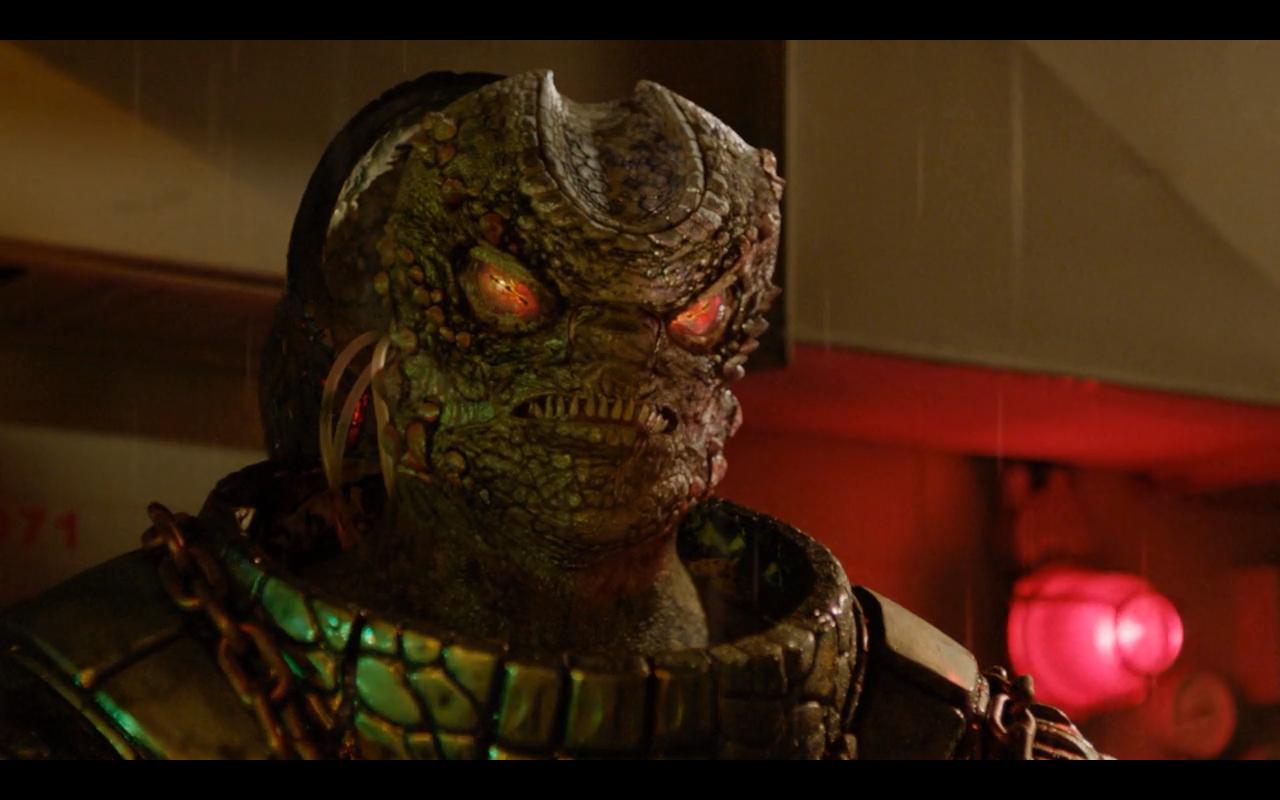
An alien warrior, frozen in the ice for thousands of years, excavated by humanity and thawed -- revealing that the warrior was dormant, not dead.  A small group of people in a confined area, under siege from the resuscitated warrior.  That warrior threatening to destroy the world thanks to nuclear power.  Yes, Mark Gatiss has chosen to remake another Troughton story: this time it's The Ice Warriors.

I mean, I suppose if you're going to reintroduce the Ice Warriors after 39 years then why mess with success (although you start to wonder how many Ice Warriors were accidentally frozen on Earth -- but then maybe Varga and his group were sent to look for Grand Marshal Skaldak and they were also trapped), but it does mean you start forming comparisons between the two stories.  The Ice Warriors had an underlying theme of people versus computers; "Cold War" is (I think) exploring the idea of mutually assured destruction, but it hardly does anything with that idea beyond a basic threat.

Grand Marshal Skaldak takes off his helmet. ("Cold War") ©BBC
The primary purpose of "Cold War" is indeed to bring back the Ice Warriors, and at this they do a good job.  The redesign is fairly minor -- the silhouette and colors are the same (beyond a more metallic sheen), although they've gotten rid of the "fur" -- and so Skaldak is instantly recognizable.  Gatiss has also incorporated some of the later character developments, so the Ice Warriors aren't evil per se, but Skaldak is portrayed as particularly militaristic -- but still with a sense of honor, which is in keeping with where we left the Ice Warriors.  (All that said, I still kind of miss the hissing voice.)  They even do one better, by finally confirming that the Ice Warriors wear armor and showing us the true face of a Martian.

Of course, that's where part of the problem lies; not the fact that they showed us an unarmored Martian, but that this leads to an extended sequence where Doctor Who "does" Alien.  In principle there's nothing wrong with that, but the fact of the matter is that they're going out at 6pm on a Saturday and so they can't make this as terrifying as it needs to be.  So while shots of the unarmored Skaldak creeping up on people and pulling them up into the ceiling are tense, they're not the pure unadulterated terror that's required to make this approach work.  We need to see the bodies and feel the fear for this to really come off, but they can't do that.

The other part of the problem is that Mark Gatiss gives us this background of heightened tensions between the US and the Soviet Union (this is explicitly set in 1983, the year of Able Archer and the Strategic Defense Initiative (aka "Star Wars")) and then hardly does anything with it.  There seems to be little in the way of rampant paranoia -- the only one who exhibits this is Stepashin, and he's portrayed as a warmongering nut -- and they don't draw any explicit parallels between the two situations (the global one and the one on the sub).  In fact, it looks like they start to go down a more interesting road, as Stepashin tries to convince Skeldak they're both alike and should help each other, but then Skeldak kills Stepashin off screen and leaves that road frustratingly untraveled.  So instead we get an unsatisfying Alien homage that leads to a standoff between the Doctor and Skaldak that could have happened at almost any point during the Cold War (the obsession with early '80s New Romantic music notwithstanding).

It's not all bad, of course; we've got a really great cast -- Liam Cunningham does a nice job as the more experienced Captain Zhukov, unwilling to push his men into war, and while Stepashin may seem overeager for a nuclear war, Tobias Menzies does a good job of playing this role -- to the point that you wish he'd stuck around a little longer (another reason to be annoyed by his unceremonious demise).  And they've finally gotten David Warner in front of the camera as Professor Grisenko (after his turn as the main villain in the animated "Dreamland" and a number of Big Finish stories (including an alternate universe Doctor)), and it's everything you'd want from him, a performance filled with dry wit and warmth.  (The best moment is when he questions Clara about the future: "Tell me what happens," he implores Clara.  "I can't," Clara replies.  "Well, I need to know," Grisenko replies mock-desperately.  "...Ultravox, do they split up?"247)  And Jenna-Louise Coleman continues to excel as Clara, being brave and scared at the same time and coming across as incredibly likeable.

If only there had been a more substantial plot to hang this all on, it could have been fabulous.  But here Mark Gatiss's urge to write pastiche falls flat here.  "Cold War" needed more than just reintroducing an old alien and giving us a new twist; it really needed to be about something.  The fact that it's not leaves you with an ultimately hollow feeling, craving something more substantial.


247 They do, but not for another four years.

June 24: "The Rings of Akhaten"

This is one of those stories that doesn't seem to get much love from fandom (233 out of 241 in the most recent Doctor Who Magazine poll), and I have to confess that I'm not certain why.  It's not like it's incompetently made or offensive or anything like that.  So why are people so down on it?

Merry the Queen of Years talks to Clara. ("The Rings of Akhaten")
©BBC
Is it to do with Clara's story, specifically the stuff before the titles?  What I mean by that is, the cold open shows the Doctor investigating Clara's history -- watching her parents meet, have Clara, followed by her mother's funeral246 -- and concluding that there doesn't seem to be anything unusual about her -- and yet she was also on a space cruise ship in the future and a Victorian governess in the past.  As the Doctor says, "She's not possible."  But then, after the titles run, this isn't touched upon again; the focus has completely shifted to Clara's first adventure in the TARDIS.  That's not to say that Clara doesn't do well with her first trip to a different time and place -- in fact, all things considered she copes astonishingly well -- but rather that the majority of the episode drops the exploration of the ongoing plotline in favor of the story around Akhaten.  If you were hoping for more revelations regarding the Impossible Girl, you would have been sorely disappointed.  But still, that's not the worst of problems, and it can't have been the deciding factor for everybody.  So what is it about the main story that people dislike?

Perhaps it's just the nature of the episode.  It isn't an action story, but it's not about the characters of our heroes either -- which does mean that quite a bit of time is spent exploring the environment, which I suppose can be dull if you're not in the right mood for such a thing.  And once we arrive at the threat, it does sometimes seem like it takes a while to get anywhere -- characters talk about what they should and shouldn't do rather than just doing it (which is an oddly retro style of television).  So perhaps you just wish they'd get on with it.

The "Old God" feasts on the Doctor's many experiences. ("The
Rings of Akhaten") ©BBC
If that's the case then I suppose there's not much to be done, but what, for me, makes "The Rings of Akhaten" work is that this is the least cynical Doctor Who story we've had in years.  Neil Cross's debut script for the show (well, sort of; he actually wrote "Hide" first, but this was broadcast ahead of that) is unabashedly about beauty and wonder and just experiencing things, and even when things are going wrong that philosophy pervades everything.  The people of Akhaten placate their god (which they refer to as "Grandfather") by singing to him (rather than anything more violent -- although I guess they do occasionally sacrifice people to him as well), and "Grandfather" is defeated via stories -- not just stories that happened, but the stories that will never happen, the potential left untapped.  It's a charmingly lyrical piece of storytelling.

And even beyond that, we're encouraged to look at this new world through Clara's eyes -- but not to stare; rather to experience the wonder of all these different peoples, to immerse yourself in the culture (prized possessions as currency, communal singing as prayer), and to marvel at how beautiful and wonderful the universe can be.

So yes, it's a bit slow at times, and it's hardly a strikingly original resolution, but "The Rings of Akhaten" is so invigoratingly optimistic and beautifully uncynical that it's hard not to be caught up in it.  It's not a standout story, but it's definitely a refreshing change of pace.


246 Clara's mother Ellie died on 5 March 2005, which happens to be the date that the ninth Doctor and Rose fought the Autons in "Rose".  Is there a suggestion that Ellie was killed by the Autons, or is it just a coincidence?

June 23: "The Bells of Saint John - A Prequel" / "The Bells of Saint John"

And now we've reached 2013 (Doctor Who's 50th year!) and the start of the second half of series 7.  And of course we have another internet prequel scene to pique your interest.  This one is simple -- it shows the Doctor on a swing, talking to a little girl -- but it drives home just how fabulously good Matt Smith is with children.  They have a nice little chat about how the Doctor is looking for someone ("Well, the first two times I met her, I just sort of bumped into her, so I thought maybe if I just wandered about a bit, I might bump into her again.  You know, like destiny, sort of," the Doctor says.  "That's rubbish," the girl replies.  "Yeah, I think it probably is," the Doctor agrees.  "Hey, maybe I could find a quiet room and have a good think about it instead" -- which we then see in the main episode is exactly what he does), and then the girl walks off, with neither of them aware that she's in fact Clara, the person the Doctor's looking for.  A quick but charming scene.

The main event, however, is "The Bells of Saint John": a cheeky title (the "bells" are the TARDIS's phone ringing -- the TARDIS, as you'll recall, having a "St. John Ambulance" sigil on the door) that nevertheless leads to an action-packed whirlwind of a tale.  This is our first proper look at the companion version of Clara (other than a brief moment at the end of the previous story), and fortunately she's not quite as perfect as the last two versions had been -- fortunately because that gives "our" Clara a chance to grow and develop and not be completely boring.  The Doctor finally finds her, after both trying the "random chance" and the "sit in a room and think" approaches (albeit in a room in a monastery in 1207 Cumbria), by pure chance -- Clara calls the TARDIS's phone after being given the number by "the woman in the shop"245, trying to get help with the internet on her laptop.  (Although Clara seems really helpless here -- is it really likely that a woman in her mid-20s in 2013 would be quite so hopeless with connecting to the Wi-Fi?)

That's the (deliberately contrived) setup, but what follows is really quite wonderful.  "There's something in the Wi-Fi," the Doctor tells us, and while it does seem somewhat fanciful, everyone treats it with sufficient seriousness to make you believe in the idea of a company out there stealing people's minds/souls via Wi-Fi, all for a sinister client: the Great Intelligence (we learn at the end) has been feeding off these minds to sustain itself.  (It's a link that's hinted at earlier in the episode, as the walking base stations -- the "Spoonheads" -- repeat back what's said to them, much as the Intelligence did with young Walter Simeon.)  This means that it has a lot of "agents" out in London, and it's not happy that the Doctor has pulled Clara out of their network before she can be fully downloaded.

(Incidentally, we get a slightly different outfit for the Doctor: the basic feel is the same (coat, bow tie, braces, etc.), but we get a longer purple coat and a darker bow tie.  Nevertheless, it still feels like a natural fit for Matt Smith's Doctor.)

The Doctor rides a motorcycle out of the TARDIS, ready to take
Clara to breakfast. ("The Bells of Saint John") ©BBC
From there it's a mad dash around, with possibly the best bit being all of London going dark except for the area Clara's in, which has a big plane heading for a crash landing -- which leads to the Doctor materializing aboard the plane (in a really wonderful shot from director Colm McCarthy, as they head into the TARDIS, dematerialize, and rematerialize and head straight into the plane) and stopping it from crashing.  But there's also the Doctor's confrontation with Miss Kizlet at the coffee shop, with Kizlet taking over the bodies of everyone in the shop.  Or the Doctor's motorcycle ride up the side of the Shard.  Or the reveal that he's gotten a Spoonhead to confront Miss Kizlet and her gang, while he's comfortably still in the shop.  Once this episode really gets going, it never stops, and all the set pieces link together in a very satisfying way.

In some ways, "The Bells of Saint John" has two jobs: introduce the companion version of Clara, and provide the equivalent of a spectacular series opener.  At both jobs it succeeds admirably.  This is Doctor Who as pure fun, with little angst and a lot of entertainment.  "The Bells of Saint John" is a great, highly enjoyable episode, getting the 2013 run off to a fabulous start.


245 The mention of this convenient arranged meeting is largely thrown away here, but they'll finally explain it in the series 8 finale.

June 22: "The Battle of Demons Run: Two Days Later" / "The Great Detective" / "Vastra Investigates - A Christmas Prequel" / "The Snowmen"

So I'm cheating a bit: strictly speaking, "The Battle of Demons Run: Two Days Later" didn't air until shortly before "The Bells of Saint John", three months after "The Snowmen" -- but as it makes more sense to view it here, that's what I'm doing.  It's not even that exciting a scene, to be honest; it shows Vastra and Jenny talking to the revived Strax and offering him a choice to go with them (back to 1888, so four years before "The Snowmen"), so that he won't be alone.  It's probably not a scene that needed to be explicitly stated, but I suppose it's nice to have the bases covered.

The next couple mini-episodes, "Vastra Investigates" and "The Great Detective", explicitly precede "The Snowmen".  "The Great Detective" aired during 2012's Children in Need telethon, and features the Paternoster Gang (as Vastra, Jenny, and Strax are referred to here) in Victorian London, trying to interest the Doctor in investigating weird happenings around the town, but he'll have none of it: "Why do you keep doing this?  What is the point?  I have told you.  I keep telling you, I don't do this any more.  I've retired."  This sets the stage for the Doctor's attitude in "The Snowmen".  The other prequel, "Vastra Investigates", simply shows that the Paternoster Gang helps Scotland Yard with their more unusual investigations (almost like a proto-UNIT), and that the Doctor still is unwilling to help out.

All this sets the stage for the 2012 Christmas episode, "The Snowmen", which is the first Steven Moffat Christmas special to not explicitly be about Christmas.  It's set at Christmas in 1892, but this is simply a backdrop for a more typical Doctor Who tale (as opposed to the previous couple, which really have been all about Christmas).  Steven Moffat appears to be taking an old rejected Douglas Adams idea -- that of the Doctor retiring but people keep bothering him for help -- as his starting point.  This is a much more somber Doctor than we're used to, one who appears to still be grieving over the loss of Amy and Rory and who has largely isolated himself from society (although it's worth nothing that he nevertheless chose a place with friends nearby, rather than complete hermitage).  His costume also reflects the change, as he's wearing a long purple coat with fur lapels, a necktie instead of his trademark bow tie (at least, until he finally comes down from his cloud and starts helping again, realizing along the way that he'd unconsciously put the bow tie on again), and a rather crumpled top hat.  He's also still wearing the round Lennon-esque glasses that Amy had in "The Angels Take Manhattan".  This is a Doctor who seems older and less inclined to stick out.

In contrast, we have a "new" character, Clara.  I say "new", but it's Jenna-Louise Coleman again, playing a similar character to Oswin in "Asylum of the Daleks".  Here she's shown as just as clever as Oswin was, albeit in a different way -- she's a lower-class barmaid who's also an upper-class governess, and thus highly adept at fitting into her surroundings and being the best at whatever she puts her mind to.  This includes tracking down the strange man who's just suggested that perhaps a suddenly appearing snowman happened because "it remembers how to make snowmen" -- a facetious answer, although we learn that's actually the truth.  Clara is unwilling to simply let this person slip away, so she chases him and learns he's called the Doctor.  And from there it's straight into the opening credits.

Dr. Simeon and his snowmen. ("The Snowmen") ©BBC
There's definitely a sense of change in the air in this episode.  A new title sequence (which is both contemporary and oddly retro, with what looks like bright orange lava lamp patterns mixed with magenta starfields -- and there's a deep-seated thrill at seeing Matt Smith's face in the titles, marking the first time the Doctor's face has appeared since 1989), subtly new logo (this one looks like snow -- the last time they'll do this), new theme arrangement (this one is much more percussive-feeling, with the bass line given greater prominence than the last time), an utterly gorgeous new console room (making it look less "whimsical" than the previous version and far more like a proper ship), and other changes dotted throughout the episode give this one a feeling of importance, of something waiting on the horizon.  This is a theme that's reflected throughout the episode, as we constantly get the impression of a hush before the storm, instead of running through the middle of it.  Part of that might be because the main villain, Dr. Walter Simeon (as played by former almost-Doctor Richard E. Grant (Scream of the Shalka)), spends much of the episode waiting for the right moment, for the Ice Governess to emerge from the frozen pond, rather than hatching elaborate plans for the Doctor to thwart.  It's also likely because the Doctor and Clara spend a lot of the episode not-quite-meeting after their initial encounter (which includes a humorous sequence involving Strax and something called a memory worm), which means the plot dances around the two, with Clara trying to enlist the Doctor's help and encountering Madame Vastra instead.

This isn't an explosive, action-packed Christmas special; instead, like most of the stories this series, it's a more intimate affair, concerned with characters and their relationships.  Clara is presented as an ideal companion for the Doctor, one to pull him out of his "sulk", and while this might be almost unbearable in the wrong hands, in Jenna Coleman's it becomes charming and somehow right -- of course she should travel with the Doctor.  Which is why (given her chemistry with Matt Smith and the fact that she'd been announced as the new companion) it's something of a shock to see her die in this.  "Asylum of the Daleks" was a one-off, a teaser, but this was supposed to be the proper debut of the new companion, so it's a genuine surprise to learn that it's not, that it's another mystery -- albeit one connected to the last, as the Doctor finally realizes that Clara and Oswin ("Soufflé Girl") were the same person (thanks to them both saying the same thing as they died: "Run, you clever boy, and remember").  It's an interesting way to make the audience intrigued and curious about the upcoming second half of series 7, and it works.

None of this, mind, marginalizes the main enemy of this story, Dr. Simeon and his mimicking snow.  It's a conceptual threat that ends up being something of a prequel to two Troughton stories (those with sharp eyes and HD televisions might have made out the words "Great Intelligence" on Simeon's business card early in the episode, but for everyone else it's made explicit at the end ("The Great Intelligence.  Rings a bell..." the Doctor remarks thoughtfully afterwards).  Richard E. Grant is suitably sinister as Simeon, even if he does seem a bit underutilized (he's largely there to repeatedly ask for the Ice Governess and to talk to the telepathic snow), and it's a joy to have Sir Ian McKellen as part of the show, voicing the Great Intelligence.  The scene with the Doctor confronting the two of them at the end is nice (even if the "snow turns to tears" resolution doesn't quite feel right), and it's cheeky to have that reference to The Web of Fear in there (the London Underground stuff).244

It's a strong story, with some fabulous characters and a lot of great direction (including our first-ever pass from outside the TARDIS to straight inside the doors into that new console room in one shot) that contributes to a very satisfying atmosphere.  The mystery of Clara is set up well, and the use of the Great Intelligence is quite lovely.  This is definitely the best Christmas special of Matt Smith's era, and possibly the best one of them all.


244 It does kind of look like the production team knew about the discovery of four of the five missing episodes of The Web of Fear, but if so, it would mean they knew about it well in advance -- the readthrough for "The Snowmen" was in August 2012, while the announcement of the recovery wasn't until October 2013.  It's perhaps more likely that they'd heard some of the rumors flying around (combined with Neil Gaiman's original idea that "House" in "The Doctor's Wife" was actually the Great Intelligence, which would have put the thought in Moffat's head) and decided to bring the Intelligence back.